Njörðr: From Proto-Germanic Roots to Viking Age Worship
Njörðr occupies a distinctive position within Norse mythology as a deity associated with the sea, prosperity, fertility, and maritime wealth. Unlike gods such as Odin or Thor, whose myths often centre on warfare and cosmic struggle, Njörðr’s role reflects the economic realities of Scandinavian life during the Viking Age and earlier Germanic periods. His importance was closely tied to seafaring, trade, fishing, and the prosperity generated through maritime activity.
The surviving evidence for Njörðr comes primarily from medieval Icelandic texts written during the 13th century, centuries after Scandinavia’s conversion to Christianity. These include the Poetic Edda and the Prose Edda, alongside skaldic poetry, place names, and limited archaeological evidence. Although these sources preserve earlier traditions, historians remain cautious when reconstructing pre-Christian beliefs because the material was transmitted through Christian scribes and authors.
The Poetic Edda
Njörðr appears in several poems within the Poetic Edda, particularly Vafþrúðnismál, Grímnismál, and Lokasenna. These texts establish him as a member of the Vanir, a divine group associated with fertility and prosperity. They also identify him as the father of Freyr and Freyja, two of the most prominent deities in the Norse pantheon.
In Grímnismál, Njörðr is associated with Nóatún, meaning “ship enclosure” or “harbour town,” reinforcing his connection to the sea and maritime life. The imagery surrounding him differs significantly from the martial atmosphere associated with Odin or Thor. Instead, the poems emphasize calm waters, prosperity, and successful voyages.
The Prose Edda
The Prose Edda, written by Snorri Sturluson in the early 13th century, provides a more structured account of Njörðr’s place within Norse cosmology. Snorri describes him as a wealthy and powerful god who governs winds, seas, and fire. Sailors and fishermen were said to invoke him for favourable conditions and successful journeys.
Snorri also recounts Njörðr’s marriage to the giantess Skaði, a myth that illustrates tensions between contrasting environments and ways of life. This narrative became one of the defining stories associated with Njörðr in medieval Icelandic tradition.
Place Names and Cult Evidence
Evidence for the worship of Njörðr survives in Scandinavian place names. Settlements and regions in Norway and Sweden preserve names derived from Njörðr, suggesting that his cult held regional importance before Christianisation.
These place names are particularly concentrated in coastal areas, supporting the literary evidence that Njörðr was strongly associated with maritime communities. However, unlike Thor or Freyr, direct archaeological evidence linked specifically to Njörðr remains limited. This scarcity reflects broader challenges in reconstructing Norse religious practices, which relied heavily on oral tradition and local cult activity rather than centralized temples or written doctrine.
Njörðr and the Vanir
The Vanir–Æsir War
Njörðr belongs to the Vanir, a group of gods associated with fertility, wealth, and natural abundance. According to Norse myth, the Vanir fought a war against the Æsir, the divine clan associated with Odin and Thor. The conflict ended in a negotiated peace sealed through the exchange of hostages.
Njörðr and his children Freyr and Freyja were sent to live among the Æsir as part of this agreement. The myth likely reflects older religious distinctions within Germanic belief systems, though scholars continue to debate its precise meaning.
Some historians interpret the story as symbolic of cultural integration between different religious traditions within Scandinavia. Others view it as a literary attempt to reconcile multiple regional cults into a unified mythological structure.
Njörðr’s Arrival Among the Æsir
After joining the Æsir, Njörðr became fully integrated into their community while retaining his Vanir associations. This dual identity distinguished him from other gods and reinforced his role as a figure linked to peace, prosperity, and exchange rather than conquest.
The hostage exchange itself may reflect historical practices common in early medieval northern Europe, where political agreements were reinforced through the exchange of elite individuals between rival groups.
Njörðr as a God of Sea and Wealth
Maritime Prosperity
Njörðr’s significance cannot be separated from the maritime world of Scandinavia. During the Viking Age, Scandinavian societies depended heavily on the sea for trade, fishing, exploration, and warfare. Control of maritime routes generated wealth and political influence.
As a deity associated with calm seas and favourable winds, Njörðr embodied the economic lifelines of the Norse world. His protection was especially relevant to merchants and sailors undertaking dangerous voyages across the North Atlantic and Baltic regions.
The connection between religion and maritime activity is visible throughout Norse culture. Ships occupied a central role in burial practices, mythology, and political symbolism. Njörðr’s association with harbours and voyages therefore reflected practical concerns as much as spiritual beliefs.
Fertility and Abundance
Although best known as a sea god, Njörðr was also associated with fertility and material abundance. In pre-modern Scandinavian societies, prosperity depended not only on successful trade but also on stable harvests and access to natural resources.
The Vanir as a whole were closely linked to fertility, and Njörðr’s role within this divine family reinforced these themes. Wealth in Norse society was measured through land, livestock, silver, and maritime success, all of which intersected within Njörðr’s sphere of influence.
The Marriage of Njörðr and Skaði

Njörd's desire of the Sea (1908) by W. G. Collingwood
The Settlement Between Gods and Giants
One of the most detailed myths involving Njörðr concerns his marriage to Skaði, daughter of the giant Þjazi. After Þjazi’s death at the hands of the gods, Skaði entered Ásgarðr seeking compensation. The gods agreed that she could choose a husband from among them, provided she selected only by looking at their feet.
Expecting to choose Baldr, Skaði instead selected Njörðr. The story reflects broader themes within Norse mythology involving negotiated settlements between gods and giants rather than constant warfare alone.
Nóatún and Þrymheimr
The marriage proved unsuccessful because Njörðr and Skaði could not adapt to one another’s environments. Njörðr preferred the coast and the sounds of seabirds at Nóatún, while Skaði favoured the mountains and wolves of Þrymheimr.
The myth is often interpreted symbolically as a contrast between coastal and inland societies or between fertility and wilderness. Scholars have also noted that the story reflects the geographic realities of Scandinavia, where maritime and mountainous communities maintained distinct economic and cultural patterns.
Family and Descendants
Njörðr as Father of the Fertility Gods
Njörðr’s children, Freyr and Freyja, became among the most prominent deities in Norse religion. Freyr was associated with kingship, fertility, and prosperity, while Freyja was linked to love, magic, and death rituals.
The importance of these figures suggests that Njörðr occupied a significant place within pre-Christian Scandinavian religion, even if fewer myths about him survived into written form.
Debates on Incest and Ritual Memory
Some medieval sources state that Freyr and Freyja were born through a union between Njörðr and his unnamed sister, reflecting customs allegedly practiced among the Vanir. This detail has generated considerable scholarly debate.
Some researchers interpret it as evidence of perceived differences between the Vanir and Æsir, while others argue that Christian authors may have emphasized such material to portray pagan practices as morally alien. The absence of earlier written evidence makes definitive conclusions difficult.
Njörðr in Scholarship

Illustration of the Thorsberg chape showing the runic inscriptions on both sides.
Possible Proto-Germanic Origins
Linguists and historians have long debated the origins of Njörðr. Some connect him to older Proto-Germanic fertility deities predating the Viking Age. Comparative mythology suggests that aspects of his character may preserve ancient Indo-European themes associated with water, fertility, and prosperity.
Njörðr and Nerthus
One of the most significant scholarly discussions concerns the possible relationship between Njörðr and Nerthus, a goddess described by Tacitus in the 1st century CE. Tacitus portrays Nerthus as an earth and fertility deity worshipped by Germanic tribes in northern Europe.
Many scholars have noted linguistic similarities between the names Njörðr and Nerthus, suggesting they may derive from a common earlier deity. However, the evidence remains inconclusive, and interpretations differ regarding whether the two figures represent direct continuity or broader thematic parallels.
Decline and Christianisation
The worship of Njörðr declined as Christianity spread across Scandinavia between the 10th and 12th centuries. Christian kings and church authorities gradually suppressed public pagan rituals while integrating Scandinavian societies into the wider Christian world.
Despite this transformation, elements of older beliefs survived in folklore, place names, and literary traditions. Medieval Icelandic authors preserved myths about Njörðr not as active religious doctrine but as part of a remembered cultural heritage.
Conclusion
Njörðr occupied a central role within the maritime and economic world of pre-Christian Scandinavia. As a god associated with seafaring, prosperity, fertility, and peace, he reflected the practical realities of societies deeply connected to the sea and dependent on trade and natural abundance.
The surviving literary and linguistic evidence suggests that Njörðr belonged to an older layer of Germanic religious tradition later integrated into the Norse mythological framework preserved in medieval Icelandic texts. His myths, particularly those involving Skaði and the Vanir, reveal a worldview shaped by negotiation, exchange, and environmental contrast rather than warfare alone.
Although fewer stories about Njörðr survive compared to Odin or Thor, his significance within Norse religion remains evident through place names, literary references, and the enduring importance of his children Freyr and Freyja. His legacy offers insight into the economic, social, and religious foundations of the Viking Age and the broader Germanic world.

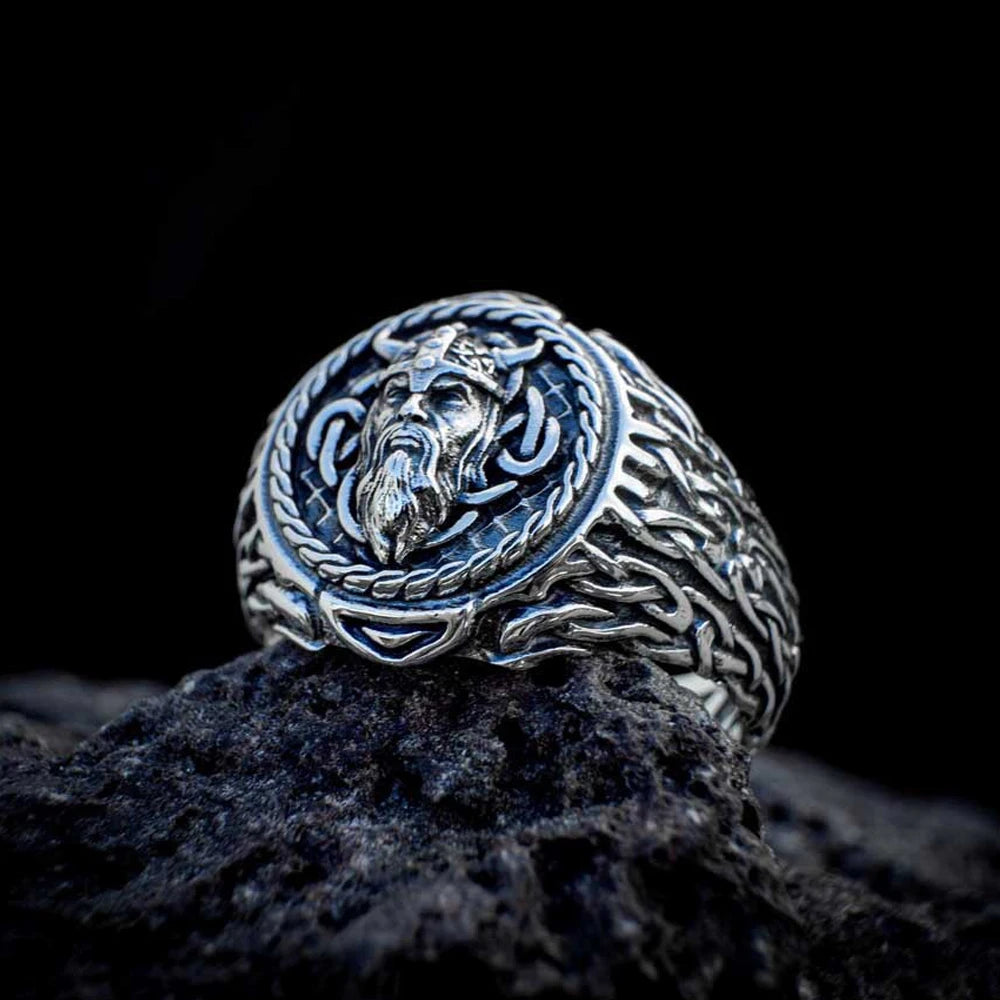
Norse Navigator: Eagle-Flanked Vegvísir Ring
Frequently Asked Questions (FAQs)
Who was Njörðr in Norse mythology?
Njörðr was a Norse god associated with the sea, maritime wealth, fertility, and prosperity.
What group of gods did Njörðr belong to?
He belonged to the Vanir, a divine family associated with fertility and abundance.
Who were Njörðr’s children?
According to Norse mythology, Freyr and Freyja were his children.
What is Nóatún?
Nóatún was Njörðr’s hall or dwelling place, strongly associated with ships and the sea.
Is Njörðr connected to the goddess Nerthus?
Some scholars believe Njörðr and Nerthus may derive from an older shared Germanic deity, though the evidence remains debated.
References
Simek, Rudolf. Dictionary of Northern Mythology.
Lindow, John. Norse Mythology: A Guide to Gods, Heroes, Rituals, and Beliefs.
Faulkes, Anthony (trans.). Edda.
Larrington, Carolyne (trans.). The Poetic Edda.
Davidson, H. R. Ellis. Gods and Myths of Northern Europe.
Turville-Petre, E. O. G. Myth and Religion of the North.
Tacitus. Germania.




Leave a comment
This site is protected by hCaptcha and the hCaptcha Privacy Policy and Terms of Service apply.