
The God Baldr: Light, Death, and Renewal in Norse Mythology
Baldr, also spelled Baldur or Balder, ranks among the most distinctive deities in Norse mythology, associated with light, beauty, purity, and wisdom. As a member of the Æsir, Baldr's myth centres on his tragic death, which serves as a pivotal event foreshadowing Ragnarök, the destruction of the current world order.
The primary sources are the Poetic Edda, a collection of anonymous Old Norse poems compiled in Iceland around 1270 CE but based on older oral traditions, and the Prose Edda, written by Snorri Sturluson around 1220 CE. References also appear in Saxo Grammaticus' Gesta Danorum, completed circa 1200 CE, offering a contrasting account. No archaeological evidence or runic inscriptions directly depict Baldr, and place-names linked to him are rare and uncertain. The name Baldr likely derives from Old Norse "baldr," meaning "bold" or "brave," though some scholars suggest connections to "lord" or "shining one." Evidence for any organised cult or worship remains limited.
Family and Relationships
Baldr is the son of Odin, the chief god of wisdom and war, and Frigg, goddess of foresight and marriage. This parentage places him among the highest-ranking Æsir. His siblings include Thor, the thunder god, and other sons of Odin such as Váli and Víðarr.

Hermod's Farewell to Baldur
Baldr marries Nanna, whose name may relate to "daring" or nettle plants. Their son is Forseti, the god of justice who presides over disputes in his hall Glitnir. The Prose Edda describes Baldr's dwelling as Breiðablik, a hall free from impurity, reinforcing his association with cleanliness and harmony. These familial ties position Baldr within the divine hierarchy, where relationships influence mythological events.
Mythological Role and Depictions
Baldr embodies fairness, eloquence, and benevolence. The Prose Edda (Gylfaginning, chapter 22) portrays him as the fairest and most gracious of the gods, loved by all, with a nature so gentle that no one can contradict his judgments. His radiance and purity set him apart from more martial deities like Thor.
In the Poetic Edda, Baldr appears in allusions rather than extended narratives. Völuspá mentions his death as a harbinger of doom, while Lokasenna includes Loki's taunts about Baldr's fate. These references highlight his innocence and the tragedy of his loss. No prominent weapons or heroic deeds are attributed to him; his role focuses on exemplary character.
The Myth of Baldr's Death
The Prose Edda (Gylfaginning, chapters 49–50) provides the fullest account. Baldr suffers ominous dreams foretelling his death. The gods, concerned, hold an assembly. Frigg secures oaths from all things—fire, water, metals, stones, earth, plants, animals, birds, poisons, and serpents—not to harm him. This makes Baldr invulnerable, and the gods amuse themselves by throwing objects at him without effect.
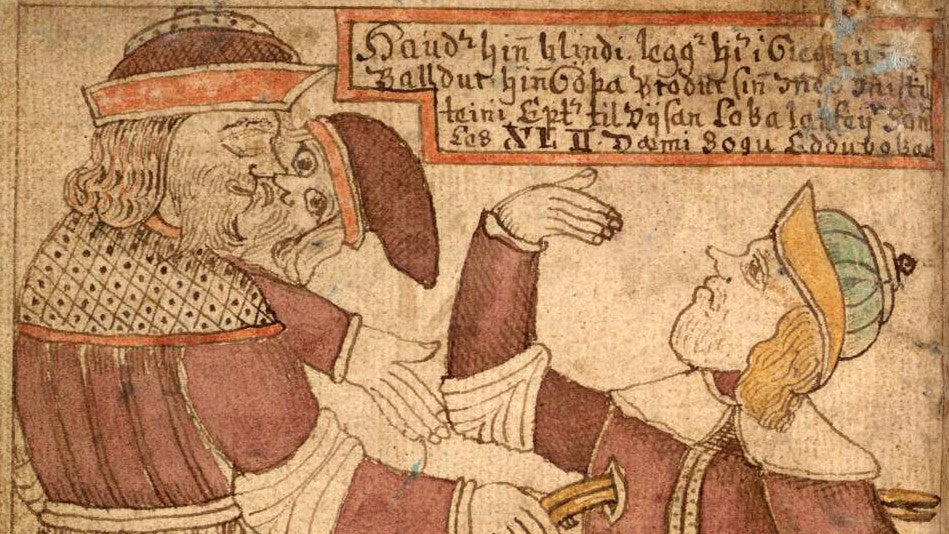
Loki, disguised as a woman, questions Frigg and learns she overlooked mistletoe, considering it too insignificant. Loki fashions a dart from the plant and approaches Höðr, Baldr's blind brother. Guiding Höðr's hand, Loki ensures the mistletoe strikes Baldr, killing him instantly. The gods stand in grief, unable to act.
Aftermath and Funeral
Frigg seeks a volunteer to retrieve Baldr from Hel, the realm of the dead. Hermóðr, another son of Odin, rides Sleipnir to Hel's gates. He finds Baldr seated honourably, but Hel agrees to release him only if all things weep for Baldr.

"Odin rides to Hel" (Illustration: W. G. Collingwood 1908)
Messengers secure tears from every creature and object except Thökk, an old giantess (suspected to be Loki in disguise), who refuses. Baldr therefore remains in Hel. Nanna dies of grief at the sight of his body. Both are placed on Baldr's ship Hringhorni for cremation. Thor consecrates the pyre with Mjöllnir, and the dwarf Litr is kicked into the flames by Thor in anger. The funeral draws gods, giants, and other beings, marking the depth of the loss.
Baldr's Resurrection and Ragnarök
Völuspá prophesies Baldr's return after Ragnarök. He emerges from Hel alongside Höðr, reconciled, and they inhabit Odin's former halls in a renewed world. The Prose Edda confirms this, describing fields of gold where Baldr and Höðr dwell in peace.
This resurrection fits Norse cyclical cosmology, where destruction precedes renewal. Baldr's survival contrasts with the deaths of Odin and Thor, positioning him as a figure of enduring light.
Contrasting Accounts in Saxo Grammaticus
Saxo Grammaticus' Gesta Danorum presents a euhemerised Baldr, named Balderus, as a demigod son of Othinus (Odin). In this version, Balderus pursues Nanna, wars with Hotherus (Höðr), and proves invulnerable except to a specific sword. The conflict involves battles and divine aid, ending with Balderus dying from wounds rather than mistletoe.
Nanna marries Hotherus, and Balderus is avenged by Bous (Váli). Saxo's portrayal emphasises martial qualities over innocence. Scholars attribute the differences to Saxo's Christian perspective and Danish focus, rationalising myths as historical events.
Interpretations and Scholarly Views
Scholars interpret Baldr in several ways. John Lindow (2001) suggests solar associations, with his death mirroring winter darkness and return evoking spring light. Rudolf Simek (1993) cautions against strong fertility links, citing limited evidence. Georges Dumézil (1959) places Baldr within Indo-European sovereignty traditions, emphasising purity.

Baldur (Baldr) the Beautiful rising (Illustration: Ludwig Fahrenkrog).
Jacob Grimm (1835) viewed Baldr as a vegetation god dying annually. Modern analyses, per Anatoly Liberman (2004), explore etymological ties to bravery, proposing an original warrior aspect softened in Eddic sources. Differences between Eddic and Saxonian versions fuel debate on pre-Christian diversity, with Snorri possibly idealising Baldr under Christian influence.
Uncertainties and Limited Information
Evidence before the 13th-century Eddas is scarce. The name appears in Old English as "Bældæg" in royal genealogies, possibly euhemerised. Reliance on Icelandic texts raises questions about mainland Scandinavian variants. Christian scribes may have shaped the narrative to align with themes of innocence and sacrifice.
Baldr's myth explores innocence, betrayal, and renewal. From his radiant life in Breiðablik to his death by mistletoe and prophesied return after Ragnarök, the story highlights the Norse view of fate and cosmic cycles. Preserved in the Eddas and contrasted in Gesta Danorum, Baldr's tale reflects medieval Scandinavian concerns with purity amid chaos, contributing to broader Germanic mythological traditions.
Frequently Asked Questions
Who were Baldr's parents?
Baldr was the son of Odin, the Allfather, and Frigg, goddess of foresight and marriage.
How did Baldr die?
Baldr died when his blind brother Höðr threw a mistletoe dart, guided by Loki, piercing his invulnerable body.
What is Baldr's role in Ragnarök?
Baldr remains in Hel during Ragnarök but returns afterward, reconciled with Höðr in a renewed world.
How does Saxo Grammaticus portray Baldr?
In Gesta Danorum, Balderus is a warlike demigod who dies in battle, contrasting the Eddas' peaceful figure.
What does Baldr's name mean?
Baldr likely derives from Old Norse "baldr," meaning "bold" or "brave," though interpretations vary.
References
Snorri Sturluson. Prose Edda. Translated by Anthony Faulkes. Everyman, 1987.
Anonymous. Poetic Edda. Translated by Carolyne Larrington. Oxford University Press, 2014.
Saxo Grammaticus. Gesta Danorum. Translated by Peter Fisher. D.S. Brewer, 1979-1980.
Lindow, John. Norse Mythology: A Guide to Gods, Heroes, Rituals, and Beliefs. Oxford University Press, 2001.
Simek, Rudolf. Dictionary of Northern Mythology. Translated by Angela Hall. D.S. Brewer, 1993.
Liberman, Anatoly. Some Controversial Aspects of the Myth of Baldr. Alvíssmál, 2004.
Dumézil, Georges. Gods of the Ancient Northmen. University of California Press, 1973.
Grimm, Jacob. Teutonic Mythology. Translated by James Steven Stallybrass. George Bell & Sons, 1883.






Leave a comment
This site is protected by hCaptcha and the hCaptcha Privacy Policy and Terms of Service apply.