Asgard: Realm of the Æsir in Norse Mythology
The stronghold of the Æsir stood at the centre of the Norse cosmos, representing divine power, sacred kingship, and the fragile barrier between order and chaos.
The Meaning and Origins of Ásgarðr
In Norse mythology, Ásgarðr was the home of the gods known as the Æsir. More than a heavenly kingdom, it represented the centre of divine authority within the cosmological structure preserved in medieval Icelandic tradition. The myths describe it as a fortified realm connected to the human world yet separated from it, standing against the dangerous forces that surrounded the ordered cosmos.
The Old Norse name Ásgarðr combines áss, meaning one of the gods of the Æsir, with garðr, meaning enclosure, yard, or fortified settlement. The term therefore carries the meaning of “enclosure of the gods” or “stronghold of the Æsir.”
The word garðr itself is deeply significant in Germanic thought. Across the Germanic languages, related terms referred to enclosed or defended spaces. This idea appears repeatedly in Norse cosmology. Humanity inhabits Midgarðr, the “middle enclosure,” while the gods reside in Ásgarðr. Beyond these protected realms exist the outer worlds associated with giants, wilderness, death, and chaos.

A depiction of Yggdrasil from the 19th century
This distinction between enclosed civilisation and hostile outer territory reflects the realities of early northern European societies. Communities survived through kinship, defence, and social cohesion within a harsh environment. The cosmology of the Norse world mirrored this understanding of existence itself.
Although later medieval writers attempted to describe Norse cosmology systematically, the surviving evidence suggests a more fluid and poetic tradition rather than a rigid theological structure. Ásgarðr consistently appears, however, as the political and sacred centre of divine order.
The Gods and Divine Society
Ásgarðr was inhabited primarily by the Æsir gods, whose stories dominate much of the surviving Norse mythological tradition. Unlike distant or abstract deities found in some religious systems, the gods of Ásgarðr often behave like magnified reflections of aristocratic Germanic society.
They feast in halls, hold assemblies, exchange gifts, seek vengeance, make alliances, and prepare constantly for war. The divine realm therefore resembles an idealised heroic society rather than a detached paradise.
Óðinn and the Rule of the Æsir
At the centre of this divine society stood Óðinn, ruler of the Æsir and one of the most complex figures in Germanic mythology. He was associated simultaneously with kingship, wisdom, poetry, warfare, magic, sacrifice, and death.
Unlike many warrior gods, Óðinn rarely relied solely upon strength. He sought knowledge through suffering, bargains, and sacrifice. The myths surrounding him repeatedly emphasise the price of wisdom, whether through hanging himself upon Yggdrasill, surrendering his eye at Mímir’s well, or learning forbidden magical knowledge.
This pursuit of wisdom reflects the expectations placed upon rulers in Germanic aristocratic culture. A successful king was not merely a warrior, but a strategist, lawgiver, diplomat, and keeper of sacred authority.
The hall of Valhǫll, ruled by Óðinn, became one of the defining symbols of Ásgarðr itself.
Þórr, Frigg, and the Structure of the Gods
Alongside Óðinn stood other major gods who fulfilled different functions within the mythological world. Þórr acted as defender of gods and mankind against the giants. Armed with the hammer Mjǫllnir, he embodied physical strength, protection, and direct action.
Frigg represented sovereignty, wisdom, and foresight, while gods such as Týr, Heimdallr, Baldr, and Bragi each occupied distinct roles within the divine order.
Together, the gods formed a society that mirrored the structures of early Germanic elite culture. Their world was one built upon kinship, hierarchy, loyalty, feasting, warfare, and fate.
Ásgarðr and the Cosmic Order
Ásgarðr existed within a larger cosmological framework centred around Yggdrasill, the immense world tree connecting multiple realms of existence. Though modern depictions often simplify Norse cosmology into a neat system of “Nine Worlds,” the medieval sources themselves are less orderly and often poetic in their descriptions.
Nevertheless, the distinction between ordered and chaotic realms remains central.
Bifrǫst and the Boundary Between Worlds
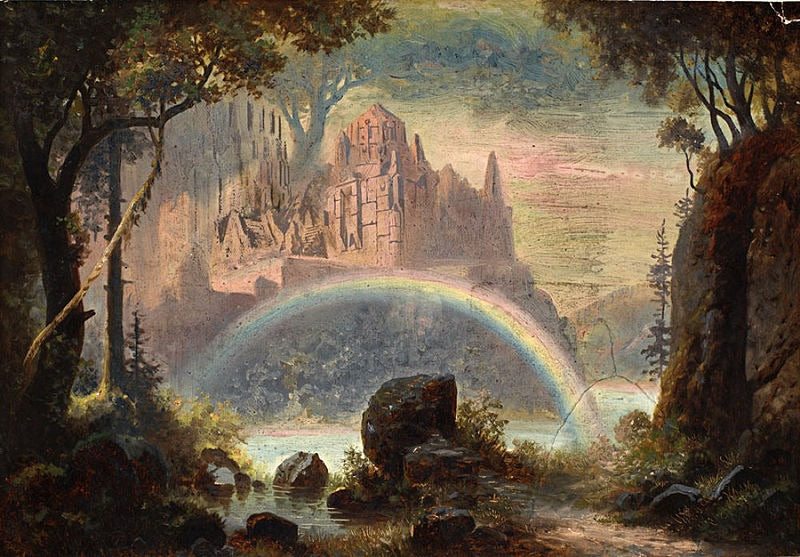
The gods travelled between Ásgarðr and Midgarðr by way of Bifrǫst, the rainbow bridge guarded by the god Heimdallr. More than a pathway, Bifrǫst symbolised the fragile boundary separating divine order from the mortal world.
Heimdallr himself reflects this liminal role. Positioned at the edge of Ásgarðr, he guards against intrusion from hostile forces and sounds the warning horn Gjallarhorn at the coming of Ragnarök.
The destruction of Bifrǫst during Ragnarök carries deep symbolic meaning. Once the bridge collapses, the separation between order and chaos fails completely.
The Giants and the Threat Beyond the Walls
One of the most misunderstood aspects of Norse mythology is the role of the giants, or jǫtnar. They were not merely monsters in the modern fantasy sense. Many possessed wisdom, ancient knowledge, and even familial ties to the gods themselves.
Yet the giants consistently represented forces existing outside the social and cosmic order maintained by the Æsir. They inhabited Útgarðr ('out-yard') and Jǫtunheimr, realms beyond the protective enclosures of civilisation.
The walls surrounding Ásgarðr therefore symbolised more than military defence. They represented the maintenance of structure against the ever-present forces of entropy, wilderness, and destruction.
This theme likely resonated strongly within the frontier societies of early Scandinavia, where survival depended upon maintaining social cohesion against environmental danger and external threat.
Valhǫll, Sacred Halls, and the Warrior Ideal
No structure within Ásgarðr became more famous than Valhǫll, the hall of the slain ruled by Óðinn.

Depiction of Einherjar being served by Valkyries in Valhalla (Valhöll) while Odin sits on his throne (Painting: Emil Doepler)
The hall functioned as both royal court and military encampment for the dead warriors known as the einherjar. Chosen from among those killed in battle, these warriors spent their afterlife feasting and fighting in preparation for Ragnarök.
Valhǫll and the Einherjar
The concept of Valhǫll reflects the immense importance of warrior culture within Germanic aristocratic society. Honour, martial reputation, and loyalty to one’s lord formed central values within heroic tradition.
Yet Valhǫll was not simply a paradise. It was preparation for inevitable catastrophe. Even in death, the warriors of Óðinn trained for the final doomed struggle against chaos.
This fatalistic perspective distinguishes Norse mythology from many later religious traditions. The gods themselves know that Ragnarök will eventually destroy them.
Divine Halls and Germanic Aristocratic Culture
The prominence of halls throughout Ásgarðr closely mirrors the role of the mead hall in early Germanic political life. Archaeological evidence and heroic literature alike demonstrate the importance of halls as centres of kingship, diplomacy, feasting, gift-giving, and military loyalty.
The divine halls of Ásgarðr therefore reflected idealised versions of institutions familiar to the societies preserving these myths.
Even the assemblies of the gods resemble the þing traditions of Germanic societies, where leaders debated, judged disputes, and negotiated communal matters within formal gatherings.
Ragnarök and the Fall of Ásgarðr
Despite its strength and sacred nature, Ásgarðr was never portrayed as eternal.
The prophecies of Ragnarök describe the collapse of cosmic order itself. Giants, monsters, and the dead advance against the gods, while natural disasters consume the world.
The battles of Ragnarök result in the deaths of many major gods, including Óðinn and Þórr. Bifrǫst breaks beneath the invading forces, and the ordered world established by the gods is consumed in fire and destruction.
What makes Norse mythology particularly distinctive is that the gods fight despite knowing the outcome is inevitable. Honour lies not in escaping fate, but in confronting it courageously.
Yet Ragnarök is not total annihilation. Several gods survive, and a renewed world rises from the sea. This rebirth suggests that destruction and renewal exist as recurring cycles rather than absolute endings.
Medieval Sources and Historical Interpretation
Most surviving information concerning Ásgarðr comes from medieval Icelandic texts written centuries after Scandinavia’s conversion to Christianity.

Snorri Sturluson (Illustration: Christian Krogh).
The most important sources are the Poetic Edda and the Prose Edda. The Poetic Edda preserves older mythological poems derived from oral tradition, while the Prose Edda was written by Snorri Sturluson during the 13th century.
Because these works were recorded within a Christian society, scholars continue debating how accurately they preserve earlier pagan belief. Snorri in particular attempted to organise myths into a more systematic narrative structure than may originally have existed.
Nevertheless, these texts remain indispensable for understanding Norse mythology and the symbolic role of Ásgarðr within it.
Modern scholarship increasingly interprets Ásgarðr not as a literal “heaven,” but as a reflection of how early Germanic societies understood kingship, order, kinship, and the precarious balance between civilisation and destruction.
Conclusion
Ásgarðr stood at the heart of Norse cosmology as the divine stronghold of the Æsir and the symbolic centre of order itself. Its halls, bridges, assemblies, and fortifications reflected the values of the Germanic societies that preserved these myths: loyalty, kingship, kinship, warfare, wisdom, and communal survival.
Yet the myths never portray this order as permanent or invulnerable. The looming certainty of Ragnarök ensured that even the gods existed within the shadow of fate. In this sense, Ásgarðr represents both the greatness and fragility of civilisation itself.
The enduring fascination with Ásgarðr lies partly in this tension. It is not a world free from fear or destruction, but a realm defined by resistance against them. Through its myths, the Norse imagination preserved a vision of heroic order standing against inevitable chaos, even when defeat itself was foreseen.
Frequently Asked Questions (FAQs)
What does Asgard mean?
Ásgarðr means “enclosure of the gods” or “stronghold of the Æsir” in Old Norse.
Who lived in Asgard?
The Æsir gods, including Óðinn, Þórr, Frigg, Baldr, Heimdallr, and others.
What connected Asgard to the human world?
The rainbow bridge Bifrǫst connected Ásgarðr and Midgarðr.
Was Asgard destroyed during Ragnarök?
Yes. Norse mythology states that Ásgarðr falls during Ragnarök before a renewed world emerges.
What sources describe Asgard?
The primary sources are the Poetic Edda and Snorri Sturluson’s Prose Edda.
References
Poetic Edda
Snorri Sturluson, Prose Edda
John Lindow, Norse Mythology: A Guide to the Gods, Heroes, Rituals, and Beliefs
Rudolf Simek, Dictionary of Northern Mythology
H.R. Ellis Davidson, Gods and Myths of Northern Europe
Andy Orchard, Norse Myth and Legend







Leave a comment
This site is protected by hCaptcha and the hCaptcha Privacy Policy and Terms of Service apply.