
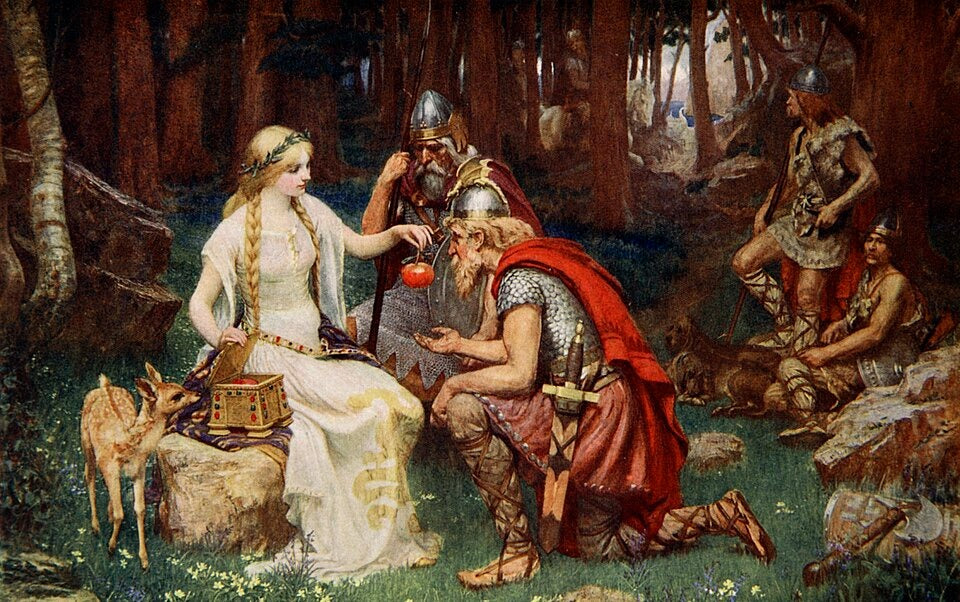
Iðunn: Guardian of Youth in Norse Mythology
Idunn, spelled in Old Norse as Iðunn, derives from a Proto-Germanic root meaning "ever young" or "rejuvenator." This etymology aligns with her role as the guardian of apples that grant eternal youth to the gods. In medieval Norse texts, Iðunn appears as a goddess among the Ásynjur, the female deities of the Æsir pantheon. Her portrayal reflects themes of vitality, fertility, and the preservation of divine order in a cosmos prone to decay and chaos. Recorded primarily in 13th-century Icelandic manuscripts, Iðunn's myths draw from pre-Christian oral traditions shaped by Viking Age beliefs, which persisted in Scandinavia until Christianization between the 10th and 12th centuries. As a figure of renewal, she embodies the cyclical aspects of nature valued in agrarian medieval societies.
Primary Medieval Sources

Iðunn, Loki, Heimdallr and Bragi featured in a depiction of a scene from the Hrafnagaldr Óðins poem by Lorenz Frølich
The Poetic Edda
The Poetic Edda, a collection of anonymous Old Norse poems compiled in Iceland around 1270, offers the earliest written attestations of Iðunn. Preserved in the Codex Regius manuscript, these verses originate from oral compositions likely dating to the 9th or 10th century, capturing fragments of pre-Christian lore.
In Lokasenna, set at a divine feast hosted by Ægir, Iðunn speaks briefly to defend her husband Bragi against Loki's insults. She urges Bragi to avoid conflict, emphasizing kinship ties among the gods. Loki retorts by accusing her of infidelity, claiming she embraced her brother's slayer. This exchange, composed perhaps in the 10th century, portrays Iðunn as a peacemaker within the volatile Æsir assembly.
Skírnismál mentions Iðunn indirectly in a list of deities. The poem, focused on Freyr's courtship of Gerðr, includes her name in a stanza invoking divine witnesses, underscoring her status among the Ásynjur.
Hrafnagaldur Óðins, a late addition to the Eddic corpus possibly from the 14th century, depicts Iðunn falling from Yggdrasil into the underworld. Gods seek her return due to failing crops and aging, leading Odin to dispatch Heimdallr and Bragi. Scholars debate its authenticity, with some attributing it to post-medieval composition, limiting its reliability as a primary source.
Snorri Sturluson's Prose Edda
Snorri Sturluson (1179–1241), an Icelandic chieftain and scholar, authored the Prose Edda around 1220 to preserve skaldic traditions for poets. Writing in a Christian context, Snorri synthesized older poetry into narrative prose.
Gylfaginning identifies Iðunn as Bragi's wife and keeper of apples in a wooden box, which the gods consume to stay young. Snorri details her abduction by the giant Þjazi, disguised as an eagle, after Loki lures her from Asgard. The gods age without her apples, forcing Loki to rescue her as a falcon, transforming Iðunn into a nut. Þjazi pursues, perishing in flames set by the Æsir.
Skáldskaparmál elaborates on the abduction, explaining poetic kennings like "Þjazi's daughter" for Skaði. It lists Iðunn in divine catalogs and notes her role in the mead of poetry myth indirectly through associations.
Other Sagas and References
Haustlǫng, a 9th-century skaldic poem by Þjóðólfr of Hvinir, preserved in the Prose Edda, depicts the abduction on a shield. Grettis saga mentions Iðunn as Bragi's wife. Heimskringla by Snorri euhemerizes her as a historical figure in Odin's Asian migration.
Iðunn's Key Attributes and Symbols
Iðunn safeguards golden apples that prevent the gods from aging. Medieval texts portray these as a source of immortality, consumed as needed. This motif parallels Greek myths of the Hesperides, suggesting Indo-European influences.
As an embodiment of rejuvenation, Iðunn links to spring and fertility. Her name and role reflect medieval Scandinavian concerns with vitality in harsh climates.
Iðunn weds Bragi, god of poetry. Their union symbolizes the harmony of renewal and eloquence, with Bragi's wisdom complementing her life-giving essence.
Major Myths and Narratives
The central myth, detailed in Gylfaginning and Skáldskaparmál, begins with Odin, Hœnir, and Loki captured by Þjazi. Loki promises Iðunn to secure release, luring her with promises of superior apples. Þjazi abducts her as an eagle. The gods weaken, compelling Loki to retrieve her using Freyja's falcon cloak. Iðunn transforms into a nut for transport, and Þjazi dies pursuing them. Skaði, Þjazi's daughter, seeks compensation, marrying Njörðr and receiving laughter from Loki's antics.

Loki and Idun (1911) by John Bauer.
In Lokasenna, Iðunn mediates, highlighting her diplomatic role. Hrafnagaldur Óðins, if authentic, shows her cosmic importance, with her absence causing famine.
Euhemeristic Interpretations
Snorri's Prologue euhemerizes Iðunn as a mortal from Asia, part of Odin's migration to Scandinavia. This aligns pagan figures with classical history, allowing Christian authors to present myths as distorted chronicles.
Iðunn in Medieval Scandinavian Society
In Viking Age and medieval Scandinavia, Iðunn symbolized renewal amid seasonal hardships. Her apples mirrored real-world preservation techniques. Skalds invoked her in kennings for women or youth. During Christianization, her tales persisted in folklore, influencing views of fertility.
Historical Uncertainties and Scholarly Perspectives
Attestations are sparse; Iðunn appears infrequently in poetry. No archaeological evidence confirms cults. Scholars like John Lindow view her as a fertility figure, while Georges Dumézil links her to Indo-European third function. Debates surround Hrafnagaldur Óðins' authenticity, with Magnus Olsen arguing for medieval origin. Uncertainties include apple symbolism's age and potential Christian influences in Snorri's framing.
Iðunn stands in medieval Norse literature as the rejuvenating goddess whose golden apples sustain divine youth, central to myths of abduction and rescue preserved in the Eddas. Composed in 13th-century Iceland by authors like Snorri Sturluson, her stories reflect pre-Christian themes of vitality amid decay. Despite limited attestations and scholarly debates on origins, Iðunn illuminates medieval Scandinavian values of renewal and harmony. Her legacy within broader European narratives highlights shared Indo-European motifs of immortality, bridging pagan lore with Christian historiography.
Frequently Asked Questions (FAQs)
What is Iðunn's role in Norse mythology?
Iðunn guards the golden apples that keep the gods young and immortal, as described in Snorri Sturluson's Prose Edda.
Who is Iðunn married to?
Iðunn is the wife of Bragi, the god of poetry, according to the Prose Edda and Grettis saga.
What is the main myth about Iðunn?
She is abducted by the giant Þjazi, causing the gods to age, until Loki rescues her, as narrated in Gylfaginning.
What does Iðunn's name mean?
Iðunn derives from Old Norse meaning "ever young" or "rejuvenator," reflecting her association with youth.
Is there evidence of Iðunn's worship?
No direct archaeological evidence exists; her portrayal relies on 13th-century texts drawing from earlier oral traditions.
References
Sturluson, Snorri. Prose Edda. Translated by Anthony Faulkes. Everyman, 1995.
The Poetic Edda. Translated by Carolyne Larrington. Oxford University Press, 2014.
Lindow, John. Norse Mythology: A Guide to Gods, Heroes, Rituals, and Beliefs. Oxford University Press, 2002.
Simek, Rudolf. Dictionary of Northern Mythology. D.S. Brewer, 1993.
Dumézil, Georges. Gods of the Ancient Northmen. University of California Press, 1973.





Leave a comment
This site is protected by hCaptcha and the hCaptcha Privacy Policy and Terms of Service apply.