

Valhalla's Bard: Bragi's Role in Viking-Age Skaldic Tradition
Bragi, recorded in Old Norse as Bragi, stands as the god of poetry, eloquence, and skaldic art in medieval Norse sources. The name likely derives from the Old Norse noun bragr, which carries dual meanings: "poetry" or "the foremost, the noblest." Medieval authors such as Snorri Sturluson explicitly linked the term for poetry to the god, stating that skaldship is called bragr after him. This connection reflects the high status of poetic composition in Viking Age and medieval Scandinavian society, where skalds preserved history, praised rulers, and ensured fame beyond death. Bragi embodies the ideal of eloquent speech and verbal mastery within the Æsir pantheon. His portrayal emerges in texts composed during the 13th century in Iceland, a period when Christian scribes documented pre-Christian traditions amid the cultural shifts following conversion around the year 1000. Bragi's role highlights the centrality of oral poetry in a largely illiterate society, where verses commemorated battles, genealogies, and mythic events across Norway, Sweden, Denmark, and Iceland.
Primary Medieval Sources
The Poetic Edda, preserved in the Codex Regius manuscript compiled around 1270 in Iceland, contains sparse but significant references to Bragi. These anonymous poems draw from older oral traditions possibly dating to the 10th century or earlier, offering glimpses of Bragi as a divine figure during the transition from paganism to Christianity.
In Grímnismál, stanza 44, Bragi receives recognition as the foremost among poets in a catalog of superlatives. The verse declares: "Yggdrasill’s ash is the most pre-eminent of trees, as is Skidbladnir of ships, Odin of the Æsir, Sleipnir of horses, Bilrost of bridges, Bragi of poets..." This attestation situates Bragi within the cosmic hierarchy, emphasizing his supremacy in the art of poetry. The poem, spoken by Odin in disguise, underscores the value placed on verbal skill in medieval Norse worldview.

Depiction of the Norse gods seated around during the Lokasenna poem (Painting: Lorenz Frølich).
Lokasenna provides the most detailed interaction involving Bragi. Set at a feast hosted by the sea-being Ægir, the poem depicts Bragi as the first to address the intruder Loki. Bragi offers gifts to avert conflict, but Loki accuses him of cowardice and lack of martial prowess. Iðunn, identified as Bragi's wife, intervenes to calm her husband, reminding him of kinship ties. The exchange, likely composed in the 10th century, reveals tensions within the divine assembly and portrays Bragi as eloquent yet non-combative, consistent with his poetic rather than warrior identity.
Sigrdrífumál mentions Bragi in the context of runes. The valkyrie Sigrdrífa instructs on carving speech-runes, noting they appear "on Bragi’s tongue" among other symbolic locations. These runes, mixed with mead and distributed to gods, elves, and humans, connect Bragi directly to the power of inspired speech and magical utterance.
Snorri Sturluson's Prose Edda
Snorri Sturluson, the Icelandic chieftain and historian who lived from 1179 to 1241, authored the Prose Edda around 1220 during the turbulent Sturlung Age. As a practicing Christian writing centuries after Iceland's conversion (c. 1000), Snorri framed the work to preserve pre-Christian lore—particularly the mythological foundations of skaldic poetry—while rendering it acceptable in a Christian context. The core sections (Gylfaginning and Skáldskaparmál) largely transmit existing pagan traditions drawn from older poetic sources, as fidelity to these was essential for the handbook's purpose: enabling poets to understand and compose in traditional skaldic styles that depended on unaltered mythic references.
In Gylfaginning chapter 26, Snorri describes Bragi systematically: "One is called Bragi. He is renowned for wisdom, and most of all for fluency of speech and skill with words. He knows most of skaldship, and after him skaldship is called bragr, and from his name a person is said to be a brag [chief] of men or women who has eloquence beyond others." Snorri identifies Bragi as the husband of Iðunn, the keeper of rejuvenating apples.
Skáldskaparmál opens with a dialogue between Bragi and Ægir, where Bragi explains the origins of the mead of poetry, kennings, and poetic diction. Bragi recounts how the gods created the poetic mead from the blood of Kvasir and how Odin acquired it. This section positions Bragi as the authoritative voice on skaldic techniques, listing him as "Idunn’s husband, inventor of poetry, and the long-bearded god."
Skáldic Poetry and Valhalla Depictions
In 10th-century skaldic poems such as Eiríksmál and Hákonarmál, Bragi appears as a resident of Valhalla who welcomes fallen kings. In Eiríksmál, Bragi questions the arrival of Eiríkr Bloodaxe. In Hákonarmál, Odin dispatches Bragi and Hermóðr to greet Hákon the Good. These compositions, preserved in sagas, reflect Bragi's role in honoring heroic memory.
Other Sagas and Lists
Grettis saga mentions Bragi as Iðunn's husband. Skáldatal lists the historical Bragi Boddason among early skalds, while Landnámabók records anecdotes about the poet. Heimskringla by Snorri references skaldic traditions without expanding on the god.

Drawing of Bragi by Carl Wahlbom
Bragi's Key Attributes and Symbols
Bragi personifies verbal artistry. Medieval sources consistently praise his wisdom in speech and command of language. In a society where skalds served kings and preserved oral history, Bragi represented the elevated status of poets who could immortalize deeds through complex meters like dróttkvætt.
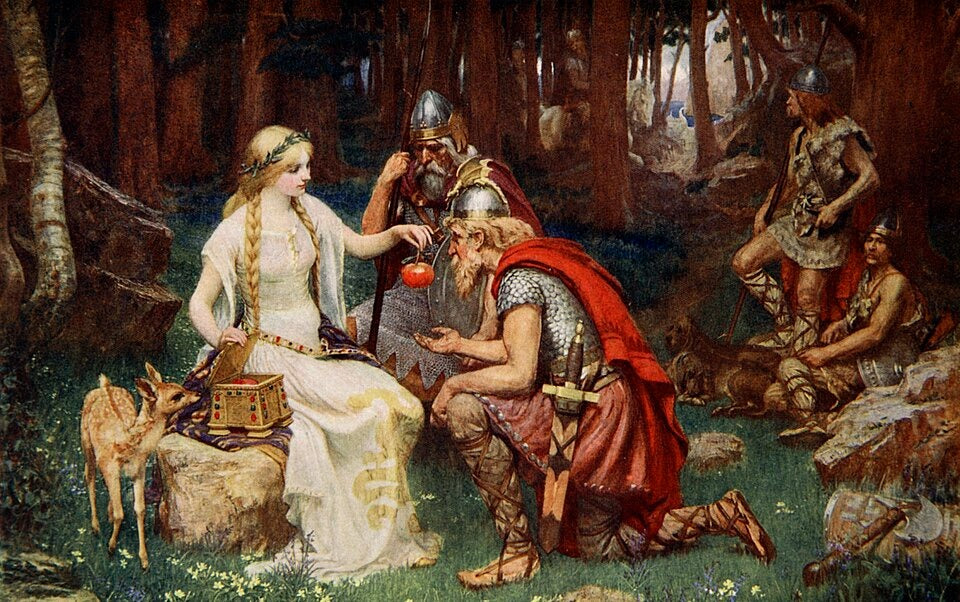
Bragi's marriage to Iðunn links poetry to eternal youth. Iðunn guards the golden apples that sustain the gods' immortality. This union, attested across the Eddas and Grettis saga, symbolizes the enduring vitality of poetic tradition.
Snorri refers to Bragi as the "long-bearded god," inspiring the kenning "beard-Bragi" for a bearded man. The carving of runes on his tongue in Sigrdrífumál associates him with inspired, magical speech.
Major Narratives Involving Bragi
The extended conversation with Ægir forms the core of Bragi's narrative presence. Bragi elucidates the mead of poetry's mythic origin and catalogs kennings for gods, giants, and natural phenomena. This medieval textbook preserves techniques essential for court poets in 13th-century Iceland and Norway.
Loki's taunts label Bragi the "bench-ornament" and the most cowardly among the Æsir. Iðunn's defense highlights familial harmony. The poem, preserved in the Poetic Edda, captures divine dynamics during feasts, a common setting in Viking Age hall culture.
Skaldic verses depict Bragi greeting slain warriors, reinforcing his function as the divine bard who ensures heroes receive proper poetic commemoration in the afterlife.

Iðunn, Loki, Heimdallr and Bragi in a depiction of a scene from the Hrafnagaldr Óðin poem (Illustration: Lorenz Frølich).
The Euhemeristic Connection to Bragi Boddason
Bragi Boddason, active in the first half of the 9th century in Norway, ranks as the earliest named skald with surviving verses. He composed Ragnarsdrápa, a shield poem describing mythological scenes gifted by a patron possibly linked to Ragnar Loðbrók. Skáldatal names his patrons as Ragnar Loðbrók, Eysteinn Beli, and Bjǫrn at Haugi. Landnámabók records his marriage and legendary encounters.
Scholars including John Lindow and Rudolf Simek attribute the god Bragi to the posthumous elevation of this historical poet. No evidence exists of a pre-Christian cult dedicated to Bragi. The deification likely occurred in the late 10th century, before full Christianization, as skalds mythologized their predecessor. Snorri distinguishes the god from the skald but draws on the poet's verses.
Bragi's Role in Medieval Scandinavian Society
In Viking Age courts from the 9th to 11th centuries, skalds like Bragi Boddason held privileged positions, receiving rings and land for praise poetry. Their verses ensured a ruler's legacy, mirroring Bragi's divine function. In medieval Iceland, Snorri's work supported skaldic training amid Norwegian influence under King Hákon Hákonarson. Bragi symbolized the cultural prestige of poetry that bridged pagan past and Christian present.
Historical Uncertainties and Scholarly Perspectives
Information on Bragi remains limited. The Poetic Edda offers only brief mentions, while the Prose Edda provides the most systematic account. No archaeological evidence confirms a cult. Scholars debate whether bragr originally meant "poetry" or "foremost," and the precise timing of deification. Contrasting views, such as those of Jan de Vries, question an early transformation, while others like Margaret Clunies Ross support a late pagan development. Uncertainties stem from the Christian filter of 13th-century sources and the oral nature of earlier traditions.
Bragi emerges in medieval Norse literature as the eloquent god of poetry, husband of Iðunn, and divine skald of Valhalla. Primary sources from the Poetic Edda and Snorri Sturluson's Prose Edda, composed in 13th-century Iceland, document his attributes, dialogues, and Valhalla role while anchoring him in the historical skald Bragi Boddason. Despite uncertainties regarding his origins and cult, Bragi illuminates the profound importance of skaldic art in Viking Age and medieval Scandinavian society. His legacy underscores how poetry preserved memory, praised power, and bridged mortal and divine realms within the broader narrative of Germanic cultural continuity and Christian adaptation in medieval Europe.
Frequently Asked Questions (FAQs)
Who is Bragi in Norse mythology?
Bragi is the god of poetry, eloquence, and skaldic art, renowned for wisdom and fluency of speech, as described in Snorri Sturluson's Prose Edda.
What is Bragi's relationship to Iðunn?
Bragi is the husband of Iðunn, the goddess who guards the apples of youth, according to the Eddas and Grettis saga.
Is Bragi based on a real person?
Yes, scholars link the god to the historical 9th-century Norwegian skald Bragi Boddason, whose verses Snorri quotes and who was later deified.
What poems feature Bragi?
Bragi appears in Grímnismál, Lokasenna, and Sigrdrífumál of the Poetic Edda, and as narrator in Skáldskaparmál of the Prose Edda.
Why is Bragi associated with Valhalla?
In skaldic poems like Eiríksmál and Hákonarmál, Bragi welcomes fallen kings to Valhalla as the divine bard.
References
Sturluson, Snorri. Prose Edda. Translated by Anthony Faulkes. Everyman, 1995.
The Poetic Edda. Translated by Carolyne Larrington. Oxford University Press, 2014.
Lindow, John. Norse Mythology: A Guide to Gods, Heroes, Rituals, and Beliefs. Oxford University Press, 2002.
Simek, Rudolf. Dictionary of Northern Mythology. Translated by Angela Hall. D.S. Brewer, 1993.
Clunies Ross, Margaret. A History of Old Norse Poetry and Poetics. D.S. Brewer, 2005.






Leave a comment
This site is protected by hCaptcha and the hCaptcha Privacy Policy and Terms of Service apply.