
Article: The Goths of Gothiscandza, the Wielbark Culture and Masłomęcz
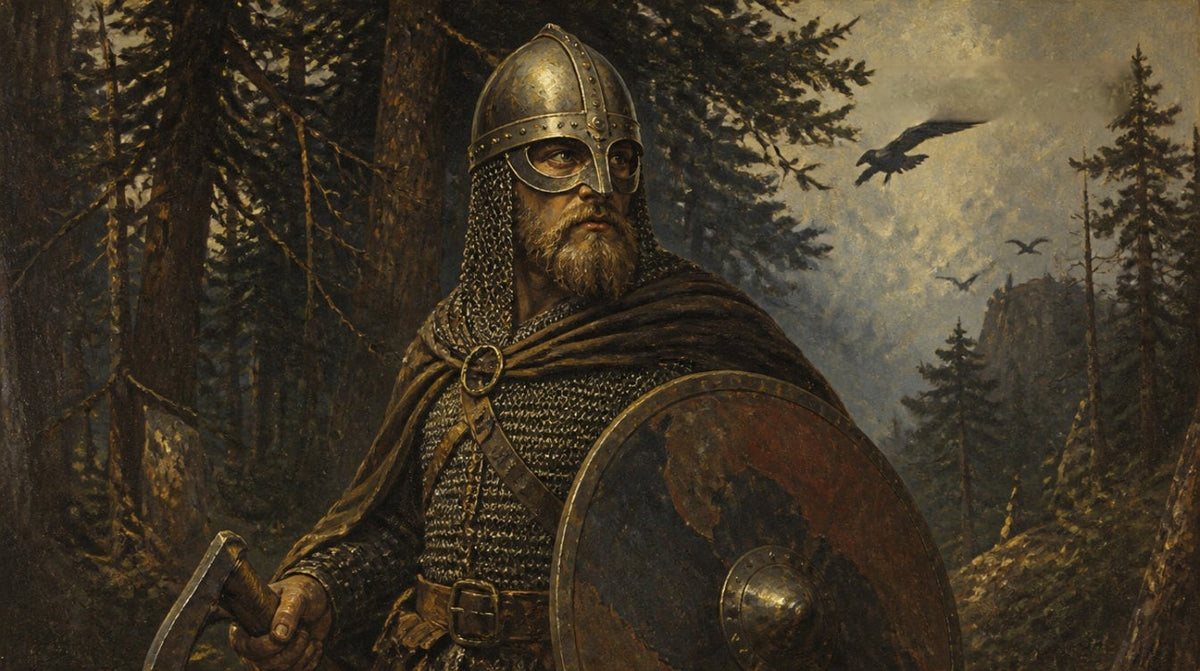
The Goths of Gothiscandza, the Wielbark Culture and Masłomęcz
The Goths are best known for their role in the final centuries of the Western Roman Empire, when Gothic armies fought Roman legions, established kingdoms and helped transform the political landscape of Europe. Yet centuries before the Sack of Rome in AD 410, the Goths belonged to the Germanic world of the southern Baltic, where communities associated with their early history developed distinctive burial customs, metalwork traditions and networks of exchange.
Three subjects are particularly important for understanding this earlier period: Gothiscandza, the place where the Gothic historian Jordanes says his people first settled after crossing the sea; the Wielbark culture, the archaeological culture associated by many scholars with the early Goths; and Masłomęcz, a settlement and cemetery complex in southeastern Poland that offers valuable evidence for the communities living on the eastern edge of the Wielbark world.
These three are closely connected, but they are not interchangeable. Gothiscandza comes from a written origin tradition recorded centuries after the events it describes. Wielbark is an archaeological classification based on material evidence. Masłomęcz is a specific archaeological site whose burials and artefacts reveal how people lived, traded and expressed identity during the period when Gothic history was taking shape.
Understanding how these sources fit together helps distinguish what we know about the early Goths from what remains uncertain.
Gothiscandza in Jordanes' History
The main written account of the Goths' origin comes from Jordanes, a sixth-century author who composed Getica, a history of the Goths, around AD 551. Jordanes drew on earlier material, including a now-lost history by Cassiodorus, alongside other literary sources. His work is indispensable, but it combines historical traditions, geographical descriptions and origin stories written long after the events they describe.

Vegvísir & Gungnir Symbol Engraved Ring
Jordanes begins the Gothic story on Scandza, the island he identifies as the source of many peoples. Most scholars associate Scandza broadly with Scandinavia, although its precise geographical boundaries in Jordanes' account are not straightforward. From there, he says, the Goths crossed the sea under a king named Berig, travelling in just three ships. Upon reaching the opposite shore, they supposedly gave the landing place the name Gothiscandza.
Jordanes places Gothiscandza on the southern shore of the Baltic, in the region associated with the later Gothic presence in northern Poland. He then describes the newcomers fighting the Ulmerugi, a people already living there, and subduing neighbouring Vandals. Several generations later, under a king named Filimer, the Goths supposedly began a further migration towards the lands Jordanes calls Scythia.
The account presents a sequence of movements: an origin in Scandinavia, a settlement on the southern Baltic coast, and a later migration towards the Black Sea. That broad outline has long attracted historians because it appears to correspond with archaeological changes across northern and eastern Europe during the first centuries AD.
However, Jordanes was writing centuries after the supposed landing of Berig. His narrative cannot independently establish that a king of this name led a migration in three ships, nor can archaeology identify a particular settlement as Gothiscandza with certainty. The story is best read alongside the material evidence rather than treated as a literal itinerary with every stage confirmed.
The name itself is significant. Gothiscandza appears to combine a form of the Gothic ethnonym with a name resembling Scandza. It may preserve a tradition linking the Goths to both Scandinavia and their early settlements on the continental shore. Its precise meaning and the historical development of the name remain less certain than the general association.
Where Was Gothiscandza?
Jordanes does not provide coordinates or a detailed description that allows Gothiscandza to be located beyond dispute. The traditional interpretation places it somewhere along the southern Baltic coast, particularly in the area of modern Pomerania and the lower Vistula region of northern Poland.

Extent of the Wielbark Culture as of the second half of the third century, marked in red. Green signifies the extenT of Götaland, pink is Gotland (Illustration: Wiglaf, Wikicommons, CC BY-SA 3.0).
This is also where archaeologists identify the Wielbark culture, whose early development and later distribution overlap with the regions associated with the Goths in ancient written sources. The geographical correspondence has been one of the principal reasons scholars connect the two. The lower Vistula was well suited to settlement and communication. Its river system connected inland territories to the Baltic, while coastal routes linked communities across the southern Baltic with Scandinavia. Rivers, estuaries and sea routes offered means of moving people and goods long before the Roman period, and the region participated in networks that extended far beyond its immediate hinterland.
The archaeological evidence therefore gives Jordanes' account a plausible geographical setting. Communities around the southern Baltic had long-standing connections with Scandinavia, and the appearance of burial customs with northern parallels during the first century AD fits a picture of continuing contact across the sea.
Yet a plausible setting is not the same as proof of a named event. No inscription or securely identified archaeological feature confirms that a place was called Gothiscandza by its inhabitants. The term remains known from Jordanes, while the archaeology provides evidence for the people and societies that occupied the region.
The Wielbark Culture
The Wielbark culture is an archaeological classification for communities that flourished in parts of present-day northern and eastern Poland during the Roman Iron Age. It emerged during the first century AD, with roots in earlier local traditions, and its territory shifted over time. Its material remains are particularly important for studying the early history of the Goths because many scholars associate it with Gothic-speaking communities in the southern Baltic region.

Reconstruction of a Wielbark culture house (Photo: MSWG CC BY-SA 3.0).
The culture is named after Wielbark, formerly Willenberg, near Malbork in northern Poland. A large cemetery discovered there became central to archaeological research into the region. The term Wielbark culture refers to a pattern recognised through burial rites, pottery, ornaments, settlement evidence and other material remains; it does not mean that every person associated with it necessarily belonged to one tribe or spoke one language.
One of its most distinctive features is the combination of cremation and inhumation. Early burials often involved cremation, while inhumation became increasingly common during the Roman period. Cemeteries also include stone settings, stone circles and barrows in some areas, practices with parallels in parts of Scandinavia. The forms and frequency of these features varied by region and period, rather than appearing uniformly throughout the culture's territory.
Another notable feature is the relative scarcity of weapons and iron tools in many Wielbark graves. In contrast to some neighbouring archaeological cultures, weapons were rarely deposited with the dead during much of the culture's later development. Jewellery, dress fittings, brooches and other personal ornaments were important grave goods. This pattern likely reflects distinctive funerary customs and social values, although the precise reasons behind it remain debated.
The absence of weapons in graves should not be mistaken for an absence of warriors. Burial practices do not directly reproduce every aspect of everyday life, and the archaeological record reflects what communities chose to place with the dead. It tells us about ritual and identity as much as it does about material possessions.
The Wielbark culture was also not isolated from the Roman world. Roman coins and imported goods circulated beyond the imperial frontier, while styles and technologies travelled through trade, diplomacy and movement between communities. The southern Baltic formed part of a connected world in which Roman products could be valued far from the empire itself.
Were the Wielbark People Goths?
The relationship between the Wielbark culture and the Goths is central to the archaeology of early Germanic Europe. Many scholars associate this culture, which emerged in northern Poland during the first century AD, with the early Goths. Its location along the southern Baltic coast and its subsequent expansion towards the southeast broadly fit the traditional account of Gothic movement from Scandinavia towards the Black Sea. The culture is also associated with the Gepids, another Germanic people whose history was closely linked with that of the Goths.
The debate concerns how this relationship developed, not whether the Goths were a historical people with their own identity and traditions. Wielbark is identified through archaeological evidence, including burial customs, cemeteries and artefacts, while the Goths are known through written sources, language and their later appearance in Roman history. These forms of evidence cannot be matched perfectly, but together they support the association between the early Goths and communities around the southern Baltic.
Wielbark developed partly from earlier regional traditions, particularly those associated with the Oksywie culture, while maintaining connections across the Baltic. Its emergence may therefore have involved both local populations and arrivals from Scandinavia, rather than the wholesale migration of an entire people. The scale of migration, its timing and the balance between population movement and cultural change remain debated. Local continuity does not disprove Scandinavian migration, nor does it establish that the inhabitants were Slavic; the identities and languages of the communities involved cannot be determined from archaeological remains alone.
The Goths' names, religious traditions and material remains reflect their place within the wider Germanic world. Their ethnonym, recorded in forms such as Gutones and Gutans, belongs to the early Germanic naming traditions shared by related peoples. Jordanes records the Gothic king Berig in his account of their migration from Scandinavia, while his description of the Goths honouring Mars is commonly understood as referring to their Germanic war god, often identified with Týr. Other evidence, including the Migration Period 'Ring of Pietroassa' possibly referencing Wodan in its inscription, demonstrates the continued importance of Wōdan in the religious world of Germanic peoples. Together with the Gothic tradition of Scandinavian origins and the archaeological evidence for connections across the Baltic, these names and beliefs place the Goths firmly within the broader Scandinavian and Germanic cultural sphere.
The remaining questions are specific: how many people migrated from Scandinavia, when and by what routes they travelled, how Gothic identity developed among communities around the Baltic, and how closely the Wielbark culture corresponds to the people named in ancient sources. Jordanes' account of Berig may preserve a tradition of migration, although its details cannot be independently verified in full. The Wielbark culture remains a major archaeological context for understanding the early Goths, and its local roots need not contradict a Scandinavian connection; they may help explain how the Gothic people established themselves and developed in mainland Europe.
The Migration South and East
During the second and third centuries AD, the Wielbark culture expanded east and southeast from the southern Baltic region. Archaeological evidence indicates that settlement zones in parts of northern Poland were abandoned or diminished while communities associated with Wielbark appeared farther east, including in areas of modern eastern Poland and western Ukraine. The changes were not uniform, and some communities remained in their earlier territories.

Valknut Othala Mjölnir - Teiwaz & Algiz Rune Thor's Hammer Amulet
These movements are often connected with the Gothic migrations described in ancient sources. Jordanes tells how Filimer led the Goths towards a land called Oium, which he places in Scythia. The archaeological record provides evidence for movements in broadly the same direction, although it cannot confirm Jordanes' named kings or every detail of his account.
The consequences were substantial. Communities associated with the Gothic world entered regions occupied by other peoples, including Vandals, Sarmatians and groups with Dacian and other local traditions. They were not moving into an empty landscape. The lower Danube and northern Black Sea region had long been a meeting ground for populations connected to the Roman Empire, the steppe and eastern Europe.
Over time, the Gothic groups known to Roman writers became part of a more complex world of alliances, warfare, migration and political consolidation. Their identity was carried forward through these changes, but the Goths of the Black Sea region were not simply an unchanged copy of the earlier communities of the Baltic coast. Their society had developed through contact with new neighbours and the incorporation of people from different backgrounds.
The Masłomęcz Group
One of the most important archaeological expressions of the Gothic world in eastern Poland is the Masłomęcz group, named after the village of Masłomęcz near Hrubieszów in the Lublin region. It flourished mainly between the second and fourth centuries AD, at a time when communities associated with the Gothic cultural complex were moving and settling farther east.
The Masłomęcz group is usually treated as part of the broader Wielbark cultural complex, though researchers distinguish it by its regional distribution and distinctive archaeological features. Its settlements and cemeteries provide evidence for a community that was connected to the Gothic world while also interacting closely with the populations of eastern Europe. Archaeologists have identified dozens of settlements and around ten cemeteries associated with the group. More than 800 graves have been excavated, especially at the cemeteries of Masłomęcz and Gródek.
The graves are particularly valuable because human remains are often well preserved, allowing researchers to study age, sex, health, burial treatment and biological relationships. Grave goods include ornaments, brooches and other items of dress, while the variety of funerary practices points to a community whose members did not all follow an identical ritual tradition.

Reconstruction of the 3rd century Gothic grave from Masłomęcz in the National Museum of Lublin. (Anonymous, Wikicommons, CC0)
Some graves contain multiple individuals; others show evidence of reopening, partial burial or the placement of selected bones alongside a principal burial. Such practices are not easy to interpret, and they should not be reduced to a single explanation. They may reflect different funerary traditions, the treatment of ancestors, ritual acts or relationships between the living and the dead that are not directly recoverable from the objects alone. The diversity itself is revealing: Masłomęcz was not a community with one rigid, uniform way of burying its dead.
The group is also important for understanding how Gothic communities changed as they moved away from the Baltic. Its material culture retains links with the wider Wielbark tradition, while some burial practices and objects show affinities with neighbouring Baltic, Sarmatian and other eastern European communities. These connections are consistent with sustained interaction rather than a sealed-off population carrying an unchanged culture from one region to another.
What the Graves Reveal About Gothic Society
Masłomęcz helps bring the early Goths into sharper focus as real communities rather than merely names in migration narratives. The cemeteries preserve evidence for personal adornment, ritual distinctions, family life and the treatment of the dead. They also demonstrate that identity could be expressed through burial customs and jewellery as well as through weapons or political allegiance.
The broader Wielbark tradition is notable for the importance of ornaments and dress fittings, including objects made with sophisticated metalworking techniques. Gold and silver, copper-alloy fittings, brooches and carefully crafted personal ornaments could communicate status, social connections and individual identity. Such items also reveal the movement of styles and materials across regions connected by trade and migration.

Bishop Wulfila explains the Gospels to the Goths (Photo: James Steakley).
The relative absence of weapons from many Wielbark graves is especially striking. It distinguishes the culture from some neighbouring groups whose burials frequently included weapons. The contrast suggests that communities could express social status and ideas about death in different ways, even within the wider Germanic world. It does not, however, prove that the people of Wielbark were less warlike or that weapons were absent from their lives.
At Masłomęcz, the range of burial rites adds another dimension. Some individuals were buried according to practices familiar from the wider Gothic cultural complex, while others were treated in ways that suggest connections to other traditions. This variety may reflect migration, intermarriage, the adoption of local customs or the presence of people whose backgrounds differed from those of their neighbours.
The graves cannot tell us exactly how each person identified themselves, but they show that the communities associated with the Goths were socially varied and connected to a much wider world.
Ancient DNA and the People of Masłomęcz
Recent archaeogenetic research has added important evidence to the debate over the origins and composition of the Masłomęcz population. A study published in Genome Biology in January 2026 analysed genetic data from 37 burials and compared the results with previously published datasets. It found that the group had substantial ancestry related to Scandinavian populations, while also incorporating individuals with ancestry connected to the Baltic region, the Balkans and areas farther into the Mediterranean.

The Ring of Pietroassa bears a runic inscription associated with the Goths. Its damaged text has been interpreted in several ways, including as a dedication to a Germanic deity identified with Wōdan (Odin), although the exact reading remains disputed. (Photo: Henric Trenk).
The results support a picture of a community shaped by long-distance movement and sustained contact. The people buried at Masłomęcz were not all descended from a single isolated population. Instead, the group appears to have incorporated people from different geographical backgrounds, consistent with the archaeological evidence for contact between Gothic communities and their neighbours.
The study also examined multiple-person burials and found no close genetic relationships among the individuals interred together in the cases analysed. This is a useful reminder that a shared grave does not necessarily represent a nuclear family. The reasons for these collective burials remain open to interpretation, and genetics alone cannot establish the social or ritual meaning behind them.
Ancient DNA does not identify a person as “Gothic” in the same way that a written inscription might identify a name or political affiliation. Ethnic identity is a social and historical matter, not a genetic category. The value of the findings lies in showing how people moved and how communities were formed, rather than assigning a single biological profile to all Goths.
Taken together, the genetic and archaeological evidence suggests that the Masłomęcz group combined strong connections to the northern European world with a substantial capacity to absorb people from elsewhere. This was not an isolated frontier settlement but part of a mobile, interconnected society beyond the Roman imperial borders.
From the Vistula to the Black Sea
The history represented by Gothiscandza, Wielbark and Masłomęcz forms part of a much larger movement that eventually brought Gothic groups into direct contact with the Roman Empire.
By the third century AD, Gothic groups were established around the northern Black Sea and the lower Danube. Roman authors increasingly recorded their raids, military campaigns and involvement in imperial politics. In the fourth century, the arrival of the Huns disrupted existing power structures and contributed to further Gothic movements across the Danube. These later events produced the Gothic groups known as the Visigoths and Ostrogoths, whose histories would become closely tied to the fate of Rome.
The connection between these later Goths and the earlier Wielbark communities is supported by the broad direction of archaeological change and the ancient traditions of Gothic migration. Nevertheless, the process involved generations of movement, political reorganisation and cultural exchange. The Goths who fought Rome in the fourth and fifth centuries had developed in a different historical setting from the communities buried at Masłomęcz.
The archaeological record is particularly useful here because it shows that Gothic history did not begin when the Goths first appeared in Roman military accounts. Their communities had already developed social practices, burial traditions and networks of contact across the Baltic and eastern Europe. Their later prominence in Roman history was the outcome of a much longer process.
The Legacy of Gothiscandza and Wielbark
Gothiscandza, the Wielbark culture and the Masłomęcz group illuminate different parts of the early Gothic story. Jordanes preserves a tradition of origins in Scandinavia and settlement on the southern Baltic coast. The Wielbark culture provides archaeological evidence for communities in that region during the first centuries AD, while Masłomęcz reveals the diversity and long-distance connections of Gothic-associated populations farther east.
The evidence does not establish every detail of Jordanes' narrative, nor does it prove that every person associated with Wielbark or Masłomęcz identified as Gothic. It does, however, support the broad picture of a Gothic world that developed around the Baltic and expanded towards the Black Sea over several centuries.
The most important point is that the Goths were not simply a people who suddenly emerged on the Roman frontier. Their history reaches back into the communities of the southern Baltic, where local traditions and Scandinavian connections contributed to the formation of a distinctive Germanic world. As Gothic groups moved eastward, they incorporated new influences and people, creating societies that were increasingly diverse.
The cemeteries of Wielbark and Masłomęcz preserve traces of that development in tangible form: burial grounds used for generations, ornaments worn by individuals, changing funerary customs and human remains that can now be studied through archaeology and genetics. Together, they offer a view of the Goths long before their kingdoms became central to the history of Rome.

Hrafnheimr - Viking Raven Oath Ring
Frequently Asked Questions (FAQs)
What was Gothiscandza?
Gothiscandza is the name given by the sixth-century historian Jordanes to the place where the Goths supposedly landed after leaving Scandinavia under King Berig. It is generally associated with the southern Baltic coast, probably in the region of modern northern Poland, but its exact location is unknown.
Was the Wielbark culture Gothic?
The Wielbark culture is widely associated with the early Goths and possibly the Gepids. Its geography, chronology and connections with Scandinavian traditions fit the broad Gothic migration narrative, although the culture was likely multi-ethnic and developed partly from local traditions.
Where was the Masłomęcz group located?
The Masłomęcz group flourished mainly during the second to fourth centuries AD around Hrubieszów in southeastern Poland. Its settlements and cemeteries provide important evidence for Gothic-associated communities and their connections with other peoples of eastern Europe.
Why are weapons rare in Wielbark graves?
Many Wielbark cemeteries contain few weapons or iron tools compared with neighbouring archaeological cultures. This reflects distinctive burial customs, but the reason for the practice remains debated. It does not mean the communities lacked warriors or weapons in everyday life.
Does DNA prove that the Goths came from Scandinavia?
Ancient DNA from Masłomęcz indicates substantial Scandinavian-related ancestry alongside ancestry from other regions. This supports long-distance connections and migration, but genetics cannot by itself prove a specific ethnic identity or verify Jordanes' account of Berig and Gothiscandza.
References
Jordanes. Getica (The Origin and Deeds of the Goths).
Tacitus. Germania.
Łuczkiewicz, Piotr, Jörg Kleemann, Michał Jankowski, Agnieszka M. Noryśkiewicz, Marcin Sykuła and Aneta
Kuzioła. “The Goths, the Wielbark Culture and over 100 years of research on the eponymous site.” Antiquity, 2021.
Urbańczyk, Przemysław. “The Goths in Poland — where did they come from and when did they leave?” European Journal of Archaeology, 1998.
Golubiński, Michał, et al. “Cosmopolitanism in the depths of Barbaricum evidenced by archaeogenomic data from the Late Iron Age Goth community of the Masłomęcz group.” Genome Biology, 2026.
University of Warsaw. “Wielbark Culture.” Migration Period between Odra and Vistula.





Leave a comment
This site is protected by hCaptcha and the hCaptcha Privacy Policy and Terms of Service apply.