Týr, Tīw, and Tīwaz: The Germanic God of Law, War, and Sacred Order
Among all the gods of the Germanic peoples, few have roots as ancient as Tīwaz. Linguistic evidence suggests that he descended from the Proto-Indo-European deity Dyḗus Ph₂tḗr, the celestial "Sky Father" whose descendants appear across much of the Indo-European world.
The Greek god Zeus, the Roman god Jupiter, and the Vedic deity Dyaus Pitar all derive from this ancient divine archetype. The Germanic Tīwaz belongs to the same family. In fact, his name is not merely the name of a god; it originally meant "god" itself.
The Name Tīwaz and Indo-European Roots
The reconstructed Proto-Germanic name Tīwaz derives from the Proto-Indo-European root deywós, meaning "god" or "shining celestial being." This linguistic connection reveals the antiquity of the deity and suggests that Tīwaz once occupied a much higher position within the Germanic pantheon than he would later hold in Viking Age mythology.
By the historical period, his name had evolved into several regional forms. In Scandinavia he became Týr. Among the Anglo-Saxons he was known as Tīw. In southern Germanic regions he appears as Ziu or Tiu. Although the names differed, they all descended from the same ancient deity.
Tīwaz Across the Germanic World
Unlike many Norse gods whose worship is primarily attested in Scandinavia, Tīwaz was known throughout the Germanic-speaking world. His presence can be detected from Iceland to England and from Denmark to southern Germany.

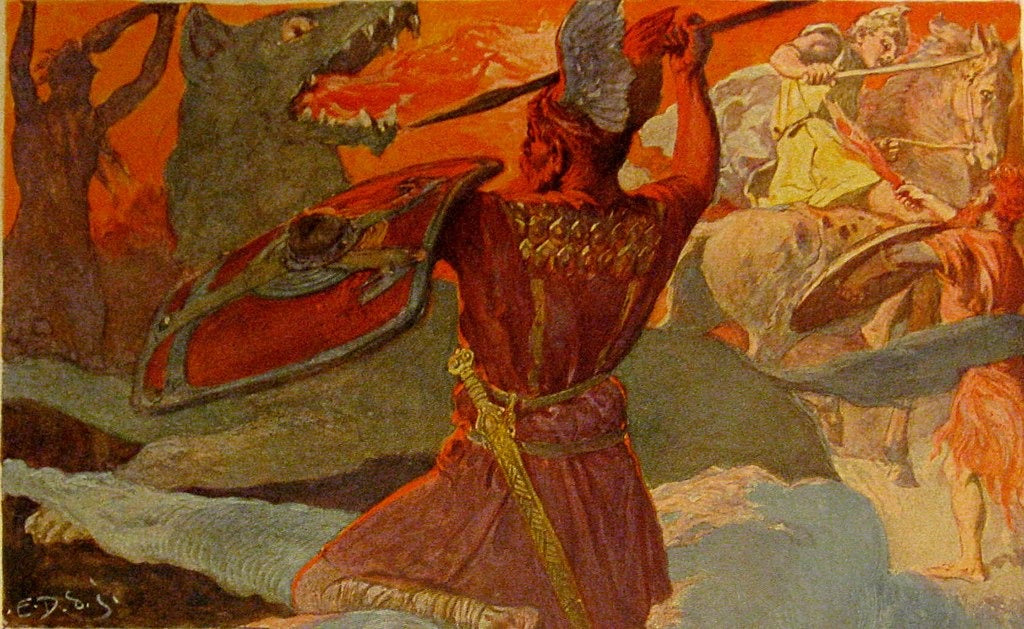
Tyr feeding Fenrir by Louis Huard
Týr in Scandinavia
The Norse Týr is best known from the Eddas, where he appears as a courageous but somewhat diminished member of the Æsir. By the Viking Age, Óðinn and Þórr had largely eclipsed him in prominence.
Nevertheless, the surviving myths preserve important clues to his earlier significance. Týr is repeatedly associated with courage, justice, oath-keeping, and lawful conduct. Even when later sources portray him as less powerful than Óðinn, he remains one of the most respected gods.
Tīw in Anglo-Saxon England
The Anglo-Saxons preserved the god's memory in the name Tīw. Although very little mythology survives from pre-Christian England, his importance is reflected in language and calendrical traditions.
Tuesday derives from Old English Tīwesdæg, meaning "Tīw's Day." This parallels the Roman dies Martis ("Day of Mars"), demonstrating that Germanic peoples identified Tīw with the Roman god Mars during the interpretatio Romana.
The Old English rune poem also preserves the T-rune, named Tīr, which associates the god with guidance, honour, and steadfastness.
Ziu in Continental Germany
Among continental Germanic peoples, the deity appears as Ziu or Tiu. References survive in place names and later medieval traditions, although much of the mythology was lost during Christianization.
The Roman historian Tacitus may have referred to this deity when describing the Germanic equivalent of Mars in the first century CE. While exact identifications remain debated, most scholars believe that the martial god described by Roman authors was some form of Tīwaz.
The God of Law, Oaths, and Assembly
Modern popular culture often portrays Týr primarily as a war god. While warfare certainly formed part of his character, the historical evidence suggests a broader and perhaps more important role.
Tīwaz appears closely connected to justice, legal procedure, oath-making, and social order. In many respects, he represented the moral framework that held Germanic society together.

The Germanic Þing
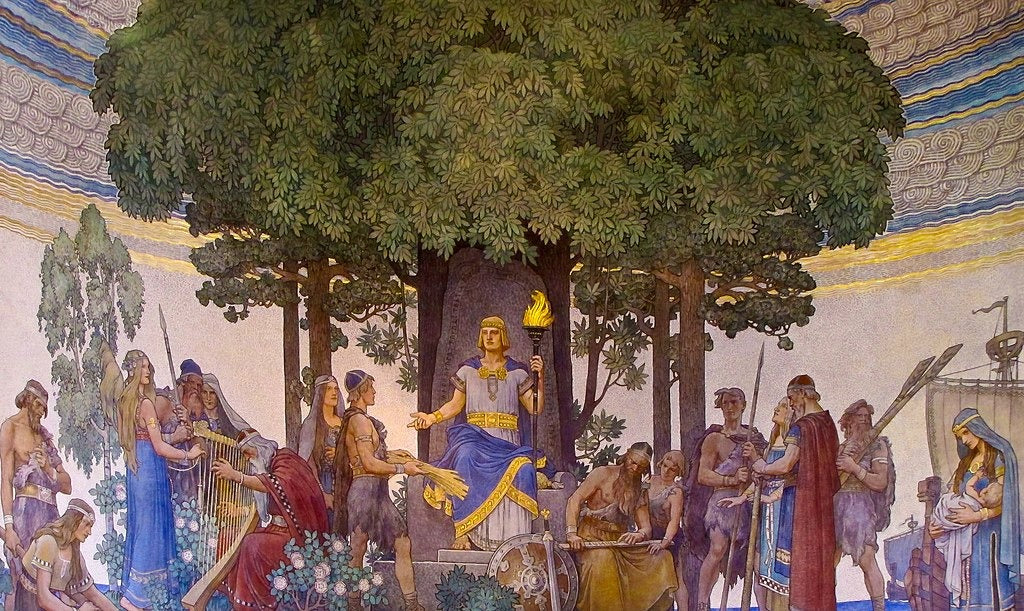
One of the most significant institutions among Germanic peoples was the Þing, the public assembly where disputes were settled, laws were recited, and leaders were chosen.
Although direct evidence linking Tīwaz to every Þing assembly is lacking, many scholars have suggested that his association with justice and oaths made him a natural divine patron of such gatherings. His character reflects ideals that were central to Germanic governance: honesty, lawful conduct, and loyalty to sworn agreements.
These values would remain influential long after the pagan period. Across northern Europe, traditions of communal assemblies, legal participation, and consensual leadership continued into the medieval era, adapting to changing political structures while retaining elements of older Germanic practice.
Týr and Fenrir
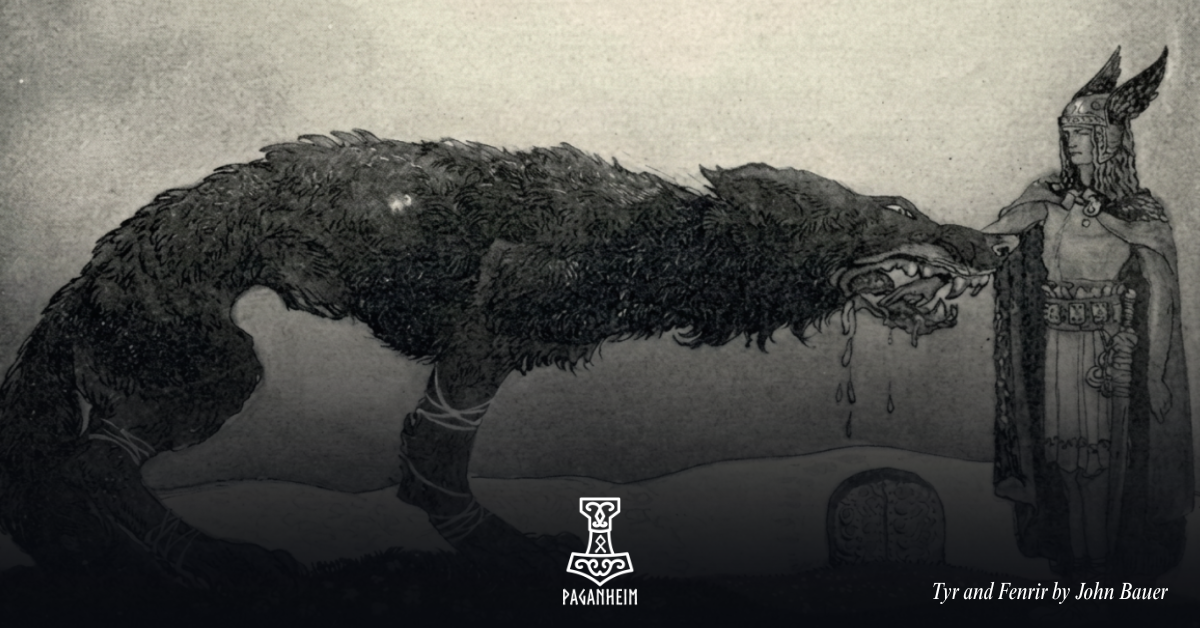
The most famous surviving myth involving Týr concerns the binding of the monstrous wolf Fenrir.

A drawing by Gunnar Creutz of a bracteate from Trollhättan, Västergötland which depicts Fenrirs biting of Týr's hand (CC BY-SA 4.0)
According to the story preserved in the Prose Edda, the gods feared Fenrir's growing power and sought to restrain him. After several failed attempts, they commissioned the dwarfs to forge Gleipnir, a magical binding made from impossible ingredients.
Fenrir suspected deception and agreed to be bound only if one of the gods placed a hand inside his mouth as a pledge of good faith.
The Meaning of the Lost Hand
Only Týr was willing to do so.
When Fenrir discovered that he could not escape, he bit off Týr's hand. The sacrifice permanently maimed the god but ensured the safety of the cosmos.
The story is remarkable because it highlights Týr's defining qualities. Unlike Óðinn, who often gains wisdom through cunning, or Þórr, who triumphs through strength, Týr succeeds through personal sacrifice and unwavering commitment to duty.
His willingness to lose his hand in order to uphold an agreement, even a deceptive one, reflects the profound importance of oath-keeping within Germanic culture.
Týr Before Óðinn
One of the most intriguing questions in Germanic religion concerns Tīwaz's original status.
Many scholars believe that Tīwaz may once have been the chief deity of the Proto-Germanic pantheon before being gradually displaced by Wōdanaz, the god who would later become Óðinn.

The Rise of Wōdanaz
The linguistic evidence supporting Tīwaz's antiquity is substantial. Unlike Óðinn, whose cult appears to have expanded during the Roman Iron Age and Migration Period, Tīwaz can be traced directly back to the Proto-Indo-European Sky Father.
This does not necessarily mean that Tīwaz ruled over the entire Germanic pantheon in a later Viking Age sense. However, it strongly suggests that he occupied an exceptionally prominent role during earlier phases of Germanic religious development.
Over time, changing social conditions may have favoured the rise of Óðinn, a deity associated with kingship, ecstatic wisdom, poetry, and elite warrior culture. As Óðinn's influence expanded, Tīwaz's role appears to have narrowed, concentrating on law, honour, and formal justice.
Týr in Place Names and Archaeology
Evidence for Tīwaz survives beyond mythology. Place names across England, Denmark, Germany, and Scandinavia preserve memories of his worship.
The survival of Tuesday as "Tīw's Day" represents one of the clearest examples. Archaeological evidence is more limited than for deities such as Þórr, but inscriptions and rune names confirm the god's widespread recognition throughout the Germanic world.
His presence across multiple linguistic branches demonstrates that worship of Tīwaz predates the separation of the Germanic peoples into their later tribal and national identities.
The T-Rune and Tīwaz Symbolism
The Elder Futhark rune ᛏ bears the reconstructed name Tīwaz. This association provides one of the strongest surviving connections between the deity and Germanic symbolic culture.
In later rune poems, the rune is linked with honour, guidance, justice, and noble conduct. These themes align closely with the characteristics attributed to Týr throughout the surviving mythological tradition.
The rune's endurance reflects the lasting prestige of a deity whose influence extended across centuries and across the entire Germanic world.
Conclusion
Týr, Tīw, Ziu, and the Proto-Germanic Tīwaz represent different expressions of one of the oldest deities in Germanic religion. Long before the Viking Age, his roots stretched back to the Proto-Indo-European Sky Father, connecting the Germanic peoples to a much older religious tradition shared across Eurasia. While later mythology often places him in the shadow of Óðinn and Þórr, the evidence of language, mythology, place names, and runic tradition reveals a god of immense antiquity and significance.
More than a deity of war, Tīwaz embodied law, honour, courage, and the sanctity of oaths. Across the Germanic world—from Anglo-Saxon England and Frisia to Scandinavia and continental Germany—his name endured as a symbol of the principles that held society together. Though his prominence diminished over time, his legacy remains embedded in language, mythology, and the cultural memory of the Germanic peoples.
Frequently Asked Questions (FAQs)
Was Týr originally more important than Óðinn?
Many scholars believe Tīwaz was an older and possibly more prominent deity in early Germanic religion, though the extent of his authority remains debated.
Are Týr, Tīw, and Ziu the same god?
Yes. They are regional Germanic forms of the Proto-Germanic deity Tīwaz.
Why is Tuesday named after Týr?
The English word Tuesday derives from Old English Tīwesdæg, meaning "Tīw's Day."
Why did Týr lose his hand?
He placed it in Fenrir's mouth as a pledge while the gods bound the wolf, sacrificing it when Fenrir realized he had been deceived.
What does the rune ᛏ represent?
The rune ᛏ is traditionally known as Tīwaz and is associated with honour, justice, duty, and leadership.
References
Poetic Edda
Snorri Sturluson, Prose Edda
Rudolf Simek, Dictionary of Northern Mythology
John Lindow, Norse Mythology: A Guide to the Gods, Heroes, Rituals, and Beliefs
H. R. Ellis Davidson, Gods and Myths of Northern Europe
Georges Dumézil, Gods of the Ancient Northmen
Germania
Andy Orchard, Dictionary of Norse Myth and Legend
Neil Price, Children of Ash and Elm




Leave a comment
This site is protected by hCaptcha and the hCaptcha Privacy Policy and Terms of Service apply.