Ymir; the Father of Giants in Norse Mythology
Ymir occupies a unique position in Germanic mythology. He belongs to the mythical age before the creation of the ordered world, before the gods established Ásgarðr, before mankind existed and before the familiar divisions between land, sea and sky had been formed.
The fullest surviving account appears in Snorri Sturluson's Gylfaginning, written in the thirteenth century, but the underlying creation tradition is considerably older. Ymir is also mentioned in several poems preserved in the Poetic Edda, particularly Völuspá, Vafþrúðnismál and Grímnismál. These sources do not provide one perfectly consistent narrative, but together they preserve the central elements of the myth: Ymir was the primordial jötunn, the ancestor of the giant race, and his body became the substance from which the gods fashioned the world.
His story therefore belongs to the deepest layer of Norse cosmology. Ymir is not a king, warrior or ancestor remembered from a human historical age. He represents existence before the ordered cosmos itself.
Ginnungagap and the Birth of Ymir
According to Gylfaginning, the beginning of the cosmos was dominated by Ginnungagap, the great void. To its north lay Niflheimr, a realm of cold and ice, while to the south lay Múspellsheimr, associated with heat and fire.
From Niflheimr came the icy rivers known as the Élivágar. As their venomous waters extended into Ginnungagap, the cold caused them to freeze, while heat from Múspellsheimr caused the ice to melt and drip. From this meeting of frost and heat came the first living being: Ymir.
Snorri identifies him with another name, Aurgelmir, which is particularly important because Vafþrúðnismál uses Aurgelmir when describing the earliest giant generations. The poem states that venom from the Élivágar formed Aurgelmir and that from him came the race of giants.
The mythology therefore does not begin with a conventional divine creator. Life emerges from the interaction of opposing elemental forces: cold and heat, ice and fire, stillness and movement.
Auðhumla and Búri
Ymir was not alone in the primordial world. From the same melting frost came the primeval cow Auðhumla.
Auðhumla fed Ymir with four streams of milk, allowing him to survive in the newly formed cosmos. She herself survived by licking the salty frost and ice. As she licked the stones, another primordial being gradually emerged: Búri.

In this 1790 painting by Nicolai Abildgaard, Ymir suckles at the udder of Auðumbla while she frees Búri from the ice by licking it.
Snorri's account describes Auðhumla revealing Búri over three days. On the first day his hair appeared, on the second his head, and on the third his entire body emerged. Búri became the ancestor of the gods through his son Borr, who married the jötunn Bestla. Their sons were Óðinn, Vili and Vé.
This creates one of the most important relationships in the creation myth. Ymir and the ancestors of the gods emerge from the same primordial environment, yet their descendants eventually become enemies.
The later conflict between gods and jötnar is therefore already present in the earliest generation of the mythology.
Ymir as Ancestor of the Jötnar
Ymir stands at the beginning of the jötunn race, and his unusual manner of reproduction reinforces what the jötnar represent within Norse cosmology. They are not simply a race of physically large beings, but primordial forces associated with the wild, unordered aspects of existence that stand in opposition to the ordered world established by the Æsir.

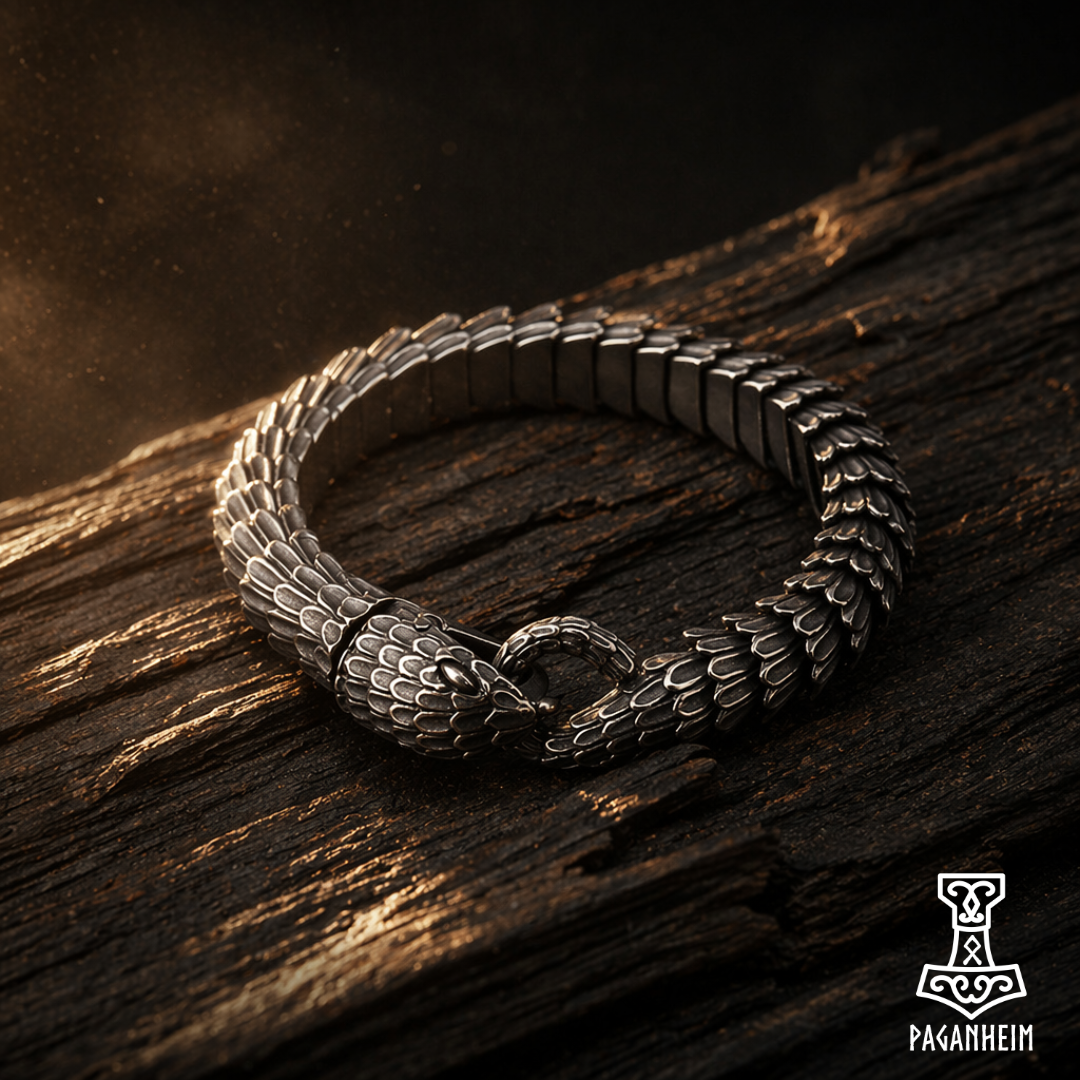
Triskele Horns of Odin Jelling Style Norse Viking Ring
Vafþrúðnismál describes Ymir producing offspring in ways unlike ordinary human or divine reproduction. While he sleeps, a male and female emerge beneath his arms, while his feet produce another being. From this primordial generation descend later jötnar, including Þrúðgelmir and Bergelmir. Ymir therefore does not merely father the giants in a conventional genealogical sense; his own body produces them through unnatural means, reflecting his existence before the ordered structures of the cosmos have been established.
This makes Ymir perhaps the clearest embodiment of the primordial character of the jötnar. The Æsir ultimately impose boundaries, structure and order upon the world, while the jötnar descend from the chaotic existence that preceded it. The conflict between the two groups is therefore not simply a struggle between rival peoples. It represents an older tension between order and the primordial forces that exist beyond it.
When Óðinn, Vili and Vé kill Ymir, his blood floods the primordial world and destroys most of the first generation of jötnar. Only Bergelmir and his wife survive, preserving the giant lineage. Ymir's death therefore serves two purposes at once: the destruction of the primordial being and the beginning of the ordered cosmos built from his remains.
The Slaying of Ymir
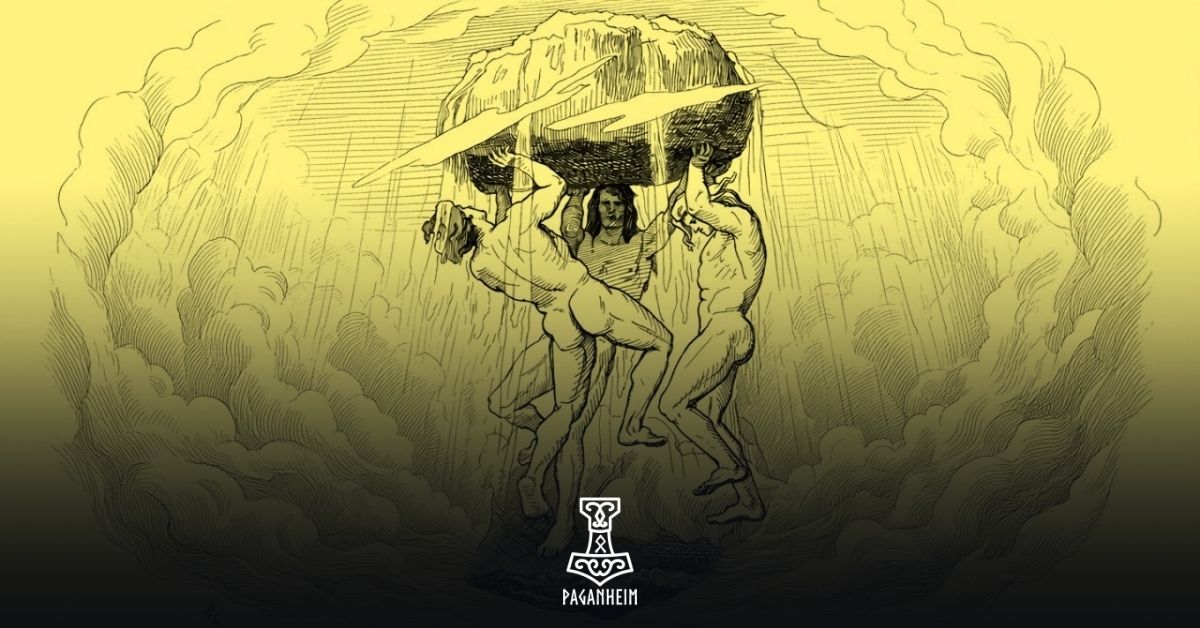
The turning point comes when Óðinn, Vili and Vé, the three sons of Borr and Bestla, kill Ymir.
The surviving sources do not give a detailed account of the battle itself. What matters is what happens afterward: the gods use Ymir's enormous body as the raw material for constructing the ordered world.
His death is therefore not merely the killing of a primordial enemy. It is the fundamental act through which the cosmos becomes physically structured.
The myth presents creation as transformation rather than creation from nothing. The world already exists in a chaotic and elemental form, but the gods impose order upon it by dismantling Ymir and distributing his body throughout the cosmos.
A World Made From Ymir
The body of Ymir becomes the physical substance of the world.
According to Grímnismál, his flesh becomes the earth, his blood becomes the sea, his bones become the mountains, his hair becomes the trees, his skull becomes the sky and his brain becomes the clouds. Gylfaginning preserves the same basic cosmology and adds further details concerning how the gods arranged the heavens.
His eyebrows are used to create Miðgarðr, the enclosure in which mankind will eventually live. The gods therefore construct the human world from part of the same primordial body from which they fashioned the greater cosmos.

The runes a:miþkarþi, Old Norse á Miðgarði, meaning "in Midgard" – "in Middle Earth", on the Fyrby Runestone (Sö 56) in Södermanland, Sweden (By I, Berig CC BY 2.5).
This is one of the most distinctive features of Germanic creation mythology. The landscape itself is understood as the transformed remains of a primordial being.
The mountains, seas, forests and heavens are consequently not separate creations. They are different parts of Ymir's body reorganised into a habitable world.
Ymir and the Creation of Humanity
Ymir's role in creation does not end with the formation of the physical world. Once the gods have established the cosmos, mankind is created.
According to Gylfaginning, Óðinn, Vili and Vé encounter two trees on the seashore and transform them into the first humans, Askr and Embla. The gods give them life, understanding, form, speech, hearing and sight before establishing their dwelling within Miðgarðr.

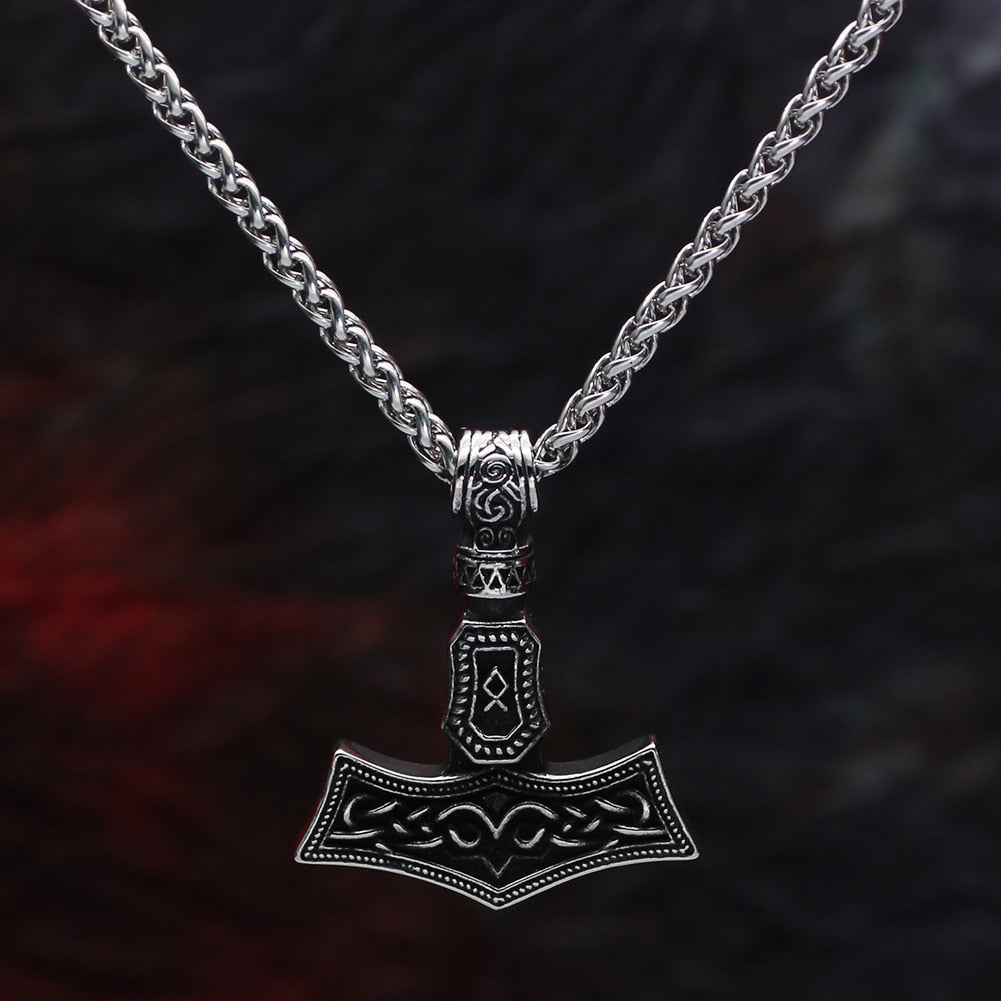
Odin's Eyes - Yggdrasil & Raven Embossed Nordic Amulet
This creates an important distinction between Ymir and humanity. Ymir provides the material substance of the world in which humans live, but he is not their direct creator. Humanity emerges later through the actions of the gods.
The sequence also demonstrates the movement from primordial chaos towards an organised cosmos: first Ymir, then the death of Ymir and formation of the world, followed by the creation of mankind.
Ymir and the Name Aurgelmir
The relationship between Ymir and Aurgelmir deserves particular attention because the two names appear in different poetic traditions.
In Gylfaginning, Snorri explicitly states that Ymir is called Aurgelmir by the frost-giants. Vafþrúðnismál, meanwhile, uses Aurgelmir when discussing the primordial giant and his descendants. This strongly connects the two figures, although the terminology of the surviving mythological poems is not always completely consistent.
The names Þrúðgelmir and Bergelmir then appear within the same genealogy. Bergelmir is described as the son of Þrúðgelmir and grandson of Aurgelmir, making him a descendant of the primordial being who survives the flood of Ymir's blood.
This genealogy demonstrates that the mythology regarded the jötnar as an ancient lineage extending back to the very beginning of existence.
The Name Ymir and Indo-European Parallels
Ymir's name has attracted considerable attention from scholars because of its possible relationship to Yama, the primordial figure of Vedic tradition, and Yima, his Iranian counterpart.
The proposed connection goes back to comparative Indo-European mythology and is based partly on similarities between the names and partly on broader parallels involving primordial figures and the ordering of the world. One influential line of interpretation connects Ymir and Yama/Yima through a reconstructed Indo-European root associated with the idea of a twin or paired primordial figure.
The comparison is particularly interesting because Indo-Iranian traditions contain their own ancient myths involving primordial figures and the formation or ordering of the human world. However, the exact historical relationship between these traditions cannot be demonstrated from the surviving sources alone.
What can be said is that Ymir belongs to a very old mythological vocabulary whose possible Indo-European connections have been studied for more than a century. The comparison with Yama and Yima remains an important part of scholarship on the figure, but it should not be presented as though a complete prehistoric version of the story has been recovered.
Ymir and the Germanic Creation Tradition
Ymir's importance extends beyond the later Icelandic literary tradition because the myth preserves a distinctive conception of how the Germanic cosmos was understood.
The gods do not create the world by simply speaking it into existence. They encounter an older and more chaotic reality, kill a primordial being and reshape his remains into the ordered universe. Creation is therefore simultaneously an act of destruction and construction.

Ymir is attacked by the brothers Odin, Vili, and Vé by Lorenz Frølich.
This idea also explains why the jötnar occupy such an important place in Norse mythology. They are not merely monsters opposing the gods. Their lineage reaches further back than the ordered divine world itself. The gods establish the cosmos, but the jötnar descend from the primordial existence that preceded it.
Ymir therefore stands at the boundary between chaos and order. He belongs to the world before the gods' established hierarchy, yet his body becomes the physical foundation upon which that hierarchy is built.
The Legacy of Ymir
Ymir is one of the most important figures in Norse cosmology because his story explains the physical structure of the world itself. From the meeting of frost and fire he emerges as the primordial jötunn, nourished by Auðhumla and becoming the ancestor of the ancient giant race. Óðinn, Vili and Vé eventually kill him, transforming his flesh, blood, bones, skull and other remains into the earth, sea, mountains, heavens and other features of the cosmos.
His story also preserves one of the clearest examples of the Norse conception of creation as transformation. The world is not made from nothing; it is formed from something older, with the body of the first giant becoming the material from which gods, humans and the ordered cosmos can exist.
The surviving traditions are recorded in medieval Icelandic manuscripts, principally the Poetic Edda and Snorri Sturluson's Prose Edda, and therefore cannot provide a verbatim record of prehistoric Germanic belief. Nevertheless, the agreement between several independent poetic passages shows that the essential idea of Ymir as a primordial being whose death produced the world was already part of the mythological tradition preserved in medieval Scandinavia.
Ymir consequently stands at the beginning of the Norse mythological universe. Before Óðinn's rule, before Miðgarðr and Ásgarðr, and before mankind, there was the primordial giant whose death gave the world its physical form.

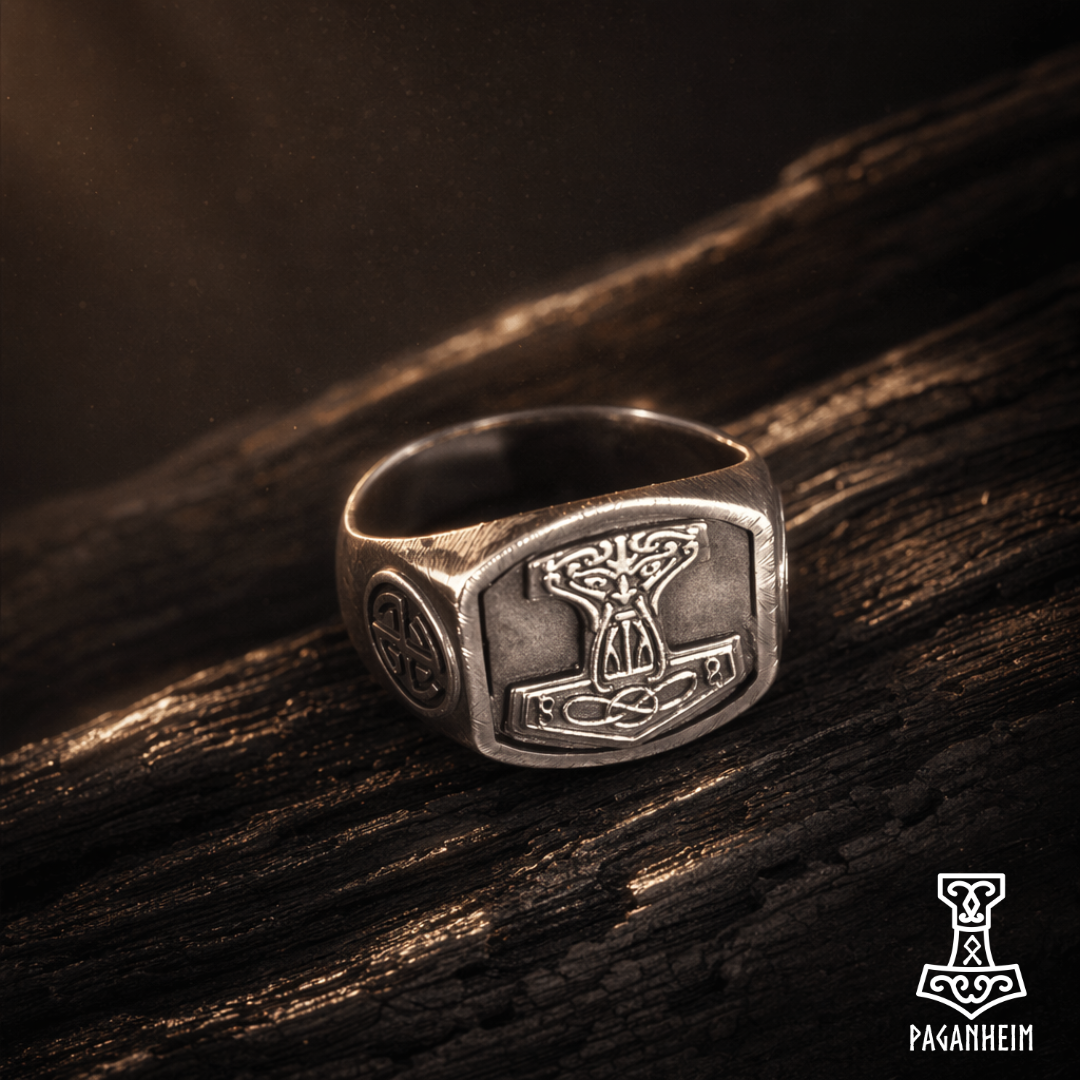
Triquetra Algiz Mjölnir - Rune Engraved Odin Thor's Hammer Viking Amulet
Frequently Asked Questions (FAQs)
Who was Ymir?
Ymir was the primordial jötunn of Norse mythology and the ancestor of the giant race. His body was used by Óðinn, Vili and Vé to create the world.
How was Ymir created?
According to Gylfaginning, Ymir emerged when heat from Múspellsheimr met the ice and frost of Niflheimr within Ginnungagap. Vafþrúðnismál similarly connects his origin with venom from the Élivágar.
Who killed Ymir?
Óðinn, Vili and Vé killed Ymir. They subsequently used his body to construct the cosmos.
What was made from Ymir's body?
His flesh became the earth, his blood the sea, his bones the mountains, his hair the trees, his skull the sky and his brain the clouds. His eyebrows were used to form Miðgarðr.
Is Ymir the same as Aurgelmir?
In Snorri's Gylfaginning, Ymir is explicitly identified as Aurgelmir, the name used for him by the frost-giants. Vafþrúðnismál also uses Aurgelmir for the primordial giant and ancestor of Bergelmir.
References
Poetic Edda, particularly Völuspá, Vafþrúðnismál and Grímnismál.
Snorri Sturluson. Prose Edda, Gylfaginning.
Lindow, John. Norse Mythology: A Guide to Gods, Heroes, Rituals, and Beliefs. Oxford University Press, 2001.
Orchard, Andy. Dictionary of Norse Myth and Legend. Cassell, 1997.
Simek, Rudolf. Dictionary of Northern Mythology. D. S. Brewer, 1993.
Encyclopaedia Iranica. “Jamšid i. Myth of Jamšid.”



Leave a comment
This site is protected by hCaptcha and the hCaptcha Privacy Policy and Terms of Service apply.