
Who is Fenrir in Norse Myth? Binding and Role at Ragnarök
Fenrir, also called Fenrisúlfr or the Fenriswolf, ranks among the most prominent monstrous figures in Norse mythology. This enormous wolf appears as the offspring of Loki and the giantess Angrboða, and his story revolves around prophecies of destruction, attempts by the gods to restrain him, and his eventual role in Ragnarök, the end of the current world order.
The main accounts come from the Poetic Edda, a collection of anonymous Old Norse poems compiled in Iceland around 1270 CE but drawing on older oral material, and the Prose Edda, written by Snorri Sturluson circa 1220 CE. Fenrir receives passing mentions in runic inscriptions and skaldic poetry, though no detailed pre-13th-century narrative survives outside these texts. The name Fenrir likely derives from Old Norse “fen-dweller” or “marsh-dweller,” tying the creature to marginal, watery places associated with danger. Scholarly discussion focuses on whether Fenrir represents chaos, natural forces, or Indo-European wolf archetypes, but evidence for any dedicated cult or worship remains absent.
Origins and Family
Fenrir is the son of Loki, the shape-shifting trickster god, and Angrboða, a giantess from Jötunheimr. The Prose Edda (Gylfaginning, chapter 34) lists his siblings as Jörmungandr, the serpent that encircles Midgard, and Hel, ruler of the realm of the dead. The gods initially allow Fenrir to be raised in Ásgarðr, but his rapid growth and ferocious behaviour arouse alarm, especially after prophecies warn of harm from Loki’s children.

The Æsir decide against killing him in their sanctuary and instead attempt to bind him. Two early chains, Læding and Dromi, prove insufficient; Fenrir snaps each one easily. The gods then commission the dwarves to forge Gleipnir, a slender but unbreakable fetter made from six impossible elements: the sound of a cat’s footsteps, a woman’s beard, mountain roots, bear’s sinews, fish’s breath, and bird’s spittle. To convince Fenrir to accept the bond, the gods offer a pledge of good faith; Týr places his right hand in the wolf’s mouth as security. When Fenrir realises the trick, he bites off Týr’s hand, leaving the god one-handed.
The Binding of Fenrir
The binding takes place on the island of Lyngvi. Gleipnir is fastened to the stone Gjöll, which in turn is anchored by the rock Thviti. A sword is wedged between Fenrir’s jaws to hold them open, and his saliva flows to form the river Ván (“Expectation”). The Prose Edda presents the episode as a necessary but reluctant act: the gods act out of foreknowledge rather than malice, yet their deception sows the seeds of their own destruction.
The Poetic Edda refers to the binding in Vafþrúðnismál (stanza 46), where Odin questions the giant Vafþrúðnir about Fenrir’s fate and confirms the wolf’s role in Odin’s death.
Role in Ragnarök
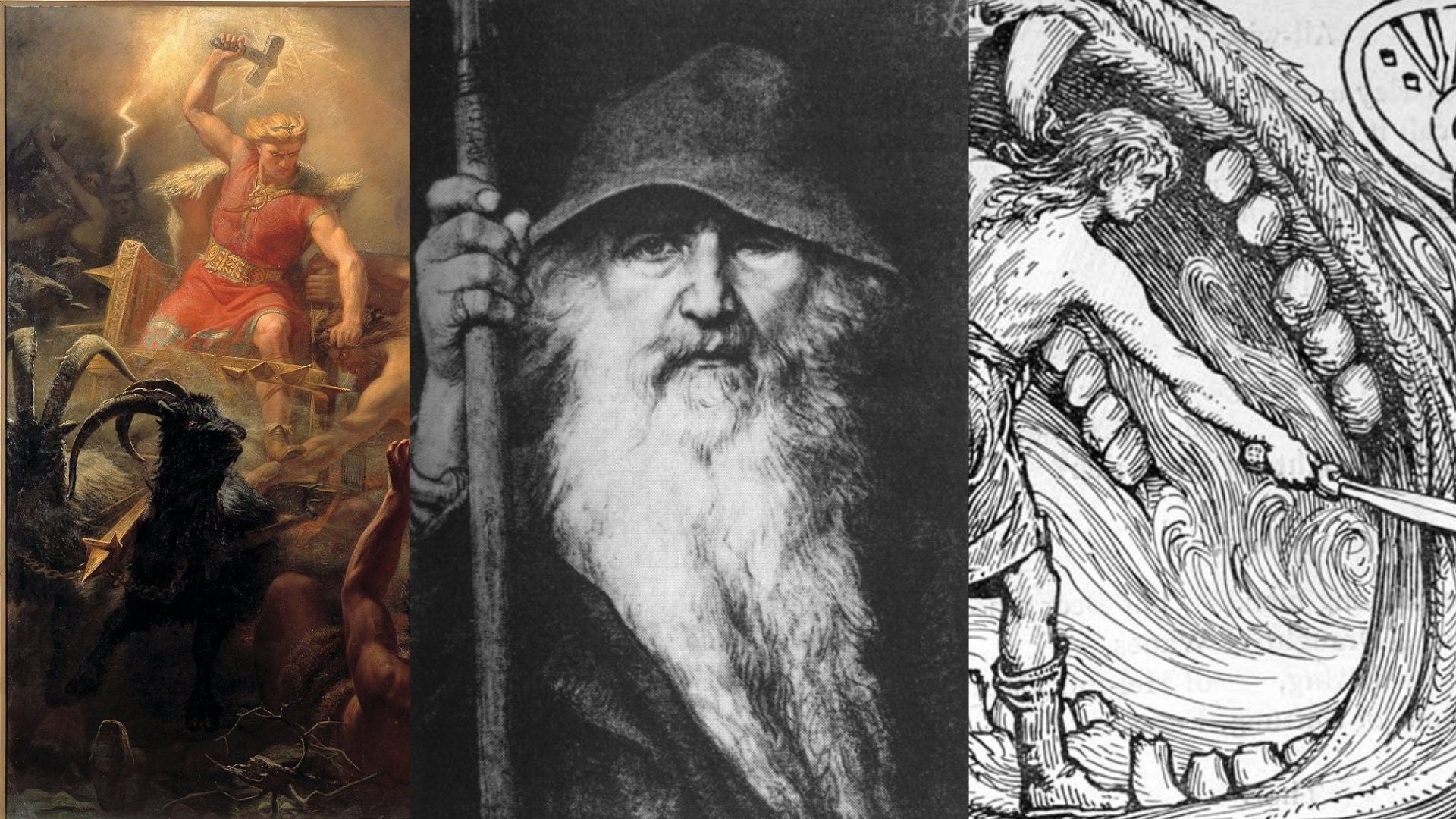
Fenrir’s full significance emerges during Ragnarök. The Poetic Edda (Völuspá) and Prose Edda (Gylfaginning, chapters 51–53) describe him breaking loose as the world collapses. He advances with jaws gaping—one touching the earth, the other the sky—swallowing everything before him, his eyes and nostrils ablaze.

At the battlefield Vígríðr, Fenrir confronts Odin and swallows the Allfather. Odin's son Víðarr steps forward, places one foot on Fenrir’s lower jaw (wearing a shoe made from leather scraps discarded by humans), and tears the wolf’s mouth apart, killing him.
Some sources attribute the devouring of the sun or moon to Fenrir’s offspring Sköll and Hati, but the Eddas consistently assign Odin’s death to Fenrir himself.
Depictions and Symbolism
Fenrir appears on several Viking Age runestones, often shown bound or in combat with human or divine figures, indicating the motif’s circulation in the 9th–11th centuries CE. The Prose Edda frames him as a symbol of inevitable fate: his growth and binding reflect the gods’ limited power over prophecy.
Scholars offer various readings. Rudolf Simek (1993) connects the name to marshy border zones, suggesting Fenrir embodies liminal chaos. John Lindow (2001) sees him as representing suppressed destructive energy that the gods temporarily control. Georges Dumézil’s comparative framework places Fenrir within Indo-European wolf-warrior traditions, highlighting raw ferocity. Some argue Snorri’s Christian background shapes the portrayal of Fenrir as an evil force akin to biblical chaos monsters.
Contrasting Accounts and Variants
Saxo Grammaticus’ Gesta Danorum contains no equivalent Fenrir narrative, as it euhemerises the gods into historical Danish kings and omits cosmic monsters. Other wolves in Norse poetry, such as Garmr in Völuspá, may represent related or overlapping figures, though most scholars treat Fenrir as distinct.
The Poetic Edda preserves scattered kennings and allusions, while Snorri provides the fullest and most coherent version, likely drawing on multiple oral traditions to create a unified account.
Uncertainties and Limited Information
Evidence before the 13th-century Eddas is fragmentary. Runestones show wolf imagery, but none name Fenrir explicitly. No surviving place-names or cult sites link directly to him, suggesting he functioned primarily as a narrative figure rather than an object of worship. Reliance on Icelandic texts raises the possibility of regional variation in mainland Scandinavia. Christian authors like Snorri may have emphasised Fenrir’s malevolence to align with themes of divine judgment.
Fenrir’s myth illustrates the Norse view of fate as inescapable: a creature born of deception, restrained through further deception, and destined to destroy the chief god at Ragnarök. From his upbringing in Ásgarðr to his fatal encounter with Odin on Vígríðr, Fenrir embodies the limits of divine control over chaos. His death at Víðarr’s hands signals the transition to a new world order. The story, preserved in the Eddas and echoed on runestones, reflects Viking Age concerns with prophecy, betrayal, and the boundaries between order and destruction, contributing to a broader Germanic tradition of wolf figures as agents of upheaval.
Frequently Asked Questions (FAQs)
Who are Fenrir's parents?
Fenrir is the son of Loki and the giantess Angrboða, with siblings Jörmungandr and Hel.
How was Fenrir bound?
After breaking two chains, the gods used the magical fetter Gleipnir; Týr placed his hand in Fenrir's mouth as pledge, and Fenrir bit it off upon realizing the deception.
What happens to Fenrir at Ragnarök?
Fenrir breaks free, kills Odin by swallowing him, and is then slain by Odin's son Víðarr, who tears his jaws apart.
What does Fenrir's name mean?
Fenrir means "fen-dweller" or "marsh-dweller" in Old Norse, associating him with liminal, dangerous wetlands.
Does Fenrir appear in Saxo Grammaticus?
No direct account exists in Gesta Danorum, which euhemerizes myths and focuses on human kings rather than cosmic wolves.
References
Snorri Sturluson. Prose Edda (Gylfaginning). Translated by Anthony Faulkes. Everyman, 1987.
Anonymous. Poetic Edda. Translated by Carolyne Larrington. Oxford University Press, 2014.
Simek, Rudolf. Dictionary of Northern Mythology. Translated by Angela Hall. D.S. Brewer, 1993.
Lindow, John. Norse Mythology: A Guide to the Gods, Heroes, Rituals, and Beliefs. Oxford University Press, 2001.
Orchard, Andy. Cassell's Dictionary of Norse Myth and Legend. Cassell, 1997.
Dumézil, Georges. Gods of the Ancient Northmen. University of California Press, 1973.
Price, Neil. The Viking Way: Magic and Mind in Late Iron Age Scandinavia. Oxbow Books, 2019.



Leave a comment
This site is protected by hCaptcha and the hCaptcha Privacy Policy and Terms of Service apply.