
Article: Veð in Old Norse Texts: What Odin’s Eye Truly Represents
Veð in Old Norse Texts: What Odin’s Eye Truly Represents
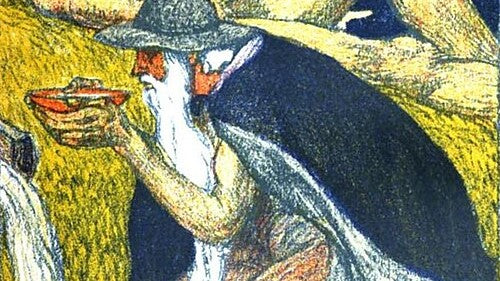
The story of Odin giving his eye to Mímir in exchange for wisdom is one of the most widely cited episodes in Norse mythology. Yet the surviving textual evidence presents this act in language that is often simplified or misunderstood in modern retellings. At the centre of this issue is the Old Norse word veð, a term that carries implications far beyond the idea of a simple sacrifice.
The primary sources for this myth are the Poetic Edda and the Prose Edda, both recorded in Iceland during the 13th century. These texts preserve earlier oral traditions, though they were written down in a Christian context, which may have shaped their presentation.
The Poetic Edda
The Poetic Edda, preserved in the Codex Regius manuscript, contains the most direct reference to Odin’s act in the poem Völuspá. The relevant stanza is brief and does not elaborate on the mechanics of the exchange. It states that Odin placed his eye as a veð in Mímir’s well, leaving the term itself to carry the weight of interpretation.
This brevity is significant. The poem assumes familiarity with the concept, suggesting that its audience understood the implications of veð without the need for explanation.
The Prose Edda
The Prose Edda, written by Snorri Sturluson, expands upon the poetic tradition. Snorri describes Odin drinking from Mímir’s well and leaving his eye as payment. However, even in this more detailed account, the deeper meaning of veð is not explicitly unpacked. Instead, it is presented in a way that aligns with the broader narrative of sacrifice for knowledge.
The Old Norse Terminology of the Myth
The Word “Veð” in Context
The Old Norse term veð is central to understanding this episode. In legal and economic contexts, veð refers to a pledge, collateral, or security placed against an agreement. It is not simply a gift or offering; rather, it implies a binding exchange with obligations attached.
When applied to Odin’s act, this term reframes the event. Odin does not merely sacrifice his eye in a one-sided act of loss. Instead, he places it as a form of collateral—something of value given to secure access to knowledge. The implication is that this is not a symbolic gesture alone, but a structured exchange governed by the same conceptual frameworks that underpinned legal agreements in medieval Scandinavian society.
Translation Challenges
Modern translations often render veð as “sacrifice,” “pledge,” or “payment.” Each of these captures only part of the word’s meaning. Translating it as “sacrifice” emphasizes loss and devotion, but risks obscuring the reciprocal nature of the act. “Pledge” conveys the legal nuance but may understate the mythological gravity. “Payment” suggests a transaction but lacks the sense of binding obligation.
Odin’s Quest for Wisdom in Norse Cosmology
Mímir and the Well
Mímir is associated with wisdom and memory, and his well lies beneath one of the roots of Yggdrasil, the world tree. The well itself is described as a source of profound knowledge, possibly linked to primordial understanding and cosmic order.
Odin’s desire to drink from the well reflects his role as a god of wisdom, but also as a figure willing to undergo transformation in pursuit of knowledge. His actions are not unique within Norse mythology, where knowledge is often acquired through hardship, loss, or binding agreements.
Sacrifice as Exchange
In Norse cultural contexts, acts of offering are frequently reciprocal. Gifts, whether to gods or between individuals, establish relationships and obligations. This principle is evident in both mythological narratives and historical sources describing social and legal practices.
The use of veð in this myth aligns with this framework. Odin’s eye is not destroyed or discarded; it is placed as part of an exchange that grants him access to wisdom. This reflects a worldview in which value is negotiated and secured, rather than simply relinquished.
Interpretations of Veð in Scholarship
Legal and Economic Connotations
Scholars examining Old Norse law have noted that veð appears frequently in legal texts, where it refers to property pledged as security in disputes or agreements. This suggests that the audience of the Eddic poems would have understood the term within a familiar legal framework.
In this light, Odin’s eye can be seen as collateral—something of immense value used to guarantee the fulfilment of an agreement. This interpretation situates the myth within the broader cultural context of medieval Scandinavia, where legal concepts were deeply embedded in everyday life.
Ritual and Mythological Significance
Other scholars argue that the meaning of veð in this context cannot be reduced to its legal definition alone. While the term retains its economic connotations, its use in a mythological narrative adds a symbolic dimension.
Odin’s act represents not only a transaction but a transformation. By placing his eye as veð, he binds himself to the pursuit of knowledge, reinforcing his identity as a god associated with wisdom, sacrifice, and self-alteration.
Limits of the Sources
The surviving sources provide only limited detail about how this term was understood in a mythological context. The brevity of Völuspá and the interpretive nature of Snorri’s account leave significant room for scholarly debate.
Additionally, both texts were written down in a Christian cultural environment, which may have influenced how earlier pagan concepts were recorded. As a result, it is difficult to determine how pre-Christian audiences interpreted the term veð in this specific narrative.
The story of Odin placing his eye in Mímir’s well is often presented as a simple act of sacrifice, but the original Old Norse terminology suggests a more complex reality. The word veð introduces the idea of a binding exchange, rooted in legal and cultural concepts of pledge and obligation.
Rather than depicting a one-sided loss, the language of the sources points to a structured transaction in which Odin secures access to wisdom through the placement of something of immense value. While the surviving texts do not fully explain the term, its presence invites a more nuanced interpretation of the myth—one that reflects the intellectual and cultural frameworks of medieval Scandinavia.
Frequently Asked Questions (FAQs)
What does the Old Norse word “veð” mean?
It generally refers to a pledge, collateral, or security in an agreement, though it can also imply an offering within a structured exchange.
Where is Odin’s sacrifice described?
It appears in Völuspá in the Poetic Edda and is expanded upon in the Prose Edda.
Did Odin permanently lose his eye?
The sources indicate that the eye remains in Mímir’s well, though they do not clearly state whether the exchange is permanent or reversible.
Why is “veð” important in this myth?
It suggests that Odin’s act was not merely a sacrifice but a binding exchange with legal and cultural implications.
Is there scholarly agreement on the meaning of “veð”?
No, interpretations vary, particularly regarding whether its primary significance is legal, ritual, or symbolic.
References
Larrington, Carolyne (trans.). The Poetic Edda. Oxford University Press.
Faulkes, Anthony (trans.). Edda. Everyman.
Byock, Jesse. Norse Mythology: A Guide to Gods, Heroes, Rituals, and Beliefs.
Simek, Rudolf. Dictionary of Northern Mythology.
Miller, William Ian. Bloodtaking and Peacemaking: Feud, Law, and Society in Saga Iceland.







Leave a comment
This site is protected by hCaptcha and the hCaptcha Privacy Policy and Terms of Service apply.