
Fenrir's Offspring: Tracing Sköll and Hati Through Ancient Sources
Sköll and Hati emerge in Norse mythology as colossal wolves eternally chasing the sun and moon across the sky, embodying the inexorable approach of cosmic destruction. These figures appear primarily in texts from the 13th century CE, though they likely stem from earlier oral traditions dating back to the Viking Age (c. 793–1066 CE). Their pursuit culminates in Ragnarök, the apocalyptic end of the world, where they devour the celestial bodies, plunging the cosmos into darkness.
The key primary sources are the Poetic Edda, a collection of anonymous Old Norse poems compiled in Iceland around 1270 CE, and the Prose Edda, authored by Icelandic scholar Snorri Sturluson in 1220 CE. The Poetic Edda preserves older verse forms, while Snorri's work systematizes myths for a Christian audience. No sagas directly feature Sköll and Hati as central characters; their mentions remain confined to poetic allusions and explanatory prose. Etymologically, Sköll derives from Old Norse "skǫll," meaning "mockery" or "treachery," and Hati from "hati," signifying "hatred" or "enemy." Depictions portray them as relentless predators, offspring of the bound wolf Fenrir, driving the sun and moon to hasten their paths out of fear.
Depictions in the Poetic Edda
The Poetic Edda provides the earliest surviving references to Sköll and Hati, embedding them within Odin's cosmological revelations. In Grímnismál, stanza 39, Odin, disguised as Grímnir, describes the wolves' pursuits while revealing secrets to King Geirröðr. The stanza states that Sköll follows the "shining priest" into the desolate forest, while Hati, son of Hróðvitnir (a kenning for Fenrir), chases the "bright bride of the sky." Here, the masculine noun "goði" (priest) aligns with Máni, the male moon god, and the feminine "brúðr" (bride) with Sól, the female sun goddess. This suggests Sköll pursues the moon and Hati the sun, framing their chase as a gendered cosmic drama.

The chariot of the sun being pursued by wolves by W.G. Collingwood
Völuspá, the prophetic poem recounting creation and destruction, connects them indirectly to Ragnarök. Stanza 41 foretells a wolf swallowing the sun, an event scholars link to Sköll or Hati, amid omens like the world's tree trembling and giants marching. These references emphasize their role as harbingers of doom, with limited elaboration on their appearance or motivations beyond pursuit. The Poetic Edda's oral roots, preserved in manuscripts like the Codex Regius (c. 1270 CE), indicate these wolves symbolized inevitable entropy in pre-Christian Norse worldview.
Depictions in the Prose Edda
Snorri Sturluson's Prose Edda expands on Eddic verses, offering narrative clarity in Gylfaginning, where the deceived King Gylfi questions divine figures about the cosmos. Snorri explains that two wolves torment the sun and moon: Sköll pursues Sól, causing her fear, while Hati Hróðvitnisson chases Máni. This assignment reverses the Poetic Edda's implications, with Sköll targeting the sun and Hati the moon. Snorri adds that both will succeed during Ragnarök, devouring their prey.
This contrast arises from Snorri's interpretive choices; as a Christian writing in post-conversion Iceland, he may have adapted verses to fit a coherent euhemeristic framework, treating gods as historical figures. Gylfaginning also notes the wolves' origin in the Iron Wood, a giant-inhabited realm east of Midgard, reinforcing their chaotic Jötunn heritage. Snorri's account, drawn from now-lost sources and his own synthesis, provides the most detailed medieval depiction, though it prioritizes explanation over poetic ambiguity.
Parentage and Kinship
Sköll and Hati descend from Fenrir, the monstrous wolf bound by the gods until Ragnarök. Both Eddas identify Hati as Hróðvitnisson, "son of the famous wolf," a kenning for Fenrir. Snorri extends this to Sköll, implying shared paternity. Their mother, an unnamed giantess in the Iron Wood, aligns with Fenrir's own Jötunn lineage through Loki and Angrboða. This kinship underscores blood ties in Norse myths, where familial bonds propel cosmic conflicts—Fenrir's offspring avenge his imprisonment by targeting divine order.
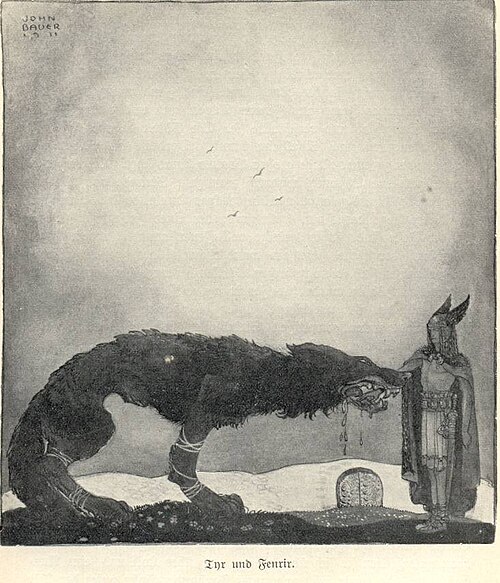
Tyr and Fenrir by John Bauer
The Iron Wood, mentioned in Völuspá as a breeding ground for wolves, symbolizes untamed wilderness opposing Ásgarðr's structure. Limited details on their birth leave uncertainties; Snorri describes the giantess raising Fenrir's progeny to devour worlds, but no saga elaborates family dynamics. This heritage positions Sköll and Hati within a lineage of destructive forces, their pursuits inherited from Fenrir's enmity toward the gods.
Role in Ragnarök
During Ragnarök, Sköll and Hati achieve their chases, consuming the sun and moon as foretold in Völuspá and Gylfaginning. Völuspá stanza 41 depicts "the sun turns black, earth sinks in the sea," linking the wolves' triumph to universal collapse. Snorri elaborates that one wolf swallows the sun, the other the moon, extinguishing stars and shaking the earth. This act precedes battles like Odin's death by Fenrir, emphasizing the wolves' collective role in eschatology.
Their success signals the breakdown of cosmic balance, established when gods assigned Sól and Máni to their chariots. Post-Ragnarök, a new sun emerges—Völuspá stanza 59 mentions a daughter of Sól illuminating the renewed world—implying the wolves' victory as temporary within cyclic renewal. This context places them amid giants, serpents, and gods clashing, their devouring act a pivotal omen in the sequence of doom.
Symbolic Interpretations in Medieval Sources
Medieval sources, influenced by Christianity, often allegorize Sköll and Hati as moral forces. Snorri, a Christian chieftain, frames them as embodiments of chaos opposing divine order, possibly echoing biblical apocalyptic beasts. In Gylfaginning, their hatred drives the sun's haste, symbolizing fleeting time and inevitable judgment, akin to Christian eschatology.
Icelandic scribes, compiling Eddas post-1000 CE conversion, may have infused pre-Christian motifs with moral undertones. Folk etymologies in medieval texts link Sköll to "repulsion" and Hati to "hatred," portraying them as vices eroding creation. This interpretation attributes no direct source but aligns with Snorri's didactic style, using myths to preserve lore while subtly Christianizing it.
Modern Scholarly Interpretations
Contemporary academics offer varied analyses grounded in linguistics, astronomy, and culture. John Lindow, in Norse Mythology (2001), argues the gender mismatch between Poetic and Prose Eddas stems from oral variants, with Snorri possibly standardizing for narrative flow. Rudolf Simek, in Dictionary of Northern Mythology (1993), suggests they represent solar and lunar eclipses, where wolves "devour" light, a motif in Indo-European folklore.

A statue of the god Sunna (Sól) (Photo: Midnightblueowl Public Domain)
Astronomical views, per Georges Dumézil's comparative mythology, link them to "sun dogs" (parhelia), optical phenomena interpreted as pursuing wolves in Scandinavian lore. Psychological interpretations, like Carl Jung's archetypes, see them as shadows pursuing consciousness, though sparingly applied to Norse myths. Debates persist on pursuits: Daniel McCoy (2016) favors Poetic Edda's assignment, viewing Snorri's as error, while others attribute it to manuscript differences.
Contrasting Historical Views
Post-medieval Scandinavian folklore preserves echoes, such as Icelandic sayings about "wolves chasing the sun" during eclipses. Comparative mythology reveals parallels: in Baltic lore, wolves pursue celestial bodies; Greek myths feature similar devourers. Georges Dumézil (1948) contrasts them with orderly Indo-European sky gods, highlighting Norse emphasis on chaos.
Victorian scholars like Jacob Grimm (1835) viewed them as natural metaphors for day-night cycles, differing from modern eclipse theories. These views attribute to textual evolution, with no unified pre-Christian interpretation surviving.
Uncertainties and Limited Evidence
Historical gaps abound: no pre-13th-century mentions exist, relying on oral transmission potentially altered. Scholarly debates, like Simek's on etymology, question if names derive from pursuits or vice versa. Kinship details remain vague; the giantess mother's identity is unspecified, leading to speculation without basis. Contrasts between Eddas highlight uncertainties in source fidelity, possibly from regional variants or Snorri's edits.
Sköll and Hati encapsulate Norse mythology's themes of pursuit, kinship-driven vengeance, and cyclic destruction, drawn from Poetic and Prose Edda depictions of their chases and Ragnarök roles. As Fenrir's sons, they embody inherited chaos dismantling order, with medieval sources allegorizing them morally and modern scholars interpreting as astronomical or linguistic phenomena. Their narrative underscores the Norse cosmos's fragility, influencing broader Indo-European eschatology and enduring in cultural motifs of inevitable eclipse.
ᚸ
Frequently Asked Questions (FAQs)
Who are Sköll and Hati's parents?
They are sons of Fenrir and an unnamed giantess from the Iron Wood, as described in the Prose Edda.
Which wolf chases which celestial body?
The Poetic Edda suggests Sköll chases the moon and Hati the sun; the Prose Edda reverses this, with Sköll pursuing the sun and Hati the moon.
What happens to Sköll and Hati during Ragnarök?
They catch and devour the sun and moon, causing cosmic darkness, as foretold in Völuspá and Gylfaginning.
Are there sagas featuring Sköll and Hati?
No; they appear only in Eddic poetry and prose, not in heroic sagas like the Volsunga Saga.
What do their names mean?
Sköll means "treachery" or "mockery," and Hati means "hatred" or "enemy," reflecting their destructive roles.
References
Anonymous. Poetic Edda. Codex Regius manuscript, c. 1270 CE. Translated by Henry
Adams Bellows. American-Scandinavian Foundation, 1936.
Snorri Sturluson. Prose Edda (Gylfaginning). c. 1220 CE. Translated by Anthony Faulkes. Everyman, 1987.
Lindow, John. Norse Mythology: A Guide to the Gods, Heroes, Rituals, and Beliefs. Oxford University Press, 2001.
Simek, Rudolf. Dictionary of Northern Mythology. Translated by Angela Hall. D.S. Brewer, 1993.
McCoy, Daniel. The Viking Spirit: An Introduction to Norse Mythology and Religion. CreateSpace Independent Publishing, 2016.
Dumézil, Georges. Gods of the Ancient Northmen. University of California Press, 1973.
Grimm, Jacob. Teutonic Mythology. Translated by James Steven Stallybrass. George Bell & Sons, 1883.




Leave a comment
This site is protected by hCaptcha and the hCaptcha Privacy Policy and Terms of Service apply.