
Beowulf: Epic Narrative of Medieval Germanic Heroism
Beowulf is the longest surviving epic poem in Old English and one of the most important literary works produced in early medieval England. Its setting, however, lies largely across the North Sea in the Germanic world of Denmark and southern Scandinavia. The poem follows Beowulf, a warrior of the Geatas, or Geats, through three great conflicts: his battles with the monster Grendel and Grendel's mother, and, many years later, his final struggle against a dragon guarding an ancient hoard. The surviving poem contains more than 3,000 lines and combines heroic storytelling with reflections on kingship, loyalty, warfare, fame, mortality and the passing of an older world.
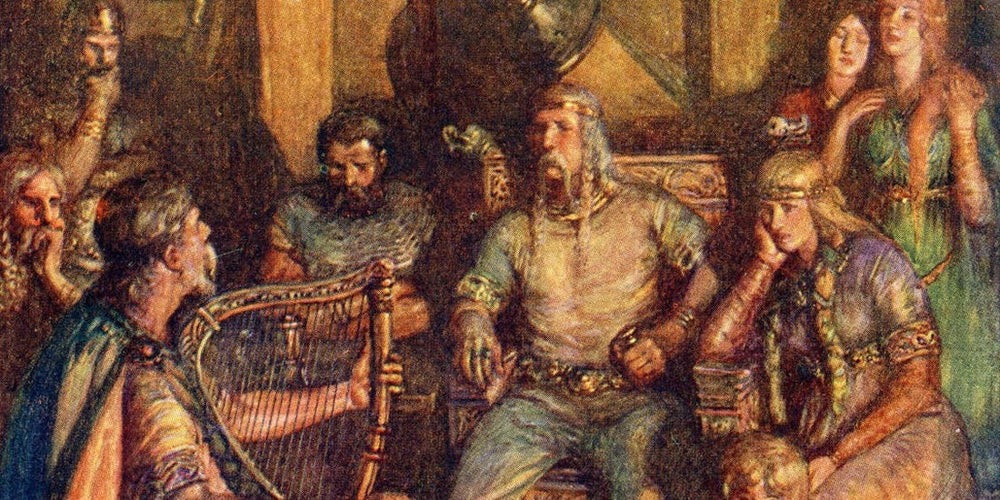
The events described belong to a world of kings, war bands, gift-giving, blood-feuds and long-distance alliances. At its centre is the hall, where a lord rewarded his retainers with weapons, armour, treasure and hospitality. The great hall of the Danish king Hroðgar, Heorot, is therefore much more than a setting for the opening of the poem. It represents the political and social order upon which the heroic society depends. When Grendel attacks it, he is not merely killing warriors; he is assaulting the community gathered around its king.
Although Beowulf is an Old English poem preserved in an English manuscript, its characters are overwhelmingly Scandinavian. The Danes, Geats, Swedes and Frisians belong to the northern European world of the Migration Period, a world closely connected to the continental homeland of the Angles, from whom the English derived their name and people. The poem's setting in Scandinavia therefore reflects more than a literary choice: it looks back towards the Germanic world from which the Angles themselves had migrated to Britain. Several of the kings and conflicts mentioned in the poem also have striking parallels in other early medieval sources, making this mixture of legend, historical memory and ancestral tradition one of the reasons Beowulf remains so valuable to historians as well as literary scholars.
Beowulf and the Geats
Beowulf himself is introduced as a warrior from Geatland. The Geatas are generally identified with the Götar of southern Sweden, although the precise geography of the poem's Geatish kingdom remains debated. He is the son of Ecgþeow and nephew of King Hygelac, placing him within the ruling family of the Geats.

His reputation is established before he ever reaches Denmark. Beowulf is presented as exceptionally strong and eager to earn honour through deeds. Yet the poem's conception of heroism is not simply physical strength. A successful warrior must be courageous, loyal to his lord, generous to his followers and conscious of the obligations created by kinship and gift-giving. Fame matters because a man's reputation is one of the few things capable of surviving his death.
This concern with reputation runs through the entire poem. Beowulf repeatedly measures himself against other warriors, accepts challenges to his honour and recounts earlier achievements when circumstances require it. The heroic ideal is therefore inseparable from memory. A warrior acts so that his deeds will be remembered after his life has ended.
Heorot and the Coming of Grendel
The story begins not with Beowulf but with the Danish royal house. Hroðgar, king of the Danes, has achieved great prosperity and constructs Heorot, an enormous hall where his warriors gather for feasting, drinking and the distribution of treasure. The hall becomes a symbol of Danish power, but its prosperity attracts a terrible enemy.
Grendel, described as a monstrous descendant of Cain, is tormented by the sound of celebration within Heorot. For twelve years he repeatedly enters the hall at night, killing Hroðgar's warriors and leaving the Danes unable to defend their king's great centre of power. The attacks are devastating not only because of the deaths themselves but because Hroðgar is unable to protect those who have placed themselves under his authority.
News of the Danish king's suffering eventually reaches Beowulf in Geatland. He decides to cross the sea with a band of warriors and offer Hroðgar his assistance. The voyage is important because it establishes one of the central characteristics of the heroic world of Beowulf: political relationships extend across the sea, and a warrior's reputation can carry him far beyond his homeland.
Beowulf arrives in Denmark determined to face Grendel without a sword. He intends to meet the monster on equal terms, relying on his extraordinary physical strength. When Grendel enters Heorot that night, Beowulf seizes him and a violent struggle follows. The warrior tears off Grendel's arm, forcing the wounded creature to flee to his lair, where he dies.
The victory restores Heorot to Hroðgar and establishes Beowulf as a hero whose reputation now extends beyond Geatland. Yet the poem immediately makes clear that the conflict is not finished.
Grendel's Mother and the Underwater Hall
Grendel's death brings a second attack. His mother comes to Heorot seeking vengeance for her son, killing one of Hroðgar's closest retainers before escaping with Grendel's severed arm.
The Danes lead Beowulf to a mysterious mere where Grendel's mother is believed to live. The landscape is deliberately ominous: dark waters, strange creatures and an isolated wilderness separate the monster's dwelling from the ordered world of Heorot. Beowulf dives into the water and reaches an underwater hall where he confronts Grendel's mother.
Unlike his first battle, Beowulf initially struggles to defeat his opponent with ordinary weapons. His sword fails him, but he discovers a gigantic ancient sword within the hall and uses it to kill her. He also finds Grendel's body and cuts off its head, bringing it back to Hroðgar as proof of his victory.
The episode deepens one of the poem's most important themes. Violence in Beowulf is rarely isolated. One killing produces another, and vengeance creates new obligations between families and communities. The heroic society depends upon loyalty and retaliation, but those same principles can perpetuate cycles of violence.
Hroðgar recognises the danger in this system. In one of the poem's most important speeches, he warns Beowulf against pride and the assumption that earthly strength will last forever. The warning becomes increasingly significant as the poem moves forward.
Beowulf Returns to Geatland
After defeating Grendel and his mother, Beowulf returns to Geatland and reports his adventures to Hygelac. The poem then expands beyond the immediate story, recounting the complicated relationships between the Geats, Swedes, Franks and other peoples of northern Europe.

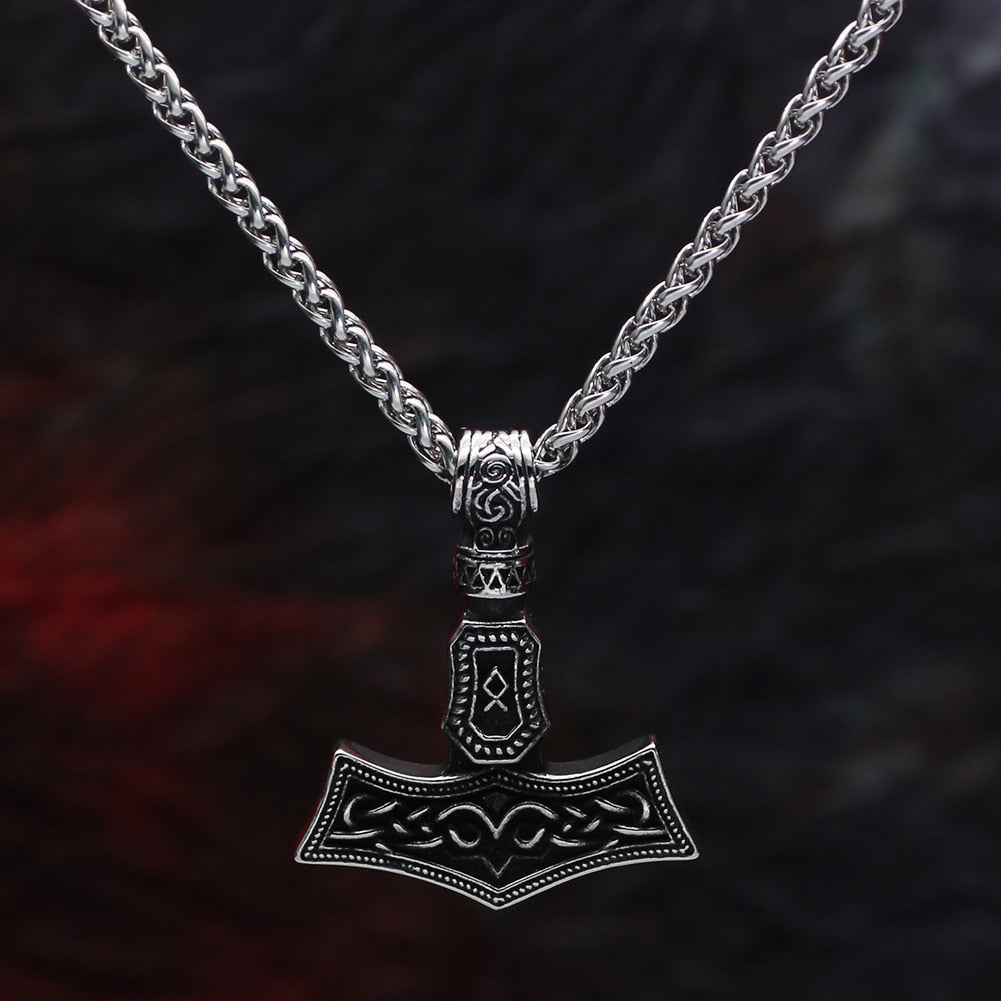
Mjölnir Valknut Talisman: Silver & Gold Norse Thor's Hammer
This historical background is one of the features that separates Beowulf from a straightforward monster story. The poet continually reminds his audience that individual lives exist within larger dynastic struggles. Kings die, alliances collapse, kingdoms are attacked and old feuds return across generations.
Beowulf eventually becomes king of the Geats after Hygelac and later his son Heardred are killed. He rules for many years before facing the final challenge of his life.
The Historical World Behind Beowulf
The poem's setting belongs to a period generally associated with the Migration Period, centuries before the Anglo-Saxon kingdoms had developed into the political landscape of later England. Remarkably, several people mentioned in Beowulf appear to correspond to figures recorded elsewhere.
The strongest example is Hygelac. Beowulf describes his death during a raid in Frisian territory, and a strikingly similar event appears in the writings of Gregory of Tours, who records a Scandinavian ruler named Chlochilaicus killed during a raid in Frankish territory. Modern scholarship has long associated Chlochilaicus with Hygelac. Cambridge scholarship places the raid around the early sixth century, probably around 520.
This does not establish Beowulf himself as a historical individual. It does, however, demonstrate that the poem preserves traditions connected to a recognisable historical environment. The poet knew names, dynasties and conflicts associated with a Scandinavian world several centuries removed from Anglo-Saxon England.
The poem also contains extensive material concerning the Geats and Swedes. The conflicts between their royal families form one of the most substantial historical backgrounds in the work, with figures such as Ongenþeow, Onela, Ohthere and Eadgils appearing within the dynastic struggles. Modern scholarship continues to examine these traditions against Scandinavian sources and archaeology.
What emerges is not a simple historical chronicle but a heroic tradition built around real peoples and remembered conflicts, transformed through generations of storytelling.
The Dragon and Beowulf's Final Battle
Fifty years after becoming king, Beowulf faces the final enemy of his life: a dragon awakened when a fugitive steals a cup from its hoard.

The dragon's treasure is itself an image of the past. Buried within an ancient barrow, the gold and precious objects have outlived the people who created and possessed them. The hoard has become useless wealth, separated from the society that once gave it meaning. The dragon merely guards what is already a monument to a vanished age.
Beowulf refuses to allow another creature to destroy his kingdom. Now an ageing king rather than a young warrior, he decides to confront the dragon personally. He approaches the barrow with a group of retainers, but when the battle begins, most of them flee. Only the young warrior Wiglaf remains.
The contrast with Beowulf's earlier battles is deliberate. In his youth, Beowulf could rely almost entirely upon his own physical strength. In old age, his mortality can no longer be ignored. The dragon is eventually killed, but Beowulf receives a mortal wound from its venom.
Wiglaf returns to the king after the battle and finds him dying. Beowulf's final thoughts turn towards the treasure he has won for his people and the succession of the Geatish kingdom. He has achieved the fame he sought, but the victory offers little comfort because his own death threatens the future of the people he ruled.
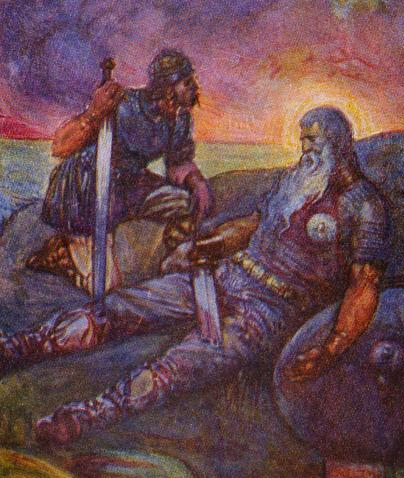
Illustration by J. R. Skelton, depicting the death of Beowulf
The poem ends with Beowulf's funeral. His body is burned and a great barrow is raised on a headland overlooking the sea. The Geats mourn their king, remembering his courage and generosity while fearing what will happen to their kingdom after his death.
The ending is deliberately sombre. Beowulf has defeated every enemy placed before him, yet even the greatest warrior cannot defeat time.
Christianity and the Older Germanic World
One of the most distinctive features of Beowulf is its combination of an older Germanic heroic world with the Christian worldview of the poem's surviving form. The characters live according to values such as kinship, vengeance, loyalty, reputation and gift-giving, while the narrator repeatedly interprets events through biblical ideas.
Grendel, for example, is connected directly to Cain. Yet the poem never simply erases the older heroic culture. Hroðgar remains a powerful Danish king; the hall remains the centre of political life; warriors seek fame; dynasties are threatened by blood-feuds; and loyalty between lord and retainer remains fundamental.
This has led to extensive debate over when and how the poem took its final form. The manuscript itself cannot settle the question. The surviving copy was produced in England around the very end of the tenth century or the early decades of the eleventh century, while the poem's composition may belong to an earlier period. The manuscript is preserved in the Nowell Codex, now bound with another manuscript as Cotton MS Vitellius A XV. Two scribes can be distinguished in the Nowell Codex.
The poem may therefore preserve traditions considerably older than the manuscript in which they survive. Exactly how long those traditions circulated orally, and when the poem reached something resembling its surviving form, remain matters of scholarly debate.
The Beowulf Manuscript
The physical survival of Beowulf is almost as remarkable as the story itself. The poem exists in a single medieval manuscript, meaning that there is no second surviving copy with which to compare the text. The manuscript was copied in England and is generally dated to around the year 1000, although the precise dating remains debated.
The manuscript suffered serious damage in the fire that affected the Cotton Library in 1731. Much of the poem nevertheless survived and remains readable. It eventually became part of the British Library's collections, where it is preserved as Cotton MS Vitellius A XV.

The poem itself is written in Old English, using the alliterative verse tradition characteristic of Anglo-Saxon poetry. Its language is highly compressed and relies upon repeated sounds, compound expressions and poetic formulas. Terms such as hringed-stefna and swan-rād evoke ships through imaginative compounds rather than straightforward description, while the famous kennings and alliterative lines give the poem its distinctive sound.
The surviving manuscript is therefore not merely a container for the story. It is itself one of the most important surviving witnesses to the language and literary culture of Anglo-Saxon England.
Beowulf and the Archaeology of the North
Archaeology provides an important backdrop to the world represented in Beowulf. The poem describes a society in which elite warriors were buried with weapons and treasure, rulers displayed wealth through monumental halls and ships connected kingdoms across the North Sea.
The discovery of the Sutton Hoo ship burial in Suffolk demonstrated just how sophisticated and wealthy the elite culture of early Anglo-Saxon England could be. The burial, dating to the early seventh century, contained a remarkable collection of weapons, gold, silver and imported objects, including a seagoing ship almost 27 metres long.

Golden buckle found in Sutton Hoo (Photo: Geni CC BY-SA 4.0)
Sutton Hoo is not evidence that Beowulf was based on a specific burial or that its characters can be identified with the people buried there. The chronology is also later than the principal period of the poem's Scandinavian setting. What the site does demonstrate is that the material culture described in Beowulf—warriors, ships, treasure, elaborate weaponry and powerful rulers—was entirely at home in the wider Germanic world of the early medieval North.
The poem's famous funerals and treasure hoards consequently belong to a cultural environment that archaeology can illuminate even where it cannot verify the events of the story itself.
The Legacy of Beowulf
Beowulf survived for centuries in a single manuscript, yet its influence eventually became enormous. For much of its modern history it was valued primarily as evidence for Old English language and literature. During the nineteenth and twentieth centuries, however, it increasingly became recognised as one of the great works of European literature.
Its importance extends beyond the monster fights that made it famous. The poem preserves an unusually detailed vision of Germanic heroic society, where personal reputation, loyalty, kinship and kingship were bound together by obligations that could determine the survival of entire communities. It also preserves the memory of a continental world from which the English themselves had emerged. Though written in England, Beowulf looks across the North Sea to the Danes and Geats of Germania and Scandinavia, while medieval traditions such as the story of the brothers Dan and Angul likewise remembered a close ancestral relationship between Danes and Angles.
That sense of impermanence is perhaps the defining quality of Beowulf. The poem looks backwards towards a heroic Scandinavian past while being written down in Christian Anglo-Saxon England. Its kings and warriors are already dead; their halls have fallen silent; their treasures have passed from their original owners; and Beowulf himself ultimately becomes part of the history he spent his life creating.
The final image is therefore fitting. Beowulf's people raise his barrow beside the sea so that sailors can see it from afar. His physical life has ended, but his memory has been given a place in the landscape. More than a thousand years later, the poem has done something similar. The Geatish king who exists only within a single surviving Old English manuscript has become one of the most enduring figures of Germanic heroic literature, while the poem itself preserves a remarkable memory of the continental Germanic heritage of the English.

Björneið Arm Ring - Old Norse Bear Cuff
Frequently Asked Questions (FAQs)
Was Beowulf a real historical person?
There is no independent evidence establishing Beowulf himself as a historical individual. However, several people and events mentioned in the poem appear to correspond to figures and conflicts recorded elsewhere, particularly Hygelac's raid into Frankish territory.
When was Beowulf written?
The exact date is disputed. The surviving manuscript was copied around the end of the tenth or beginning of the eleventh century, but the poem itself may preserve considerably older material.
Where is Beowulf set?
The poem is primarily set in Scandinavia, especially among the Danes and Geats. Important events also involve Sweden, Frisia and other parts of northern Europe.
Was Beowulf a Viking?
Not in the historical sense normally associated with the Viking Age. The poem's setting belongs largely to the sixth century, several centuries before the conventional beginning of the Viking Age around the late eighth century.
Where is the Beowulf manuscript kept?
The unique medieval manuscript of Beowulf is preserved by the British Library as Cotton MS Vitellius A XV, within the section known as the Nowell Codex.
References
Beowulf. Old English poem, Cotton MS Vitellius A XV.
Gregory of Tours. The History of the Franks.
Bjork, Robert E., and John D. Niles, eds. A Beowulf Handbook. University of Nebraska Press, 1997.
Chase, Colin, ed. The Dating of Beowulf: A Reassessment. University of Toronto Press, 1981.
Fulk, R. D., Robert E. Bjork, and John D. Niles, eds. Klaeber's Beowulf and the Fight at Finnsburg. University of Toronto Press, 2008.
Shippey, Tom. Beowulf and the North Before the Vikings. Arc Humanities Press, 2022.
Tolley, Clive. The Nordic Beowulf. Arc Humanities Press, 2022.






Leave a comment
This site is protected by hCaptcha and the hCaptcha Privacy Policy and Terms of Service apply.