

The Færeyinga Saga: The Saga of the Faroe Islanders
The Færeyinga saga, known in English as the Saga of the Faroe Islanders, is a 13th-century Icelandic text recounting events in the Faroe Islands from the late 10th century to the mid-11th century CE. The saga focuses on the settlement, internal rivalries among chieftains, resistance to Norwegian royal authority, and the conversion to Christianity under pressure from King Olaf Tryggvason.
The work does not survive as an independent manuscript. Its text survives only in excerpts incorporated into larger compilations: primarily Óláfs saga Tryggvasonar en mesta (The Greatest Saga of Olaf Tryggvason), Flateyjarbók (a late 14th-century Icelandic manuscript), and sections of Óláfs saga helga in Heimskringla and related manuscripts. The original was composed in Iceland shortly after 1200 CE, with the author unknown. Scholars date it to the first two decades of the 13th century, likely in a northern Icelandic monastic environment such as Þingeyrar. The saga combines elements of kings' sagas (tying events to Norwegian rulers) and family sagas (emphasising chieftain feuds), but its structure and style align more closely with the latter. Historical reliability varies: while some events align with Norwegian royal chronology, much of the narrative involves dramatic characterisation and dialogue that reflect literary conventions rather than verifiable records. Archaeological and genetic evidence provides partial corroboration for settlement patterns, but no contemporary Faroese documents exist.
Manuscript Tradition and Transmission
The saga's text was never preserved separately. Scribes integrated its chapters into Olaf Tryggvason's saga because the story intersects with his reign (995–1000 CE) and missionary efforts. The fullest version appears in Flateyjarbók (GKS 1005 fol., c. 1387–1394 CE), where it is distributed across the Olaf Tryggvason material. Other fragments come from AM 62 fol. and related copies of Óláfs saga helga.

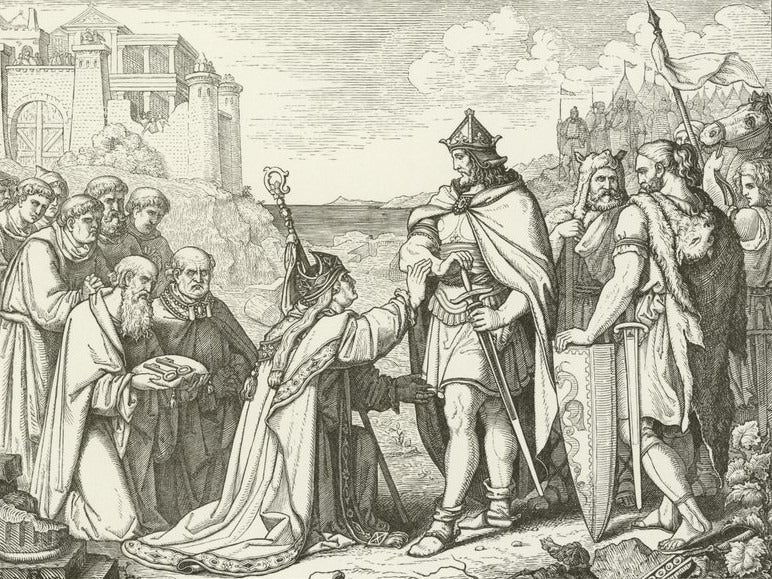
Olav Tryggvason arrives in Norway (Illustration: Peter Nicholai Arbo).
Ólafur Halldórsson's editions (1987 and 2006) reconstruct the saga by printing Flateyjarbók as the main text for most chapters, with variants from other manuscripts. Earlier editions include those by Carl Christian Rafn (1832) and Finnur Jónsson (1927). English translations include Frederick York Powell (1896), George Johnston (1975), and more recent ones by Robert K. Painter (2016) and others. The lack of a complete original manuscript leaves room for textual variation, especially in the opening settlement chapters.
Settlement and Early History
The saga opens with the Norse settlement of the Faroes, traditionally dated to the reign of Harald Fairhair (c. 872–930 CE). Grímr Kamban is named as the first settler, arriving to escape Harald's overbearing rule in Norway. The text notes that some emigrants fled to the Faroes, while others went to Iceland or other uninhabited lands.
Early power structures emerge around chieftains on different islands. The northern islands (Eysturoy and others) are controlled by cousins Brestir and Beinir Sigmundsson, while southern areas fall under Hafgrímr. These divisions set the stage for feuds. The saga describes Þrándr í Gøtu (Tróndur í Gøtu), a cunning and influential man living at Gøta on Eysturoy, who becomes the central antagonist.
Rise of Sigmundur Brestisson
The narrative shifts to Sigmundur Brestisson (c. 961–1005 CE), son of Brestir Sigmundsson. After his father's death in conflict with Þrándr and northern rivals, Sigmundur and his cousin Þórir flee to Norway. They enter the service of Earl Hákon Sigurðarson (r. c. 975–995 CE) and fight in his campaigns.

The grave of Sigmundur (left) is located at the Skúvoy church's graveyard (Photo: Antissimo CC BY-SA 3.0).
After Hákon's death, Sigmundur gains the favour of King Olaf Tryggvason (r. 995–1000 CE). Olaf commissions Sigmundur to return to the Faroes, secure loyalty to Norway, and enforce Christianity. Sigmundur receives a ring from the earl as a token of luck and sets sail with a force.
Conversion and Conflict with Þrándr
Sigmundur arrives in the Faroes and calls an assembly (Althing) in Tórshavn to proclaim Olaf's decree. Opposition, led by Þrándr í Gøtu, proves strong; the crowd nearly kills Sigmundur. He retreats and later forces Þrándr's baptism under threat of death.
Þrándr outwardly submits but harbours resentment. Sigmundur establishes control, but tensions persist. The saga details raids, betrayals, and power struggles between Sigmundur's supporters and Þrándr's faction.
Death of Sigmundur and Aftermath
In 1005 CE, Þrándr and his men attack Sigmundur's farm on Skúvoy. Sigmundur and his followers flee by sea in bad weather. Pursued, Sigmundur swims to Suðuroy with a gold ring (a gift from Olaf), but is captured by Þrándr's ally. Refusing to surrender the ring, Sigmundur is killed and buried at Sandvík.
The saga concludes with Þrándr's continued influence and the eventual consolidation of Norwegian authority. Later Faroese chieftains maintain ties to Norway, and Christianity takes root despite resistance.
Historical Context and Reliability
The saga is set against the late Viking Age transition from paganism to Christianity and Norwegian expansion in the North Atlantic (c. 950–1050 CE). It reflects Iceland's interest in peripheral Norse societies and Olaf Tryggvason's missionary legacy.

Wooden Christian crosses found in Toftanes dating to 860–970 (Photo: FunkMonk CC BY-SA 3.0).
As a historical source, reliability is mixed. Chronology aligns broadly with Norwegian kings' reigns, and some events (e.g. Sigmundur's role in conversion) are plausible. However, dramatic dialogue, character motivations, and literary motifs (feuds, betrayals, heroic deaths) follow saga conventions rather than eyewitness reporting. Scholars view it as a historical novel rather than a chronicle. Genetic studies (e.g. 2024 Frontiers in Genetics) show diverse Norse origins in the Faroes, partially supporting migration accounts, but archaeological evidence (settlement sites, pagan-Christian transitions) provides the main corroboration. The saga's Icelandic origin and 13th-century date introduce potential bias toward Norwegian royal narratives.
The Færeyinga saga narrates the Faroe Islands' incorporation into the Norwegian realm and the adoption of Christianity, framed through the rivalry between Sigmundur Brestisson and Þrándr í Gøtu. Composed in Iceland shortly after 1200 CE and preserved in excerpts within Olaf sagas, it blends historical elements with literary conventions typical of family sagas. While not a strict chronicle, the work offers insight into North Atlantic Norse society during the conversion period, highlighting themes of loyalty, resistance, and cultural change. Its survival in larger compilations underscores the interconnectedness of medieval Icelandic historiography.
Frequently Asked Questions (FAQs)
When was Færeyinga saga written?
The saga was composed in Iceland shortly after 1200 CE, likely in the first two decades of the 13th century.
Why does it not survive as a separate manuscript?
It survives only in excerpts incorporated into larger sagas of Olaf Tryggvason and Olaf Haraldsson, primarily in Flateyjarbók and related texts.
Who are the main figures in the saga?
Key characters include Sigmundur Brestisson (Christianising chieftain loyal to Norway) and Þrándr í Gøtu (pagan resistor and rival).
Is the saga historically reliable?
It contains plausible chronology and events tied to Norwegian kings, but dramatic elements and dialogue reflect literary style; scholars treat it as a historical novel rather than a precise record.
What is the saga's main theme?
The narrative traces the Faroes' conversion to Christianity and submission to Norwegian rule amid chieftain rivalries.
References
Ólafur Halldórsson (ed.). Færeyinga saga. Stofnun Árna Magnússonar á Íslandi, 2006.
Faulkes, Anthony (trans.). Færeyinga saga. Thorisdal Dundee, 2016.
Powell, Frederick York (trans.). The Tale of Thrond of Gate. Nutt, 1896.
Painter, Robert K. (trans.). Faroe-Islander Saga: A New English Translation. McFarland, 2016.
Halldórsson, Ólafur. "Færeyinga saga." In Medieval Scandinavia: An Encyclopedia, edited by Phillip Pulsiano. Garland, 1993.
Debes, Hans Jacob. "Problems Concerning the Earliest Settlement in the Faroe Islands." Frit, 1991.
Wikipedia contributors. "Færeyinga saga." Wikipedia, The Free Encyclopedia.







Leave a comment
This site is protected by hCaptcha and the hCaptcha Privacy Policy and Terms of Service apply.