The Angles and the Fragmented Legacy of Angelin
The Angles were one of the most influential Germanic peoples of the Migration Period, yet their origins remain only partially visible through historical and archaeological evidence. What can be said with relative certainty is that they were part of the wider North Sea Germanic world, closely connected to the Saxons, Frisians, and Danes through shared geography, trade networks, and shifting patterns of settlement.
In later medieval memory, the Angles were traced back to a homeland known as Angelin or Angeln, located in what is now southern Denmark and northern Germany. This region is still associated with the historical core of Angle identity, and classical and early medieval writers consistently link the people known as Angli to this area.
Dan and Ængul in the Anglo-Saxon Chronicle Tradition
The Anglo-Saxon genealogical tradition preserved in the Anglo-Saxon Chronicle and related genealogical texts presents a mythicised account of shared ancestry among the North Sea peoples. In this tradition, the figures of Dan and Ængul are described as ancestral brothers whose descendants became the Danes and Angles.
The narrative states that these peoples ultimately derive from a common forefather, often named Humble or Humbl. While this account cannot be treated as literal genealogy in the modern historical sense, it reflects an early medieval attempt to explain the striking linguistic, cultural, and political closeness between neighbouring Germanic peoples of the North Sea world.

What makes the tradition historically significant is not whether Dan and Ængul were real individuals, but what the story reveals about how Anglo-Saxon writers understood ethnic relationship and ancestry. The Angles and Danes were viewed not as distant foreigners, but as deeply related peoples who shared a common cultural inheritance. During the Viking Age, Old English and Old Norse remained similar enough that communication between Anglo-Saxons and Danes was often possible with relative ease, particularly in regions shaped by long-term contact and settlement.
Modern genetic studies have also demonstrated how difficult it is to sharply distinguish Danish and Anglo-Saxon ancestry in England dating to this period. The populations involved were already extremely closely related before the Viking migrations began, sharing deep roots within the same broader Germanic population of southern Scandinavia and the North Sea coast. The Angles, Saxons, Jutes, Frisians, and Danes were not entirely separate peoples in the modern ethnic sense, but branches of closely connected Germanic groups that had diverged regionally over time while still maintaining extensive cultural and biological overlap. In many respects, the formation of the English people involved these related North Sea populations splitting apart across earlier centuries and then partially merging together again within Britain.
This overlap makes it difficult for historians and geneticists alike to determine precisely how large the later Scandinavian genetic contribution to England was during the Viking Age, because the incoming Danes and the existing Anglo-Saxon populations were already so similar biologically and culturally.
Seen within this context, the story of Dan and Ængul becomes more understandable as a reflection of remembered kinship. Early Germanic societies frequently framed identity through ancestral lineages and heroic forefathers, with tribes, dynasties, and extended kindreds often tracing themselves back to a single named ancestor. While the story cannot be verified historically, neither is the underlying idea entirely implausible within the social structure of early Germanic societies, where powerful families and clans could expand over generations into much larger tribal identities. More important than literal descent, however, is the fact that Anglo-Saxon tradition itself preserved the memory that the Angles and Danes were considered, in origin and character, extraordinarily close peoples.
Angelin and the Early Germanic Landscape
Archaeological and linguistic evidence suggests that Angelin was part of a broader North Sea cultural zone during the late Iron Age and early Roman periods. This region was not politically unified but consisted of interconnected communities engaged in farming, seafaring, and coastal trade.
Material culture from this area shows strong similarities with neighbouring Saxon and Frisian regions, reinforcing the idea of a shared cultural continuum rather than sharply defined ethnic boundaries. The Angles, in this sense, were one expression of a wider Germanic coastal world rather than an isolated tribal entity.
The Migration of the Angles Across Europe
The Migration Period saw the gradual dispersal of Angle groups across multiple regions of Europe. Unlike a single coordinated migration, the movement of the Angles appears to have taken place over several generations and through multiple routes.

The Angles in Britain and the Formation of Anglo-Saxon England
The most well-documented movement of Angle groups was into post-Roman Britain during the 5th and 6th centuries. Alongside Saxons and Jutes, they established settlements across eastern and northern parts of the island.
Over time, these groups contributed to the formation of what later became known as Anglo-Saxon England. Kingdoms such as Mercia and Northumbria preserved strong Angle cultural and linguistic identities, particularly in northern and central regions.
The transformation of Britain during this period involved both migration and assimilation. Archaeological evidence suggests a combination of population movement and cultural adoption, rather than a uniform replacement of earlier populations.
Angles Among the Saxons and Frisians in the North Sea World
The Angles did not disappear from continental Europe after the migrations to Britain. Instead, evidence suggests continued interaction and movement across the North Sea region. Saxon and Angle groups remained closely connected, often operating within shared coastal networks that extended into Frisian territories.
Later traditions suggest that some Angle groups moved into areas associated with the Frisians, particularly during periods of political disruption. These movements are sometimes linked to Roman military campaigns on the continent, including episodes of mass violence and forced displacement recorded in late antique sources. However, the exact scale and nature of these events remain debated in modern scholarship.
What is clear is that the North Sea world remained highly mobile, with groups frequently shifting settlement areas in response to conflict, opportunity, and political pressure.
Movement Toward the Baltic and Continental Hinterlands
Some historical and linguistic evidence has been interpreted as suggesting Angle-related presence further east, potentially extending toward Baltic regions. However, this remains one of the least certain aspects of Angle history.
While Germanic cultural influence is clearly visible across northern and eastern Europe during the Migration Period, directly attributing specific Baltic movements to identifiable Angle groups is difficult. Most evidence points instead to broader patterns of Germanic expansion and interaction rather than clearly defined tribal migrations.
The Angles and Their Germanic Neighbours
The Angles existed within a tightly interconnected network of North Sea Germanic peoples, including the Saxons, Frisians, and Danes. These groups shared linguistic similarities, maritime culture, and overlapping settlement zones.

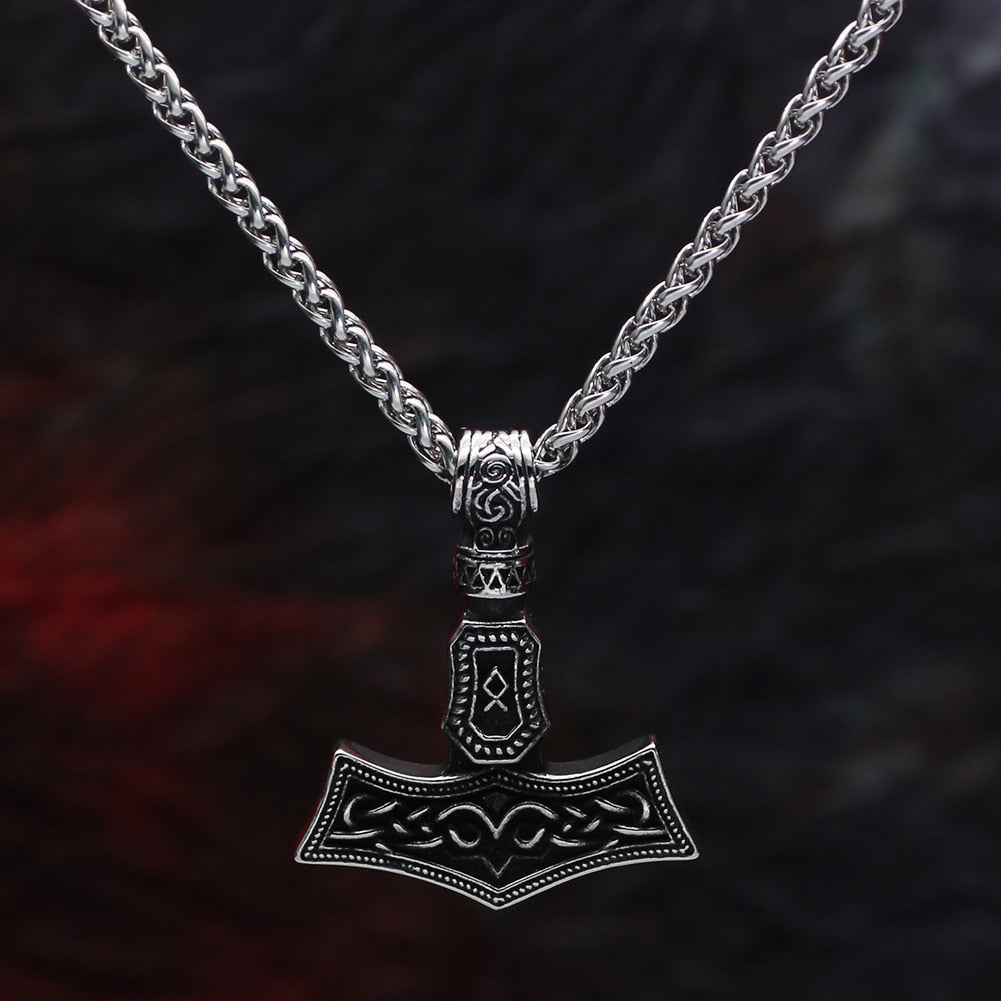
Gungnir and Mjolnir amulets discovered in Gilton, Kent dating back to the 6th century.
Warfare, Alliance, and Shared Identity
Relationships between these groups were fluid, alternating between conflict and cooperation. Raiding, migration, intermarriage, and alliance-building were all common features of North Sea Germanic society during Late Antiquity and the early medieval period.
The proximity of these peoples meant that cultural boundaries were often indistinct. Language differences were likely minimal, allowing for mutual intelligibility in many contexts. This facilitated movement across regions and helped sustain a shared cultural horizon across the North Sea world.
The Frisians and Roman Frontier Disruption
Later medieval traditions sometimes describe periods of upheaval in Frisian territory involving external pressure and displacement. Roman military activity in northern Gaul and the lower Rhine region is well documented, and these frontier zones experienced repeated cycles of conflict during Late Antiquity.
Within this context, it is plausible that population movements occurred between Frisian, Saxon, and Angle groups, although the precise details remain difficult to reconstruct with certainty. What can be observed is the continued interweaving of these communities across shifting political boundaries.
The Survival of Angelin and Later Memory
Despite large-scale migrations, the original homeland of the Angles in Angelin did not disappear from historical memory. Medieval sources continue to identify this region as the ancestral origin of the Angles, and the name itself survives in modern geographical terminology.
Archaeological continuity in the region suggests that not all Angle identity was lost to migration. While many groups left for Britain or other parts of Europe, others almost certainly remained, contributing to the long-term cultural continuity of the region.
Conclusion
The history of the Angles is best understood not as a single migration, but as a long process of dispersal across a shared North Sea world. From their origins in Angelin, Angle groups moved into Britain, interacted closely with Saxons and Frisians, and remained part of a broader Germanic cultural network that extended across continental Europe.
The mythic traditions preserved in sources such as the Anglo-Saxon Chronicle reflect an awareness of shared ancestry between the Angles and their neighbours, particularly the Danes. While not historically literal, these traditions capture a genuine perception of closeness among North Sea peoples whose languages, customs, and political structures were deeply interconnected.
Modern scholarship increasingly views the Angles not as an isolated tribe, but as part of a dynamic and fluid Germanic world in which identity was shaped by movement, interaction, and shared cultural horizons rather than fixed boundaries.

Gungnir Amulet with Handcrafted King Chain
Frequently Asked Questions (FAQs)
Who were the Angles?
The Angles were a Germanic people from the North Sea region, strongly associated with the area of Angelin in modern northern Germany and southern Denmark.
Where did the Angles live originally?
Their homeland is traditionally identified as Angelin (Angeln), though Angle groups also moved widely across Europe during the Migration Period.
Did all Angles migrate to Britain?
No. While many Angles settled in Britain, others remained on the continent or moved into neighbouring regions such as Saxon and Frisian territories.
What is the Anglo-Saxon Chronicle story about Dan and Ængul?
It presents a mythic genealogy in which Dan and Ængul are brothers, representing the ancestral origins of the Danes and Angles.
Were the Angles related to the Danes and Saxons?
They were closely connected culturally and linguistically within the North Sea Germanic world, sharing similarities in language, customs, and settlement patterns.
References
Anglo-Saxon Chronicle
Bede, Historia Ecclesiastica Gentis Anglorum
Guy Halsall, Barbarian Migrations and the Roman West
Peter Heather, Empires and Barbarians
James Campbell (ed.), The Anglo-Saxons





Leave a comment
This site is protected by hCaptcha and the hCaptcha Privacy Policy and Terms of Service apply.