
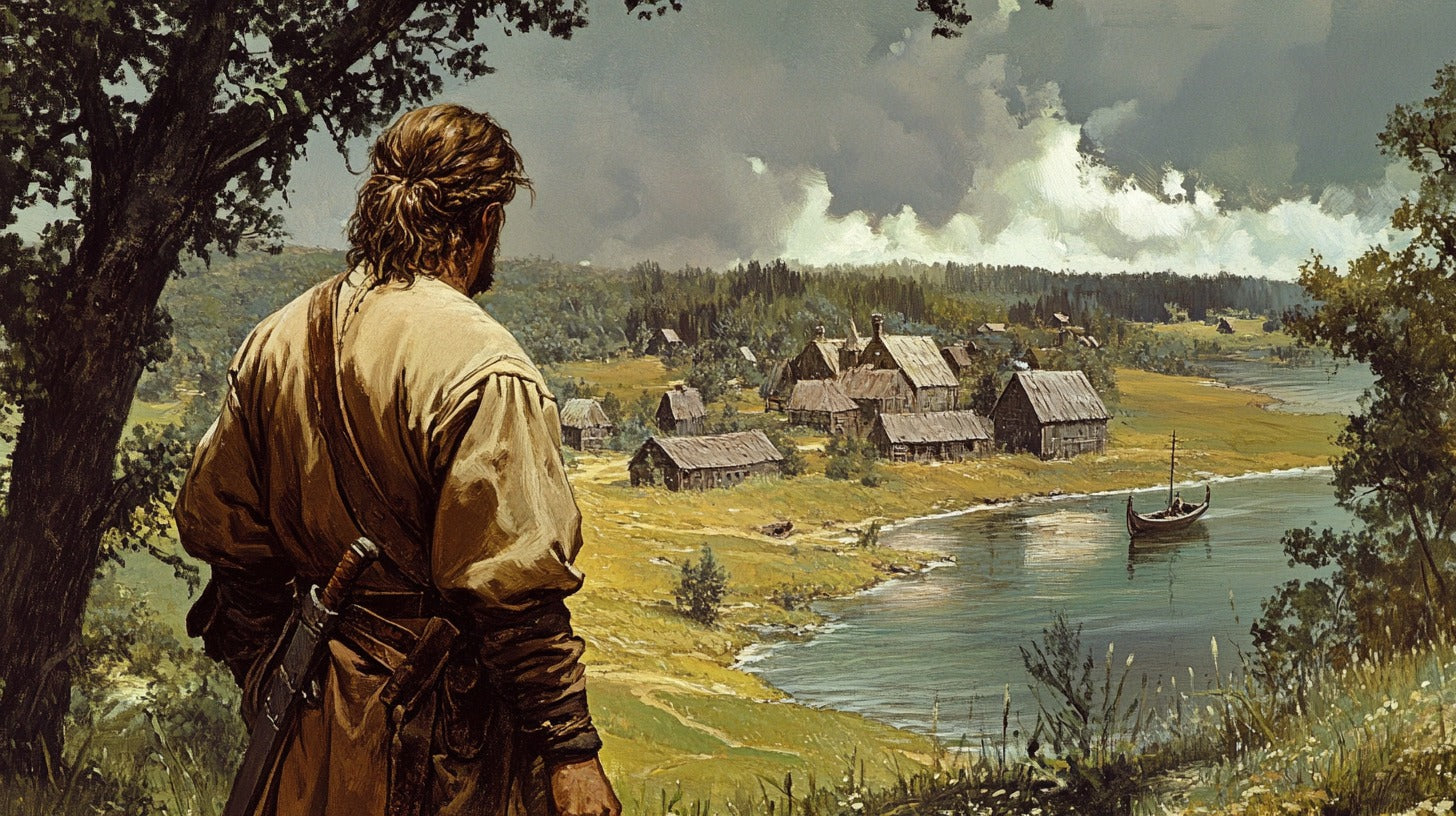
Leif Eriksson: The Norse Explorer Who Reached North America
Leif Eriksson occupies a distinctive place in medieval history. He was born into the expanding Norse world of the North Atlantic, a maritime society whose settlers had already carried Scandinavian culture from Norway to Iceland and from Iceland to Greenland. His father, Erik the Red (Eiríkr rauði), had established the Norse settlement of Greenland in the late tenth century, and Leif belonged to the generation that pushed this Atlantic network farther west.
The historical evidence for Leif is unusual. Unlike many Viking Age figures, his name appears in later Icelandic literary traditions alongside accounts of his family and voyages, while archaeology independently demonstrates that Norse people reached and established a settlement in North America during the same period. At L’Anse aux Meadows in Newfoundland, archaeologists uncovered an eleventh-century Norse settlement containing timber-framed turf buildings, workshops and a forge. UNESCO identifies it as the earliest known European settlement in North America.
The archaeological site does not contain an inscription naming Leif, however. Consequently, historians distinguish between what archaeology proves about Norse activity in North America and what the sagas attribute specifically to Leif.
The Son of Eiríkr rauði
Leif was the son of Erik the Red, the Icelandic settler traditionally credited with establishing the first lasting Norse colony in Greenland. His mother was Þjóðhildr, and the family lived at Brattahlíð in the Eastern Settlement.
The family belonged to the Norse aristocratic class that had emerged in Iceland and Greenland. Leif's upbringing therefore took place within a society built around farming, seafaring, trade, kinship and regional chieftaincies. Greenland's Norse population depended heavily upon maritime connections with Iceland and Norway, making long-distance navigation an ordinary part of elite life.
Leif's generation inherited a society that was already accustomed to Atlantic exploration. Iceland had been settled by Norse migrants from the late ninth century, while Eiríkr's colonisation of Greenland followed in the tenth. The journey from Greenland to North America was consequently not an isolated leap into the unknown, but another stage in an established sequence of westward expansion.
The Lands Beyond Greenland
The Norse discovery of lands west of Greenland may also have begun before Leif.

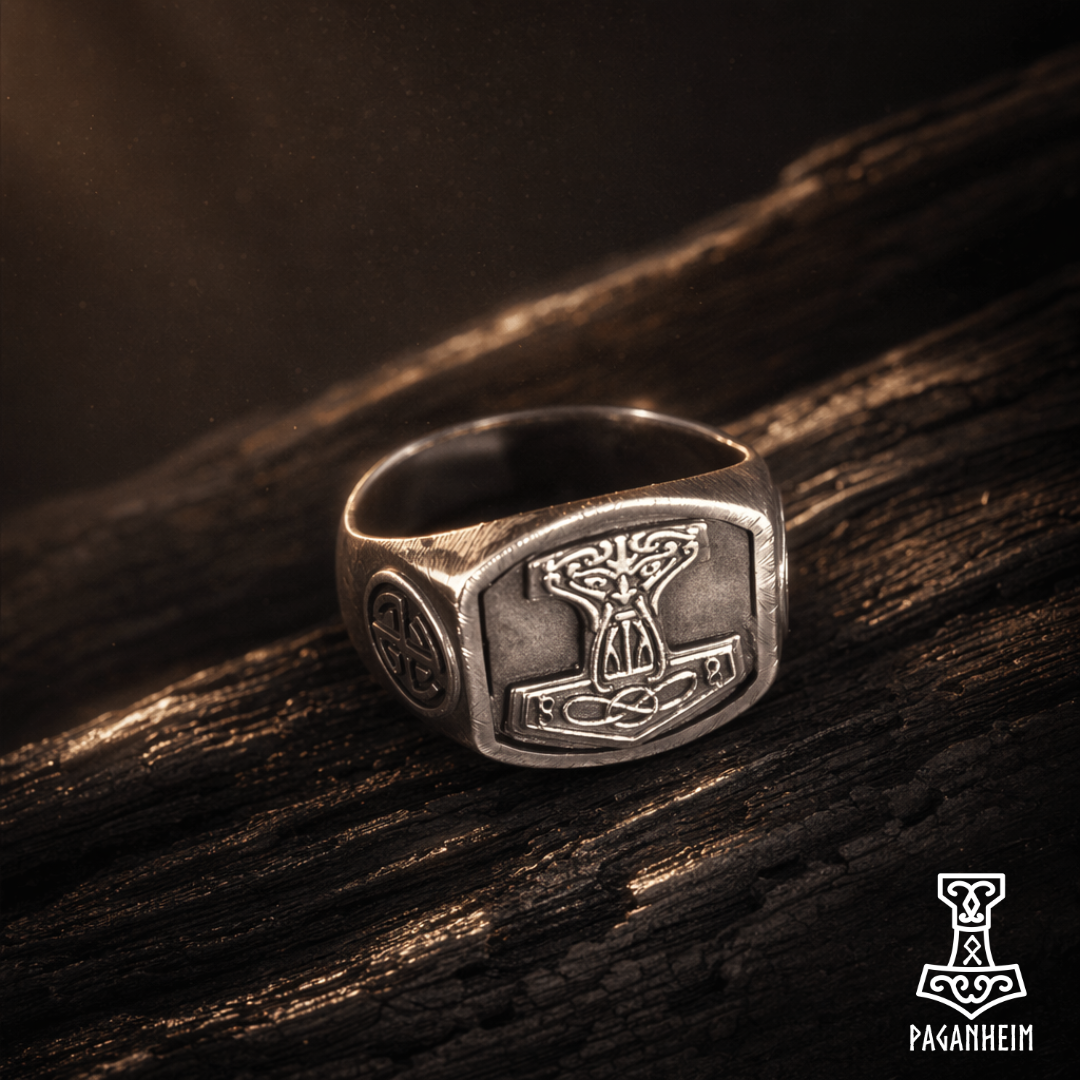
Leif's Talisman - Valknut Vegvísir Carved Icelandic Viking Ring
According to the Saga of the Greenlanders, an Icelandic merchant named Bjarni Herjólfsson was blown off course while sailing toward Greenland. He reported seeing land but did not go ashore. His voyage provided the knowledge that lands existed farther west, which later encouraged Leif and others to investigate them.
This tradition is important because it makes Leif's expedition part of a larger process. The Norse did not necessarily sail blindly into an entirely unknown ocean. Sailors were gathering information about the western Atlantic through successive voyages, and the sagas preserve memories of several expeditions rather than a single act of discovery.
Leif at the Court of Óláfr Tryggvason
The sagas place an important episode in Leif's life in Norway.
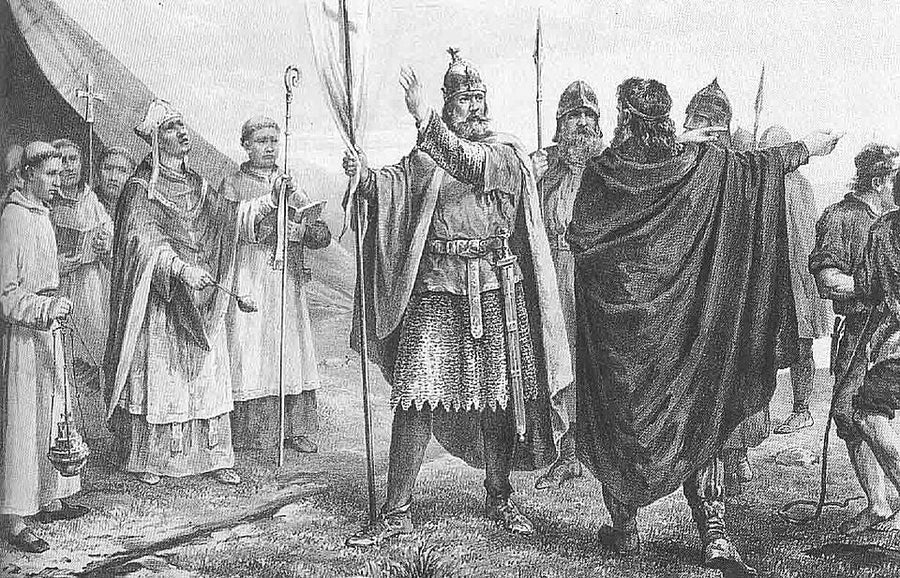
Olav Tryggvason arrives in Norway by Peter Nicolai Arbo
According to Eiríks saga rauða, Leif travelled from Greenland to Norway and entered the service of King Óláfr Tryggvason, who ruled Norway from approximately 995 to 1000. The saga describes Óláfr taking a favourable view of Leif and eventually converting him to Christianity.
Óláfr then commissioned Leif to return to Greenland and promote Christianity among the settlers. The saga portrays Leif as reluctant to undertake the mission because he expected resistance, but the king regarded him as particularly suited to the task.
The episode fits the broader religious transformation taking place across Scandinavia. Óláfr Tryggvason actively promoted Christianity in Norway and among Norse communities overseas. Leif's association with the king therefore placed him within one of the major political and religious developments of the period.
The extent of Leif's personal role in converting Greenland is less certain. The sagas were written centuries after the events, and archaeological evidence indicates that Christianity was already present among Greenland's Norse population around the time of Leif's voyage. Nevertheless, the medieval tradition consistently remembered him as an important figure in the Christianisation of Greenland.
Leif's Voyage to Vínland
The most famous episode in Leif's life concerns his voyage westward from Greenland.
The surviving Vinland narratives provide two somewhat different versions of how Leif reached the western lands. In Eiríks saga rauða, Leif is blown off course while returning from Norway to Greenland. He encounters previously unknown lands and finds vegetation that includes wild wheat, vines and maple trees. He also discovers the survivors of a shipwreck and brings them safely back to Greenland. It is this act of rescue that earns him the epithet Leifr hinn heppni, "Leif the Lucky."

Another tradition, preserved in the Saga of the Greenlanders, gives Leif a more deliberate role. In this account, he purchases or obtains a ship associated with the earlier voyage of Bjarni Herjólfsson and deliberately sails west to investigate the lands Bjarni had reported.
The differences between these accounts demonstrate the limitations of using the sagas as straightforward historical chronicles. Both preserve traditions about Leif and the western lands, but they disagree over the circumstances of his voyage.
What they share is more significant: Leif sailed west from Greenland and reached lands that became known in Norse tradition as Vínland.
Helluland, Markland and Vínland
The Vinland sagas describe several western territories rather than a single destination.

Leif Eirikson discovering America by Christian Krohg
The first was Helluland, generally interpreted as "Land of Flat Stones". The sagas associate it with rocky terrain and little vegetation. The second was Markland, or "Forest Land", a heavily wooded region that provided an important contrast with Greenland's comparatively treeless environment.
The final region was Vínland, whose name has traditionally been translated as "Vinland" or "Wine Land". The sagas associate it with fertile country, wild grapes or berries, timber and comparatively favourable conditions.
Exactly how far south Vínland extended remains debated. The name may have referred to a broad region rather than a single settlement, and the saga descriptions were written centuries after the voyages.
The archaeological evidence provides the crucial geographical anchor.
L'Anse aux Meadows
In 1960, Norwegian explorers Helge Ingstad and Anne Stine Ingstad identified the remains of a Norse settlement at L'Anse aux Meadows on the northern tip of Newfoundland.
Excavations revealed timber-framed buildings covered with turf, including dwellings, workshops and a forge. The architecture closely resembles contemporary Norse structures from Iceland and Greenland. Archaeologists also recovered hundreds of artefacts, including objects associated with woodworking and iron production.
The site fundamentally changed the historical discussion surrounding the Vinland sagas.

A model depicting the Norse settlement established at L'Anse aux Meadows by Torbenbrinker (CC BY-SA 3.0).
Before its discovery, the existence of Norse voyages to North America was known primarily through medieval Icelandic literature. L'Anse aux Meadows provided physical evidence that Norse sailors had actually crossed the North Atlantic and established a settlement in North America.
Radiocarbon and other archaeological evidence places the occupation in the eleventh century, and research has established Norse activity there around the year 1021. The settlement appears to have been relatively short-lived rather than the beginning of a permanent Norse colony comparable to Greenland.
UNESCO describes L'Anse aux Meadows as the first and only known Viking settlement in North America and the earliest known European settlement in the Americas.
What the Archaeology Proves
The distinction between archaeology and the sagas remains important.
L'Anse aux Meadows proves that Norse people reached North America and established a settlement there. It also demonstrates that the Norse possessed the shipbuilding, navigation and logistical capabilities required to operate across the western Atlantic.
It does not, however, provide direct archaeological evidence that Leif Eriksson himself stood at the site.
The identification of the settlement with the Vinland described in the sagas is extremely strong, because the buildings, artefacts, environment and geographical position correspond closely with the Norse descriptions. UNESCO specifically notes that the archaeological remains correspond with the journeys described in the Vinland sagas.
The most defensible historical formulation is therefore that Leif is the principal figure traditionally associated with the discovery of Vínland, while L'Anse aux Meadows provides independent evidence that Norse expeditions reached and settled North America during the same period.
The Norse Encounter with North America
The Norse were not entering an empty continent.
Indigenous peoples had inhabited North America for thousands of years before the arrival of Europeans. The sagas describe encounters between Norse settlers and peoples they called Skrælingjar. These accounts include trading, exchanges of goods and violent confrontations.

Leif Eriksson Discovers America by Hans Dahl (1849–1937)
The archaeological evidence at L'Anse aux Meadows also indicates that the settlement was part of a wider exploratory effort. UNESCO notes evidence that those occupying the site travelled farther south, suggesting that Newfoundland may have functioned partly as a base from which Norse crews explored other areas.
The sagas describe attempts to establish a more permanent presence in Vínland after Leif's initial expedition. Þorfinnr Karlsefni later led a larger expedition accompanied by Guðríðr Þorbjarnardóttir, while Leif's brother Þorsteinn Eiríksson also attempted to reach the western lands.
These later voyages suggest that Leif's expedition was not an isolated event. Knowledge of the western territories circulated among Greenland's Norse population and encouraged further exploration.
Why the Norse Did Not Colonise North America
The Norse presence in North America did not develop into a permanent colony.
The reasons are not known with certainty, but the geography of the Norse Atlantic provides important context. Greenland itself was difficult to sustain and depended upon regular connections with Iceland and Norway. A settlement farther west required additional shipping, manpower and supplies.
The Vinland sagas describe conflict with the local population, which eventually contributed to the abandonment of the settlement attempts. The archaeological evidence shows that L'Anse aux Meadows was occupied for a limited period rather than developing into a large permanent community. UNESCO describes the settlement as lasting only a relatively short time.
The failure to establish a lasting North American colony should not be interpreted as a failure of Norse exploration. The Greenlanders had already demonstrated their ability to maintain settlements thousands of kilometres from Scandinavia. The western voyages extended that maritime network even farther, but the economic and logistical advantages of doing so were apparently insufficient to sustain a permanent settlement.

Norse Viking Drakkar Longship Ring
Leif the Lucky
The epithet Leifr hinn heppni, "Leif the Lucky", became an enduring part of Leif's identity in Icelandic tradition.
The name is particularly appropriate to the saga portrayal of his voyage. He encounters valuable lands, returns safely to Greenland and rescues shipwreck survivors. His good fortune is therefore presented not merely as luck at sea but as a characteristic of his life.
The epithet also distinguishes Leif from his father. Eiríkr rauði, "Eiríkr the Red", is remembered for his violent temperament and the chain of conflicts that ultimately drove him from Iceland. Leif, by contrast, is repeatedly portrayed as successful, capable and fortunate.
The contrast is particularly visible in the Christianisation narrative. Leif adopts Christianity, returns to Greenland as Óláfr's representative and becomes associated with the conversion of the settlement. His mother Þjóðhildr also converts and is traditionally associated with the construction of a church at Brattahlíð.
Leif's Later Life
The sources provide considerably less information about Leif after his return to Greenland.
The sagas indicate that he remained an important figure in Greenland and that his family continued to hold considerable status. His father Eiríkr had established the family estate at Brattahlíð, and Leif inherited a prominent position within Greenlandic society.
His brother Þorsteinn later attempted an expedition to Vínland but died before completing it. The saga traditions then move toward the voyages of Þorfinnr Karlsefni and Guðríðr, whose son Snorri Þorfinnsson became an important figure in the Greenlandic and Icelandic genealogical traditions.
Leif himself disappears from the historical narrative. There is no reliable contemporary record of his exact date of death, although he is generally believed to have died sometime in the first half of the eleventh century.
Leif Eriksson and the Historical Record
One of the challenges surrounding Leif is the chronological distance between the events and the surviving written accounts.
The Vinland sagas were written in medieval Iceland several centuries after the voyages they describe. They preserve traditions that may have originated much earlier, but they are literary works rather than contemporary expedition logs.
There are nevertheless earlier references to Vínland. Adam of Bremen, writing in the eleventh century, recorded information about lands across the western ocean in his Gesta Hammaburgensis ecclesiae pontificum. The Icelandic historian Ari Þorgilsson also referred to western lands in Íslendingabók, composed in the early twelfth century.
These sources demonstrate that knowledge of western lands existed in the medieval North Atlantic before the fully developed Vinland sagas were written.
The archaeology of L'Anse aux Meadows provides the strongest independent confirmation that these traditions were rooted in genuine Norse voyages.
Leif Eriksson and the "Discovery" of America
Leif Eriksson's voyage to Vínland represents one of the most significant geographical discoveries of the medieval world. North America was already inhabited by Indigenous peoples, but to the peoples of Europe and the wider Eurasian world, the existence of a vast landmass across the western Atlantic remained unknown. The Norse voyages changed that by demonstrating that land could be reached far beyond Greenland.
For the Norse, this was a remarkable extension of their Atlantic world. Their sailors had already crossed from Scandinavia to Iceland and Greenland, but Vínland carried them onto an entirely new continent. The discovery opened access to unfamiliar forests, fertile land and resources that were scarce in Greenland, particularly timber.
The discovery of L'Anse aux Meadows in Newfoundland provides the archaeological evidence for this achievement. The settlement demonstrates that Norse explorers had not merely sighted North America but had actually reached the continent, established buildings and workshops, and explored the surrounding region during the early eleventh century.
Leif Eriksson's voyage therefore represents the first known European discovery of North America, nearly five centuries before Christopher Columbus's transatlantic voyages. It stands as the westernmost expansion of the medieval Norse world and one of the clearest demonstrations of the extraordinary range of Viking Age seafaring.
The Legacy of Leif Eriksson
Leif's historical reputation grew considerably in the modern era, particularly during the nineteenth and early twentieth centuries, when Scandinavian communities in North America took increasing interest in the Norse exploration of the continent.
The discovery of L'Anse aux Meadows transformed that tradition into an archaeological fact. The settlement was recognised as a National Historic Site of Canada and was inscribed on the UNESCO World Heritage List in 1978.
Leif's name subsequently became closely associated with the broader recognition of the Norse presence in North America. Leif Erikson Day, observed in the United States on 9 October, commemorates his role in Norse exploration.
The modern commemoration, however, represents a much later interpretation of his legacy. The medieval sources remembered Leif primarily as a Greenlandic chieftain, Christian missionary and fortunate explorer. His transformation into a symbol of European exploration of North America belongs largely to the modern period.
Conclusion
Leif Eriksson emerged from a Norse Atlantic world that had already stretched from Scandinavia to Iceland and Greenland. As the son of Eiríkr rauði, he inherited a family deeply involved in that expansion, and the medieval sagas remember him as a capable leader who travelled to Norway, entered the service of Óláfr Tryggvason, adopted Christianity and returned to Greenland. His most enduring achievement was his association with Vínland and the Norse voyages westward from Greenland. Although the sagas were written centuries after the events and cannot independently prove every detail of Leif's biography, archaeology has confirmed the essential historical foundation behind their western narratives. L'Anse aux Meadows demonstrates that Norse explorers reached and established a settlement in North America around the beginning of the eleventh century, making Leif Eriksson one of the central figures in the history of the medieval North Atlantic and the earliest known European exploration of North America.
Frequently Asked Questions
Who was Leif Eriksson?
Leif Eriksson was a Norse Greenlander and the son of Eiríkr rauði. Medieval Icelandic sources associate him with the exploration of Vínland and the Christianisation of Greenland.
When did Leif Eriksson reach North America?
His voyage is generally placed around 1000 CE, although the exact date cannot be established with certainty. Archaeological evidence demonstrates Norse activity in Newfoundland around 1021.
Where was Vínland?
Vínland was a region described in the Norse sagas. L'Anse aux Meadows in Newfoundland is the only confirmed Norse settlement in North America and is widely associated with the Vinland voyages.
Did Leif Eriksson discover America?
Leif did not discover an uninhabited continent, as Indigenous peoples had lived throughout North America for thousands of years. He is, however, traditionally associated with the earliest known European arrival in North America.
Was Leif Eriksson a Christian?
According to the medieval sagas, Leif converted to Christianity while serving King Óláfr Tryggvason in Norway and subsequently helped introduce Christianity to Greenland.
References
Eiríks saga rauða (The Saga of Eiríkr the Red).
Grænlendinga saga (The Saga of the Greenlanders).
Óláfs saga Tryggvasonar.
Ari Þorgilsson, Íslendingabók.
Adam of Bremen, Gesta Hammaburgensis ecclesiae pontificum.
UNESCO World Heritage Centre, L’Anse aux Meadows National Historic Site.
Keneva Kunz, trans., The Sagas of Icelanders: A Selection.
Gwyn Jones, The Norse Atlantic Saga: Being the Norse Voyages of Discovery and Settlement to Iceland, Greenland, and North America.
Else Roesdahl, The Vikings.
Judith Jesch, The Viking Diaspora.







Leave a comment
This site is protected by hCaptcha and the hCaptcha Privacy Policy and Terms of Service apply.