Ivar the Boneless: The Viking King Behind the Saga
Few Viking figures are as difficult to separate from legend as Ivar the Boneless. Medieval Scandinavian literature presents him as one of the sons of the legendary Ragnar Loðbrók and gives him a central role in the vengeance for his father's death. English and Irish sources, meanwhile, record powerful Viking leaders who appear to correspond closely with Ivar, although they do not preserve the same genealogy or mythology.
The historical Ivar is generally associated with a Viking leader named Ímar, who became one of the most powerful Scandinavian rulers in Ireland during the ninth century. The Irish annals record Ímar as a major figure from the 850s until his death in 873. He ruled Dublin, campaigned in Britain and Ireland, and became the ancestor of the dynasty later known as the Uí Ímair.
At the same time, the Anglo-Saxon Chronicle records a Viking commander called Ingware or Hingwar, who participated in the campaigns of the Great Heathen Army in England. The identification of this man with Ímar, and with the saga's Ivar the Boneless, has attracted considerable scholarly discussion. The identification is compelling, but it should not be presented as an absolute certainty because the surviving ninth-century sources never explicitly connect all three names.
That distinction is important. Ivar's historical career is real enough to reconstruct, but the dramatic biography found in the Icelandic sagas was written centuries later and contains substantial legendary material.

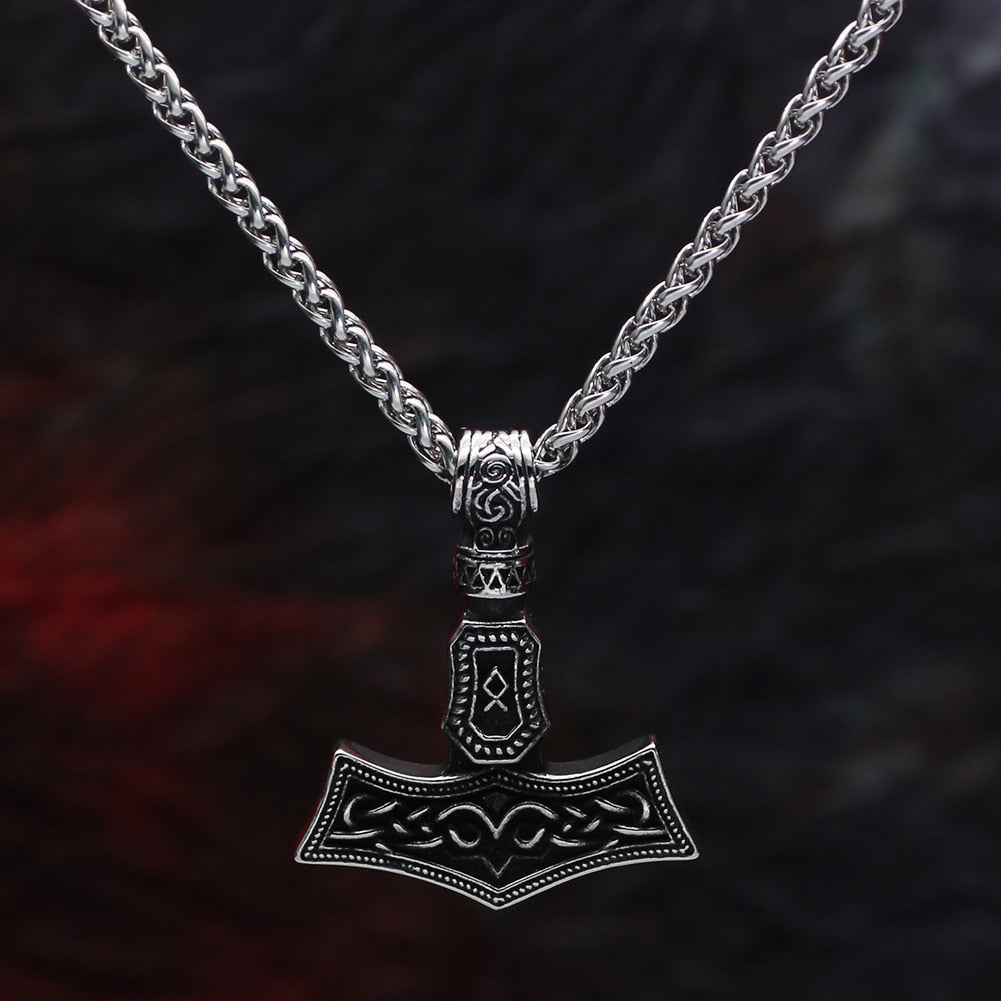
Rune‑Bead Mjölnir — Thor’s Hammer with Othala Engraving
Ivar in the Saga Tradition
The fullest account of Ivar's legendary life appears in Ragnars saga loðbrókar and the related Ragnarssona þáttr. These works belong to the medieval Icelandic saga tradition and were written long after the events they describe.
The saga presents Ivar as the son of Ragnarr Loðbrók and Áslaug, also known as Kráka. His brothers include Bjǫrn Járnsíða, Hvítserkr, and Sigurðr ormr í auga, "Snake-in-the-Eye." The saga places Ivar within a heroic family whose members travel throughout northern Europe, wage wars against kings, and establish dynasties.
The genealogy is therefore inseparable from the legendary Ragnar tradition and the older Völsung tradition. Through his father, Ragnar Loðbrók, Ivar belongs to the legendary Ragnarsson dynasty, while through his mother, Áslaug, he is presented as a descendant of King Völsung, the founding ancestor of the Völsung clan, through Sigurðr Fáfnisbani and Brynhildr. While there is historical evidence for a ninth-century Viking leader named Ragnar, the saga's detailed account of Ragnar's family and Ivar's descent from the Völsungs cannot be treated as a contemporary historical genealogy.
Ivar's Epitaph
The saga gives a mythologised explanation for Ivar's unusual epithet.
According to Ragnars saga loðbrókar, Ragnar married Áslaug after encountering her under unusual circumstances. Their union produced several sons, but before Ivar's birth Áslaug warned Ragnar that they should wait three days before consummating their marriage. Ragnar ignored the warning, and Ivar was subsequently born "boneless."
The saga associates his condition with the circumstances of his conception. It is a literary explanation for an otherwise mysterious nickname, rather than a medically reliable account.
The precise meaning of inn beinlausi, usually translated as "the Boneless", remains uncertain. The surviving medieval sources never explain the epithet directly, and there is no contemporary description establishing that Ivar suffered from a physical or medical condition. Although the later sagas interpret the name literally and portray Ivar as unable to walk, this explanation belongs to a much later literary tradition and should not automatically be projected onto the historical Ivar.
The nature of Old Norse personal epithets also leaves room for other interpretations. Norsemen were frequently distinguished by names referring to appearance, temperament, abilities, reputation, or notable deeds, and beinlausi may therefore have carried a figurative meaning that is now lost. One possibility is that it referred to unusual agility, flexibility, or speed, perhaps describing a warrior who moved with such ease that he was figuratively "boneless". This interpretation cannot be proven, but it avoids assuming that the epithet necessarily referred to a bodily defect.
The Death of Ragnar and the Vengeance

The central episode of Ivar's legendary career begins with the death of Ragnar.
According to the saga tradition, Ragnar launched an invasion of England and was captured by King Ælla of Northumbria. Ælla ordered Ragnar to be thrown into a pit of snakes, where he died.
The story then turns to Ragnar's sons.
When news of their father's death reached them, they assembled their forces and prepared to invade Northumbria. Ivar initially opposed an immediate attack. Rather than simply rushing into battle, the saga portrays him as an exceptionally calculating political figure.
This is one of the most important characteristics of the literary Ivar. He is not primarily the strongest warrior among Ragnar's sons. His power comes from intelligence, diplomacy and strategic calculation.
Ivar eventually negotiated with Ælla, asking for as much land as he could cover with an oxhide. After obtaining the hide, he supposedly cut it into extremely thin strips and used them to enclose a much larger area of land.
The Great Heathen Army
The historical record becomes much clearer in the middle of the ninth century.
In 865, a large Viking army arrived in eastern England. The Anglo-Saxon Chronicle calls it the micel hæþen here, usually translated as the "Great Heathen Army." It spent the winter in East Anglia before moving north toward Northumbria.
The Chronicle does not identify Ragnar Loðbrók as the army's father or Ivar as its sole commander. Instead, later manuscripts and other sources preserve names including Hingwar, Ubba, and Halfdan.
The army reached York in 866 or early 867, depending on how the chronology of the different versions of the Chronicle is interpreted. Northumbria was already divided by a civil conflict between King Osberht and Ælla. The Viking invasion exploited this political division.
In 867, the Northumbrian kings joined forces against the Vikings. They attacked York but were defeated. Both Ælla and Osberht were killed. The Chronicle then records that the surviving Northumbrians made peace with the Viking army.
The event corresponds closely with the saga tradition, which places Ivar and his brothers in the campaign against Ælla.
What the contemporary English record does not provide is the famous revenge narrative. It does not say that the Vikings invaded England specifically to avenge Ragnar, nor does it describe Ælla being subjected to the blood eagle.
Ivar and the Blood Eagle
The execution of Ælla by the blood eagle is one of the most famous episodes associated with Ivar.
In later Scandinavian literature, Ælla is captured after the defeat at York and subjected to an extraordinarily violent execution in which his ribs are opened from his back and his lungs drawn out.
The historical problem is straightforward: the earliest English account of Ælla's death does not mention this ritual. The detailed blood-eagle story belongs to later Scandinavian literary tradition.
Scholars have therefore debated whether the account preserves a distorted memory of a genuine execution method or represents literary elaboration. It cannot be treated as an established fact that Ivar personally killed Ælla in this manner.
The important historical point is that Ælla really did die in the Viking conquest of York in 867. The saga subsequently incorporated that genuine event into its story of Ragnar's revenge.
Ivar in Ireland
While the English sources place a figure named Hingwar among the Viking forces operating in England, Irish sources provide an exceptionally important parallel.
The Irish annals record Ímar, a major Viking ruler active in Ireland from the 850s. He became associated with Dublin and ruled alongside Amlaíb, usually identified with the Olaf of later Scandinavian tradition.

"Hyngwar", Ivar's name as it appears in Harley MS 2278, a fifteenth-century Middle English manuscript.
Donnchadh Ó Corráin argued that Ímar was the historical Ivar associated with the Scandinavian traditions and that he established himself as king of Dublin. According to Ó Corráin, Ímar and Amlaíb ruled jointly from approximately 853, making Ímar one of the most important Scandinavian rulers in the Irish Sea world.
The chronology is particularly significant because Ímar disappears from the Irish annals for a period corresponding broadly with the campaigns in Britain. This absence has contributed to the argument that Ímar and the Ivar associated with the Great Heathen Army were the same person.
The identification is strengthened by the similarity of the names and the subsequent links between the Scandinavian political networks of Dublin and York. Nevertheless, historians continue to acknowledge difficulties in proving the equation conclusively.
The Siege of Dumbarton
One of the strongest historical episodes associated with Ímar occurred in Britain rather than Ireland.
In 870, Ímar and Amlaíb attacked Dumbarton Rock, the great fortress of the Brittonic kingdom of Strathclyde. The siege lasted approximately four months before the fortress fell.
The Vikings subsequently returned to Ireland with a large number of captives. The campaign demonstrates the scale of Ímar's military operations and his ability to project power across the Irish Sea.
This historical Ímar was therefore not merely a raider. He was a ruler operating across a maritime political sphere encompassing Ireland, western Britain and, potentially, the Viking armies active in England.
Ivar's Death in 873
The Irish annals provide a relatively firm endpoint for Ímar's career.
The Annals of Ulster record his death in 873. By this point he had spent roughly two decades as one of the dominant Scandinavian rulers in the Irish Sea region.
His death did not end the political influence of his family. The dynasty associated with him, the Uí Ímair, became one of the most important Viking ruling houses of the British Isles.
The historical Ivar therefore left a political legacy considerably greater than the legendary image of Ragnar's vengeful son might suggest.
The Uí Ímair Dynasty
The descendants of Ímar remained important in Dublin, York and other Scandinavian-controlled territories.
Members of the Uí Ímair dynasty ruled or contested power across Ireland, northern Britain and the Irish Sea region for generations. Their political networks demonstrate how Scandinavian power in the British Isles was not simply a series of isolated raids.
Instead, Viking rulers established dynasties, controlled towns, collected tribute, participated in diplomacy and competed with established Irish, Anglo-Saxon and Brittonic rulers.
Ivar's historical importance therefore extends beyond the campaigns traditionally associated with him. If Ímar and the Ivar of the English and Scandinavian traditions were indeed the same man, he was one of the principal architects of the Scandinavian political order that emerged around the Irish Sea.
The Historical Ivar and the Saga Ivar
The distinction between the two portraits is essential.
The saga Ivar is the son of Ragnar Loðbrók, brother of famous heroes, avenger of his father's death and an almost supernaturally intelligent strategist. His physical condition is central to his characterization, and his inability to fight in the conventional manner is contrasted with his exceptional intellect.
The historical figure is harder to reconstruct. Ímar appears in Irish annals as a powerful Viking king, while Hingwar appears in English sources in connection with the Great Heathen Army. The chronological and political evidence makes their identification with Ivar highly plausible, but the surviving ninth-century sources never explicitly state that these figures were one and the same.
The saga tradition also transforms historical events into a coherent family narrative. The invasion of Northumbria becomes revenge for Ragnar. Ælla's historical death becomes the culmination of a blood feud. The Viking conquest becomes a chapter in the history of one extraordinary dynasty.
This process was not unusual in medieval literature. Historical events frequently survived through oral traditions before being written down generations later, allowing genuine memories to become intertwined with heroic storytelling.

Why Ivar Became the "Boneless"
The Old Norse epithet inn beinlausi, usually translated as “the Boneless”, has no certain surviving explanation. The later Icelandic sagas interpreted it literally, portraying Ivar as unable to walk and requiring others to carry him, but this may reflect a literary explanation of an already obscure name rather than a historical description of his body.
Norse epithets often referred to a person's appearance, character, abilities or reputation, making it possible that “Boneless” described Ivar's agility, flexibility or speed as a warrior rather than a physical defect. Another theory proposes that the name resulted from a mistranslation or corruption of an earlier term associated with fearlessness or courage. The original meaning has therefore been lost, but the saga's image of Ivar as physically disabled is not the only possible interpretation.
A Viking at the Boundary of History and Legend
Ivar the Boneless is significant precisely because the historical and legendary traditions overlap so closely.
The Viking conquest of York happened. Ælla was a real king. A great Viking army invaded England in 865. A Viking leader called Hingwar was associated with that army. Ímar was a real Scandinavian king who dominated Dublin and campaigned across Britain and Ireland. He died in 873. These are historical facts supported by medieval sources.
The more dramatic elements belong to another category. Ragnar Loðbrók's precise historical identity remains uncertain, the revenge motive is not recorded by contemporary English sources, the blood eagle is disputed, and the explanation of Ivar's physical condition comes from much later saga literature.
The result is a figure whose biography cannot be divided neatly into "true" and "false". Instead, the evidence shows how historical Viking rulers became transformed into legendary heroes as their deeds were remembered and retold.
Conclusion
Ivar the Boneless occupies an unusual position in Viking history because his name survives through several overlapping traditions. The Ivar of the Icelandic sagas is the brilliant and physically impaired son of Ragnar Loðbrók, the strategist who avenged his father's death and helped bring down King Ælla of Northumbria. The historical record, meanwhile, preserves Ímar as a powerful Viking king in Ireland and the Irish Sea and records Hingwar among the leaders of the Great Heathen Army that conquered York in 867. Modern historians have strong reasons to connect these figures, although the identification cannot be proved beyond doubt from the surviving ninth-century evidence. What is certain is that a Scandinavian ruler named Ímar left a substantial mark on the political history of the British Isles, while the later saga tradition transformed that historical legacy into one of the most enduring stories of the Viking Age.
Frequently Asked Questions
Who was Ivar the Boneless?
Ivar the Boneless was a Viking ruler remembered in Scandinavian saga literature and traditionally identified with the historical Ímar, a major Viking king in Ireland during the ninth century.
Was Ivar the son of Ragnar Loðbrók?
The Icelandic sagas identify him as Ragnar's son, but this genealogy is not independently confirmed by contemporary ninth-century sources.
Did Ivar lead the Great Heathen Army?
A Viking leader named Hingwar appears in English sources in connection with the Great Heathen Army. Historians commonly identify him with Ivar, although the identification remains a matter of scholarly debate.
Did Ivar kill King Ælla?
Ælla was killed during the Viking conquest of York in 867. The later saga tradition attributes his death to Ivar and describes the blood eagle, but the contemporary English sources do not record this method of execution.
When did Ivar the Boneless die?
The historical Ímar died in 873, according to the Irish annals.
References
The Anglo-Saxon Chronicle, entries for 865–871.
Annals of Ulster, ninth-century entries concerning Ímar and the Scandinavian rulers of Dublin.
Ragnars saga loðbrókar.
Ragnarssona þáttr.
Donnchadh Ó Corráin, “High-kings, Vikings and other kings,” Irish Historical Studies, vol. 21, no. 83.
A. P. Smyth, Scandinavian York and Dublin: The History and Archaeology of Two Related Viking Kingdoms.
Guy Halsall, The Viking Age: A Reader.
Clare Downham, Viking Kings of Britain and Ireland: The Dynasty of Ívarr to A.D. 1014.
Neil Price, Children of Ash and Elm: A History of the Vikings.
Rudolf Simek, Dictionary of Northern Mythology.





Leave a comment
This site is protected by hCaptcha and the hCaptcha Privacy Policy and Terms of Service apply.