
Article: The 11th-Century Viking Well Found Under Dublin Lidl Store
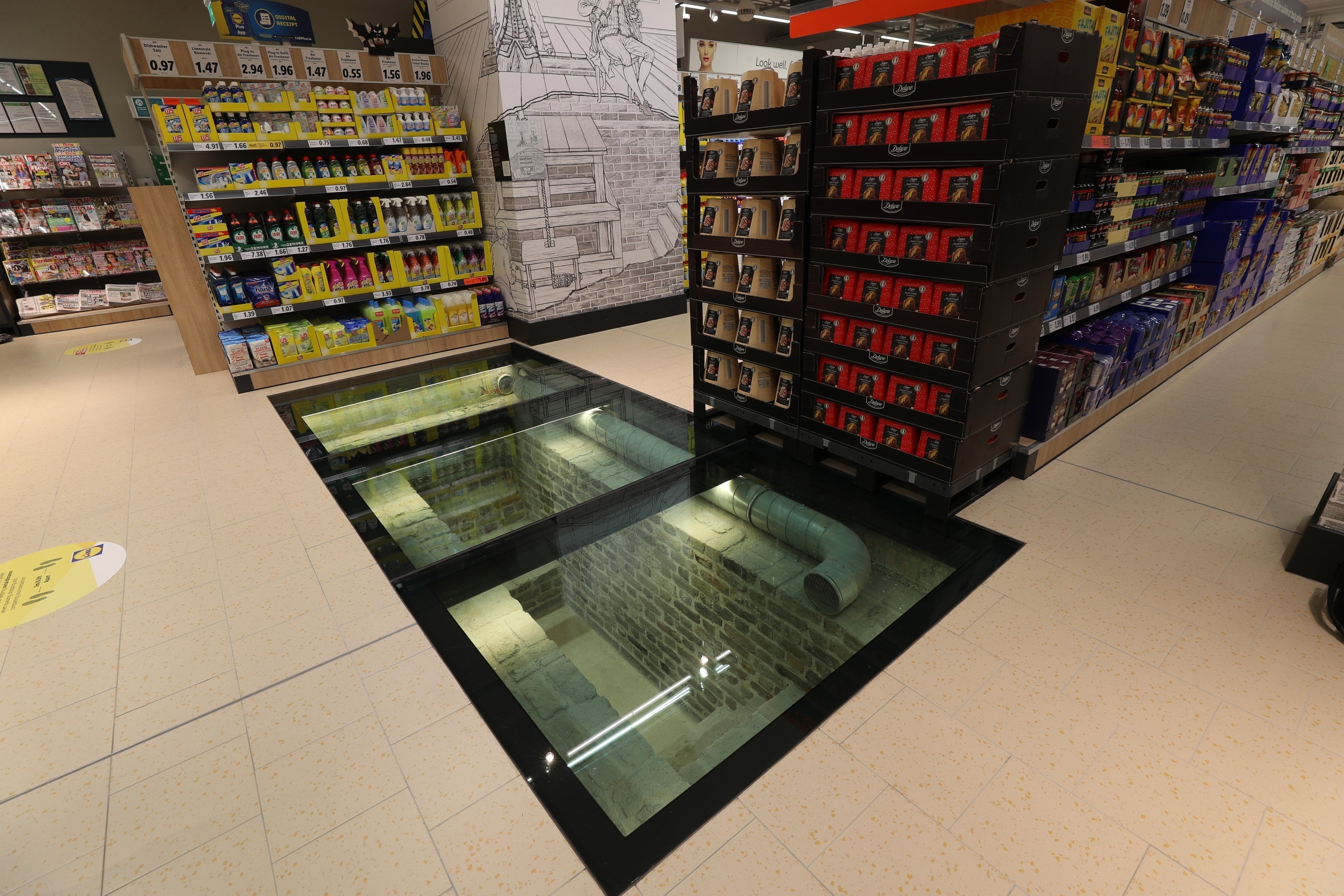
The 11th-Century Viking Well Found Under Dublin Lidl Store
In October 2020, a Lidl supermarket opened on Aungier Street in central Dublin, Ireland, revealing an unexpected window into the city's medieval past. During construction preparations in 2019, archaeologists uncovered the remains of an 11th-century sunken-floored structure associated with Hiberno-Norse inhabitants. This find, dated to approximately 1070 AD, lies near Dublin Castle in an area long recognized for its Viking-era archaeology. Rather than covering the remains, developers integrated them into the store's design with glass flooring panels, allowing shoppers to view the site below. The discovery highlights the challenges and opportunities of urban archaeology in a city founded as a Viking settlement in the 9th century.
Viking-Age Dublin: Historical Background

Vikings from Norway established a longphort, or fortified naval base, at Dublin around 841 AD, initially as a raiding outpost. By the late 9th century, it evolved into a permanent settlement known as Dyflin, becoming a major trading hub in the Irish Sea network. Archaeological evidence from sites like Wood Quay, excavated in the 1970s and 1980s, reveals wooden houses, streets, and workshops from this period. Dublin's population grew through intermarriage with local Gaelic Irish, leading to a hybrid culture by the 11th century. The city's strategic location facilitated trade in slaves, timber, amber, and walrus ivory, connecting it to Scandinavia, Britain, and beyond. Key figures such as Sigtrygg Silkbeard, king of Dublin from 989 to 1036, oversaw expansions that solidified its economic dominance.
Hiberno-Norse Culture
The term Hiberno-Norse describes the blended Scandinavian-Irish society that emerged in Dublin by the 10th and 11th centuries. Inhabitants spoke Old Norse influenced by Gaelic, practiced a mix of pagan and Christian rituals, and adopted local building styles while retaining Viking shipbuilding expertise. Domestic architecture typically featured post-and-wattle construction with thatched roofs, often including sunken floors for storage or insulation. Artifacts from similar sites include bone combs, amber beads, and iron tools, reflecting daily life. By 1070 AD, Dublin had transitioned fully to Christianity, with churches like Christ Church Cathedral founded in 1030 AD nearby. This cultural fusion persisted until the Anglo-Norman invasion in 1170 AD, which integrated Dublin into the English sphere.
The Excavation Process
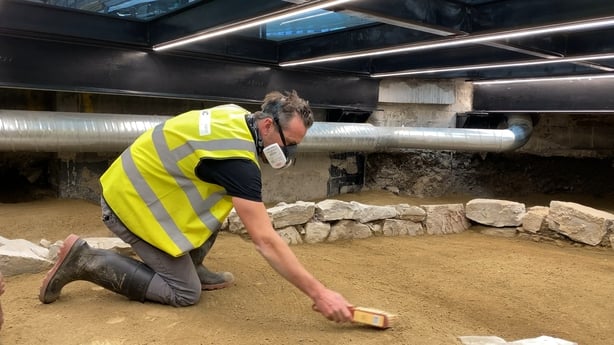
Shot of Archaeological Paul Duffy working underneath the store's glass floor.
Irish law requires archaeological assessments for developments in historically sensitive areas like Dublin's medieval core. In 2018, the Irish Archaeological Consultancy (IAC) conducted test trenching at the Aungier Street site, initially expecting remnants of the medieval St. Peter's Church, active from around 1050 to 1650 AD. Instead, excavations directed by Paul Duffy revealed earlier features. The dig, completed in 2019, uncovered layers spanning from the 11th to 18th centuries. Dublin City Council's conservation team mandated preservation in situ, leading to design modifications for the Lidl store and adjacent Scape student accommodation.
Key Archaeological Finds
The primary discovery was a rectangular sunken-floored building measuring approximately 3 meters by 2 meters, dug about 1 meter into the ground. Radiocarbon dating of wooden elements places its construction around 1070 AD. The structure represents a rare intact example of Hiberno-Norse domestic architecture in urban Dublin.
Excavators recovered a 13th-century wine jug, likely imported from Saintonge in France, indicating trade connections. Other finds included pottery sherds, animal bones, and charcoal residues suggesting domestic use. Later layers yielded remnants of the 18th-century Aungier Street Theatre's pit trap, a wooden staircase used for stage effects.
Detailed Description of the Structure
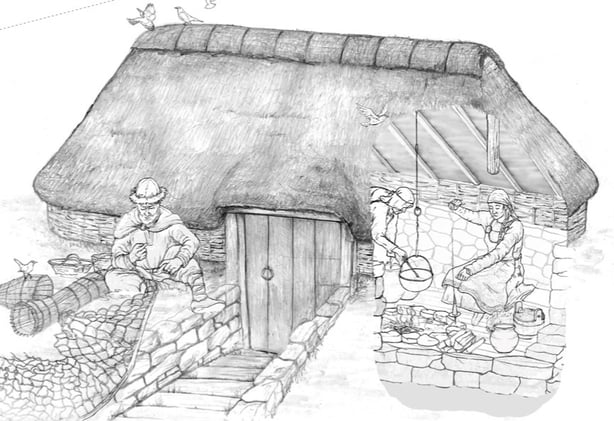
A sketch (by Matthew Ryan) depicting what the structure would have originally looked like.
Construction Techniques
Builders excavated the pit and lined the walls with local calp limestone slabs and oak planks, sourced from nearby woodlands. The floor consisted of compacted clay, while the roof featured a thatched covering supported by an arched wooden frame of hazel or willow branches. Postholes indicate internal supports, and evidence of repairs suggests occupation for several decades. A fire scar on one plank points to a minor conflagration around 1100 AD, after which the structure was rebuilt. This building technique parallels those found at rural sites like Deer Park Farms in Northern Ireland but is uncommon in Dublin's urban excavations.
Function and Use
The structure likely served as a semi-subterranean storage space or ancillary room attached to a larger above-ground house. Its depth provided insulation for perishable goods, and a gully channeled rainwater into an internal cistern for water collection.
Popular media often mislabels this as a "Viking well," but archaeologists classify it as a cistern within a domestic context. Organic residues indicate storage of foodstuffs, while its proximity to Aungier Street suggests integration into a suburban neighborhood outside Dublin's main walled area.
Preservation Decisions and Implementation

Photo originally shared by Lidl Ireland.
Lidl Ireland, IAC, and Dublin City Council collaborated to preserve the site. Paul Duffy, IAC's archaeological director, emphasized the structure's uniqueness as the first such Hiberno-Norse find in Dublin. Developers altered floor plans to avoid disturbing the remains, incorporating toughened plexiglass panels capable of supporting foot traffic.
This approach complied with Ireland's National Monuments Acts, which prioritize in situ preservation for significant finds.
Two glass panels were installed: one amid home goods aisles revealing the Hiberno-Norse structure, and another near checkouts displaying the theater staircase. Informational plaques provide context, detailing the site's history and excavation process. The design ensures the remains stay protected from moisture and vibration, with monitoring systems in place.
Public Access and Educational Impact
Since opening on 15 October 2020, the store has attracted visitors beyond shoppers, including history enthusiasts and tourists. The display democratizes archaeology, allowing free public access without museum fees. Educational programs, such as guided tours organized by Dublin Civic Trust, have utilized the site to teach about Viking Dublin. Media coverage from outlets like RTÉ and Smithsonian Magazine has heightened awareness, contributing to broader appreciation of Ireland's medieval heritage.
Broader Significance in Medieval Archaeology
This discovery adds to understanding of suburban expansion in 11th-century Dublin, suggesting denser settlement beyond the core at Fishamble Street and Winetavern Street. It complements major excavations like Wood Quay, which uncovered over 200 Viking houses, by providing evidence of peripheral domestic life. The site's integration into a commercial space exemplifies modern heritage management, influencing similar projects in cities like York and London.
Historical Uncertainties and Scholarly Perspectives
Information on the structure's exact occupants remains limited, as no human remains or inscribed artifacts were found. Dating relies on radiocarbon analysis with a margin of error, and the absence of comparable urban examples creates uncertainties about its prevalence. Scholars like Linzi Simpson, a consultant on the project, view it as a storage annex, while others suggest possible craft use based on tool marks. Contrasting interpretations attribute the cistern to practical water management rather than ritual purposes, aligning with functionalist schools in Viking archaeology.
The 11th-century Hiberno-Norse structure beneath Dublin's Aungier Street Lidl, uncovered during 2019 excavations and dated to circa 1070 AD, offers a tangible link to Viking-age suburban life. Through collaborative preservation by Lidl, IAC, and Dublin authorities, glass flooring enables public viewing of its limestone-lined walls, wooden frame, and cistern. This find enriches knowledge of Hiberno-Norse culture, highlighting domestic architecture and trade in medieval Dublin. Within broader European narratives, it underscores the enduring legacy of Viking settlements, blending Scandinavian and Irish elements, and demonstrates innovative urban archaeology that balances development with heritage conservation.
Frequently Asked Questions (FAQs)
What was discovered under the Lidl on Aungier Street?
A sunken-floored Hiberno-Norse structure dated to around 1070 AD, likely used for storage, with a cistern for water collection.
Why is it called a "Viking well"?
Popular media uses the term due to the cistern, but archaeologists describe it as a domestic feature, not a standalone well.
Who conducted the excavation?
The Irish Archaeological Consultancy (IAC), directed by Paul Duffy, as part of pre-construction assessments.
How can visitors see the remains?
Through glass flooring panels in the store, one showing the structure and another an 18th-century theater staircase.
What is the historical significance?
It provides rare evidence of 11th-century suburban Dublin, illustrating Hiberno-Norse daily life and building techniques.
References
Duffy, Paul. "Excavations at Aungier Street and George's Street, Dublin." In Medieval Dublin XIX, edited by Seán Duffy. Four Courts Press, 2023.
"New Lidl Store Gives Shoppers Glimpse of Dublin's Past." RTÉ News, 14 October 2020. (Contemporary news coverage with expert quotes.)
Bromwell, Philip. "Shoppers at Dublin Grocery Store Glimpse Viking History Beneath Their Feet." Smithsonian Magazine, 28 October 2020.
Simpson, Linzi. "Archaeological Assessment: Aungier Street, Dublin." Irish Archaeological Consultancy Report, 2019.
Hurley, Mary F., and Claire Walsh. Archaeological Excavations at Wood Quay, Dublin. National Monuments Service, 1997.







Leave a comment
This site is protected by hCaptcha and the hCaptcha Privacy Policy and Terms of Service apply.