Sleipnir: The Eight-Legged Horse of Norse Mythology
Sleipnir occupies a unique position within Norse mythology as the mount of Odin and one of the most unusual creatures in medieval European mythological literature. Described as an eight-legged horse capable of travelling between worlds, Sleipnir appears in several Old Norse texts preserved in medieval Icelandic manuscripts. These accounts portray the animal not merely as a supernatural steed but as a symbol tied to kingship, warfare, death, and cosmological movement.
The surviving evidence for Sleipnir comes primarily from the Poetic Edda, the Prose Edda, skaldic poetry, and archaeological imagery from Viking Age Scandinavia. Although the stories were written down in the 13th century after Scandinavia’s conversion to Christianity, they preserve traditions rooted in earlier oral culture.
The Poetic Edda
References to Sleipnir appear throughout the Poetic Edda, particularly in poems associated with Odin and journeys between worlds. In Grímnismál, Sleipnir is described as the finest of horses:
“Sleipnir er beztr hesta.”
This brief statement reflects the animal’s elevated status within the Norse cosmological hierarchy. The poems also associate Sleipnir with journeys to Hel, the realm of the dead, reinforcing the horse’s role as a being capable of crossing supernatural boundaries.
In Baldrs draumar, Odin rides Sleipnir into the underworld in search of knowledge concerning the fate of Baldr. The horse functions as a vehicle enabling movement between the worlds of gods, living humans, and the dead.
The Prose Edda
The most detailed account of Sleipnir survives in the Prose Edda, written by Snorri Sturluson during the early 13th century. Snorri identifies Sleipnir as Odin’s horse and describes him as grey in colour with eight legs, capable of unmatched speed and endurance.
Snorri also records the myth explaining Sleipnir’s birth, a narrative involving Loki, a giant builder, and the stallion Svaðilfari. This story became the central literary tradition associated with Sleipnir in medieval Icelandic literature.
Skaldic and Saga References
Sleipnir also appears in skaldic poetry and saga literature. Poets used the horse in kennings and metaphorical expressions associated with travel, battle, and elite status. Such references demonstrate that Sleipnir was widely recognised throughout Norse literary culture.
Although the references are often brief, they indicate that the figure held symbolic importance beyond individual myths. Sleipnir represented not only Odin’s mount but also an idealised supernatural horse connected to movement, prestige, and divine authority.

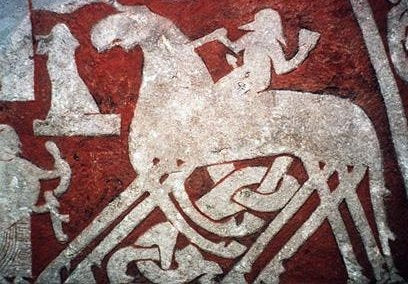
The Ardre VIII stone, depicting Odin and Sleipnir at the top right side (Photo: Michael Fergusson (CC BY 4.0)
The Birth of Sleipnir
The Builder of Ásgarðr
The story of Sleipnir’s birth begins with the construction of the walls surrounding Asgard, the stronghold of the gods. According to the Prose Edda, an unnamed builder offered to complete the fortifications within a single winter in exchange for the goddess Freyja, as well as the sun and moon.
The gods initially rejected the proposal but later agreed under strict conditions, believing the task impossible. The builder, however, possessed an extraordinarily powerful stallion named Svaðilfari, whose strength enabled rapid progress.
As the deadline approached, the gods realised the builder might succeed. They blamed Loki for persuading them to accept the bargain and demanded that he resolve the situation.
Loki’s Transformation
To prevent completion of the walls, Loki transformed himself into a mare and lured Svaðilfari away from the construction site. The stallion pursued Loki throughout the night, disrupting the builder’s work and ensuring he failed to complete the fortifications on time.
The myth reflects Loki’s ambiguous role within Norse mythology. He acts simultaneously as problem-maker and problem-solver, using deception and transformation to preserve the gods’ interests.
Shape-shifting appears frequently in Norse mythological narratives, but Loki’s transformation into a mare is among the most striking examples. Medieval Icelandic authors treated the episode with a mixture of humour and discomfort, reflecting broader Norse attitudes toward gender fluidity and magical transformation within mythological contexts.
Sleipnir’s Birth
Following the encounter with Svaðilfari, Loki gave birth to Sleipnir. Snorri describes the horse as grey and possessing eight legs, adding that he became the finest horse among gods and men.
The birth of Sleipnir from Loki and Svaðilfari places the animal in an unusual genealogical position. He emerges from both divine and giant-associated origins, reflecting the blurred boundaries common within Norse cosmology.
Sleipnir and Odin
Travel Between Worlds
Sleipnir’s most important role in Norse mythology involves Odin’s journeys across cosmic boundaries. Unlike ordinary horses, Sleipnir moves freely between the realms connected by Yggdrasil, the great world tree.
In Baldrs draumar, Odin rides Sleipnir to Hel in order to consult a dead völva regarding prophetic knowledge. This journey emphasizes the horse’s role as a psychopompic creature associated with passage into the realm of the dead.
The ability to traverse worlds also reinforced Odin’s identity as a god of wisdom, magic, and hidden knowledge. Sleipnir functions as the means through which Odin accesses otherwise unreachable realms.

Odin and Sleipnir by John Bauer
Sleipnir in Warfare and Kingship
Horses held immense importance within Germanic and Scandinavian societies. They served as symbols of status, mobility, warfare, and aristocratic power. Sleipnir represents the supernatural culmination of these associations.
As Odin’s mount, Sleipnir became linked to kingship and military authority. Scandinavian rulers frequently associated themselves with Odin, particularly in royal genealogies and warrior ideology. Possession of an extraordinary horse therefore reinforced divine legitimacy and elite status.
The horse also appears in depictions connected to battle and funerary symbolism, suggesting broader associations with warrior identity and the afterlife.
Symbolism and Interpretation
The Eight Legs
The most distinctive feature of Sleipnir is his eight legs. Medieval texts do not explicitly explain their significance, leading to extensive scholarly interpretation.
Some historians interpret the eight legs as a symbolic representation of extraordinary speed. Others argue they may reflect artistic or ritual imagery connected to funerary processions, in which four bearers carrying a bier create the visual impression of an eight-legged horse.
Another interpretation links the number eight to cosmological symbolism or ritual numerology within Germanic religion. However, definitive conclusions remain impossible because the sources themselves provide no direct explanation.
Death and the Otherworld
Sleipnir’s repeated association with journeys to Hel and the dead has led many scholars to interpret the horse as a symbol of transition between life and death.
Horses played an important role in Germanic burial practices. Archaeological evidence from Viking Age graves demonstrates that horses were often sacrificed and buried alongside elite individuals. These practices suggest beliefs connecting horses to status, mobility, and the afterlife.
Sleipnir may therefore represent a mythological extension of real-world ritual associations between horses and funerary journeys.
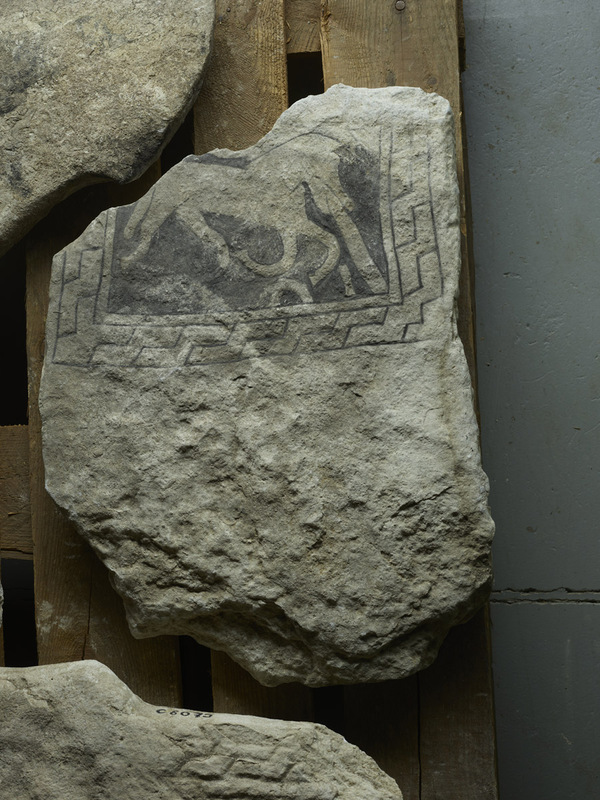
Picture stone, 'GP 164 Halla Broa XV', from Gotland (Photo: Michael Fergusson CC BY 4.0)
Shamanic and Religious Theories
Some modern scholars have proposed that Sleipnir’s role reflects shamanic elements within Norse religion. Odin himself is frequently associated with ecstatic practices, altered states, and journeys beyond ordinary reality.
In this interpretation, Sleipnir functions as a symbolic vehicle for spiritual travel. However, the application of the term “shamanism” to Norse religion remains controversial among historians and scholars of religion. Critics argue that such interpretations risk oversimplifying complex cultural traditions through modern comparative frameworks.
Sleipnir in Archaeology and Art
Picture Stones and Carvings
Visual depictions believed to represent Sleipnir appear on several Viking Age picture stones from Gotland. These stones often depict mounted figures approaching scenes associated with the dead or the divine.
The imagery is frequently ambiguous, but many scholars identify certain eight-legged horses as representations of Sleipnir carrying Odin or deceased warriors.
The Tjängvide and Ardre Stones
The Tjängvide image stone is among the most discussed examples. It depicts a rider approaching a female figure offering a drinking horn, imagery often associated with arrival in Valhǫll.
Similarly, the Ardre picture stones contain scenes interpreted as mythological narratives involving Odin and Sleipnir. Although interpretations remain debated, these monuments demonstrate the importance of horse imagery within Viking Age visual culture.

Picture stone, 'GP 15 Ardre kyrka I', from Gotland (Photo: Michael Fergusson CC BY 4.0)
Christianisation and Medieval Preservation
The preservation of Sleipnir myths depended largely on medieval Icelandic writers working after the conversion to Christianity. Authors such as Snorri Sturluson viewed the old myths as part of a cultural and literary heritage rather than active religious belief.
This Christian context shaped the surviving material. Certain aspects of pagan religion may have been altered, simplified, or omitted entirely. Nevertheless, the continuity of Sleipnir imagery and references across multiple sources suggests the horse held genuine importance within earlier Scandinavian traditions.
Conclusion
Sleipnir stands as one of the most distinctive figures in Norse mythology, combining themes of movement, death, kingship, and supernatural power. As Odin’s eight-legged horse, he embodied the ability to cross boundaries between worlds, linking the divine, human, and underworld realms.
The myths surrounding Sleipnir reflect broader realities of Scandinavian society, where horses represented status, mobility, and martial prestige. Archaeological evidence, literary references, and artistic depictions together demonstrate the cultural significance of horses within the Viking Age and earlier Germanic traditions.
Although many aspects of Sleipnir’s symbolism remain uncertain, the surviving evidence reveals a figure deeply connected to Norse cosmology and ritual imagination. Through Odin’s journeys and the mythic landscape of the Eddas, Sleipnir became not merely a supernatural animal but a representation of passage itself — between lands, between worlds, and between life and death.
Frequently Asked Questions (FAQs)
Who was Sleipnir in Norse mythology?
Sleipnir was Odin’s eight-legged horse and is described as the finest horse among gods and men.
Who were Sleipnir’s parents?
According to the Prose Edda, Sleipnir was born from Loki, who transformed into a mare, and the stallion Svaðilfari.
Why did Sleipnir have eight legs?
The sources do not explain the symbolism directly, and scholars continue to debate its meaning.
What role did Sleipnir play in Norse mythology?
Sleipnir carried Odin between worlds, including journeys to the underworld and across the Norse cosmos.
Are there archaeological depictions of Sleipnir?
Several Viking Age picture stones from Gotland are commonly interpreted as depicting Sleipnir and Odin.
References
Faulkes, Anthony (trans.). Edda.
Larrington, Carolyne (trans.). The Poetic Edda.
Simek, Rudolf. Dictionary of Northern Mythology.
Davidson, H. R. Ellis. Gods and Myths of Northern Europe.
Turville-Petre, E. O. G. Myth and Religion of the North.
Lindow, John. Norse Mythology: A Guide to Gods, Heroes, Rituals, and Beliefs.
Price, Neil. The Viking Way.



Leave a comment
This site is protected by hCaptcha and the hCaptcha Privacy Policy and Terms of Service apply.