
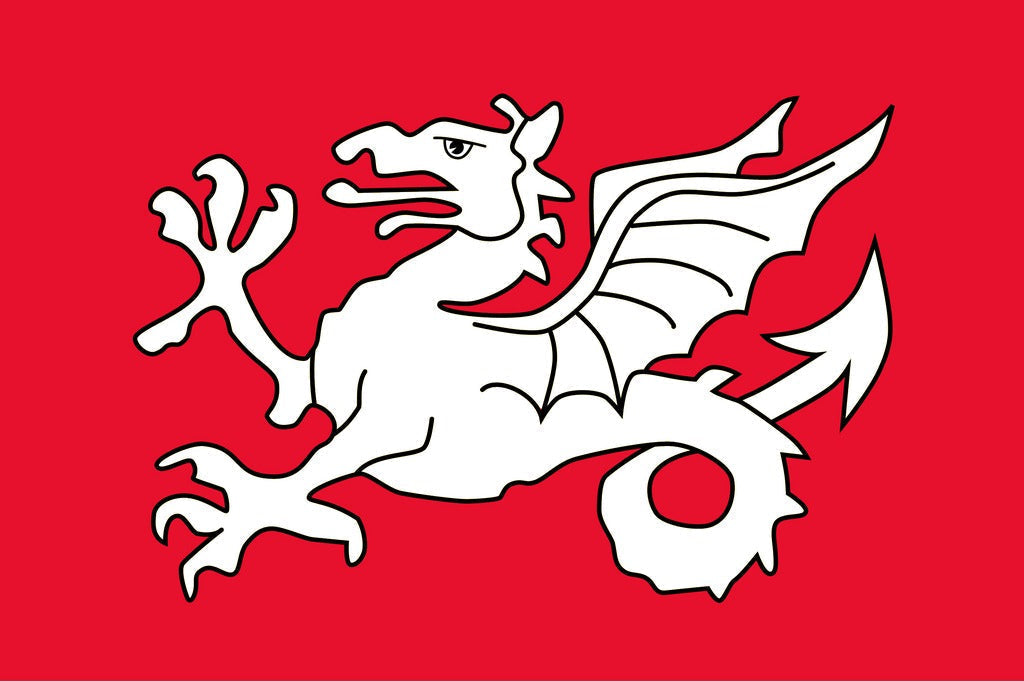
The White Wyrm: Symbol of the Ængles in Medieval British Lore
The White Wyrm, often rendered as the White Dragon in Latin and Welsh sources, stands as a potent emblem in medieval British mythology, representing the invading Anglo-Saxon peoples, including the Ængles. This creature appears in prophecies symbolizing conflict between native Britons and Germanic settlers during the 5th and 6th centuries CE. Unlike the typically malevolent wyrms in Germanic folklore, the White Wyrm assumes a role that, from an Anglo-Saxon perspective, could signify strength and destiny, though British chroniclers portrayed it as an antagonistic force.
Primary sources include the Historia Brittonum, attributed to Nennius around 829 CE, and Geoffrey of Monmouth's Historia Regum Britanniae, completed circa 1136 CE. These texts, written from a Brittonic viewpoint, frame the wyrm within Arthurian precursors. Anglo-Saxon records like the Anglo-Saxon Chronicle offer no direct mentions, creating uncertainties about its adoption among the Ængles themselves. The term "wyrm" derives from Old English, denoting serpents or dragons, while "white" may evoke purity, power, or opposition to the red dragon of the Britons.
Mythological Origins
The tale of the White Wyrm originates in the Historia Brittonum, where it features in a prophetic vision. King Vortigern, a 5th-century British ruler, attempts to build a tower at Dinas Emrys in Snowdonia, but the structure collapses nightly. Advisors recommend sprinkling the blood of a fatherless boy on the site. They find young Ambrosius (later Merlin), who reveals an underground pool containing two dragons—one red and one white—locked in combat.
Upon release, the dragons fight fiercely. The red dragon, symbolizing the native Britons, ultimately prevails over the white, representing the Saxon invaders. Ambrosius interprets this as a sign that the Britons will eventually repel the foreigners, though Vortigern's troubles persist. This narrative, likely drawing from earlier Welsh oral traditions, positions the White Wyrm as a harbinger of invasion and strife.
Interpretations in Medieval Chronicles
Geoffrey of Monmouth expands the story in his Historia Regum Britanniae, identifying the boy as Merlin and integrating it into the Arthurian cycle. Merlin explains to Vortigern that the white dragon signifies the Saxons, who initially dominate but face eventual defeat by the red dragon's people. Geoffrey's account, influential in shaping medieval British history, portrays the white dragon as embodying the Ængles, Saxons, and Jutes' aggressive expansion.
In these chronicles, the White Wyrm symbolizes foreign oppression from a British perspective, yet it underscores the invaders' formidable presence. The color white may derive from heraldic contrasts or natural symbolism, though no contemporary Anglo-Saxon texts confirm its use as a banner. Scholars attribute the story's popularity to its explanatory power for the subjugation of Celtic Britain.
The White Wyrm in Germanic Lore
Germanic mythology frequently depicts wyrms as destructive or dangerous creatures. In Beowulf (composed between the 8th and 11th centuries CE), the unnamed wyrm is a greedy guardian of treasure that devastates the land when disturbed. In the Völsunga Saga and related Norse myths, Fáfnir becomes a wyrm through avarice, while Níðhöggr gnaws at the roots of Yggdrasil and the Miðgarðsormr encircles the world—serpentine beings functionally equivalent to dragons in many traditions, even if often wingless in northern art.
The White Wyrm contrasts this pattern by serving as a tribal symbol for the Ængles and allies, potentially viewed positively as a protector or emblem of victory. From the invaders' standpoint, it represents conquest and settlement, not inherent evil. This duality arises from the sources' Brittonic bias; Anglo-Saxon lore lacks equivalent positive wyrms, suggesting the symbol's adoption post-migration or as a retrospective motif.
Connection to the Ængle.
The Ængles, one of the primary Germanic tribes migrating to Britain from Angeln in modern Schleswig-Holstein around 450 CE, formed kingdoms like Northumbria, Mercia, and East Anglia. The White Wyrm's association stems from its representation of all Anglo-Saxon groups in British texts, encompassing the Ængles' role in displacing Romano-Britons.
Bede's Historia Ecclesiastica Gentis Anglorum (731 CE) details the Ængles' arrival but mentions no dragon symbols. The wyrm's link likely reflects Welsh perceptions of the invaders as a unified, draconic threat. In later traditions, the White Dragon flag appears in heraldry, sometimes claimed as an ancient Ænglish banner, though evidence remains limited to post-medieval revivals.
Possible Links to White Stallions
A possible thematic parallel exists with white stallion motifs in Anglo-Saxon tradition. The legendary brothers Hengist and Horsa, whose names mean "stallion" and "horse" in Old English, purportedly led the Anglo-Saxon invasion at Ebbsfleet in Kent around 449 CE, as recorded by Bede. Kent's flag features a white horse rampant on red, symbolizing these figures and broader Saxon heritage.
The white color in both dragon and horse symbols may denote purity or divine favor in Germanic culture, as seen in Tacitus' Germania (98 CE), describing sacred white horses among continental Germans. No direct textual link ties the wyrm to stallions, but both serve as animal totems for invading tribes, possibly reflecting shared Indo-European archetypes.
Archaeological and Heraldic Evidence
Archaeological finds offer indirect support. The Bayeux Tapestry (c. 1070s CE) depicts a golden dragon standard for King Harold Godwinson at Hastings, indicating dragon banners among Anglo-Saxons. Wessex's golden wyvern, mentioned in later sources, suggests regional variations.
Heraldically, the White Dragon reemerges in modern contexts, such as flags for English nationalism, drawing from Geoffrey's narrative. No pre-Norman artifacts confirm a white variant, leaving its historical use uncertain.
Historiographical Debates
Scholars debate the legend's origins. John Morris (1973) views it as a genuine 5th-century memory, while Nicholas Higham (1992) argues it as 9th-century Welsh propaganda to explain losses. Herwig Wolfram (1988) notes that wyrms are well-attested in Germanic (including Norse) mythology—Níðhöggr, Fáfnir, the Miðgarðsormr, and the dragon in Beowulf—but are almost always antagonistic or chaotic rather than positive royal emblems. This makes the White Wyrm's tribal symbolism unusual and possibly influenced by Celtic narrative traditions or later adaptations. Modern interpretations, per Matthew Townsend (2009), see it as a metaphor for ethnic conflict, with the white wyrm embodying Germanic expansionism while drawing on shared mythological motifs.
Uncertainties and Limited Information
Anglo-Saxon sources provide no corroboration for the White Wyrm as a self-adopted symbol, raising questions about its authenticity among the Ængles. The story's Welsh provenance may exaggerate or invent details. Limited pre-9th-century material surviving overall complicates firm conclusions about early usage.
The White Wyrm encapsulates the cultural clash between Britons and Ængles during Britain's transformation into England, symbolizing Germanic invaders in a narrative of prophecy and conflict. Contrasting typical wyrm malevolence, it potentially represents positive tribal identity from an Anglo-Saxon view, paralleling motifs like white stallions in migration legends. Its legacy endures in heraldry and national symbolism, highlighting the Migration Period's enduring impact on British identity.
Frequently Asked Questions (FAQs)
What does the White Wyrm symbolize?
In medieval British texts, it represents the Anglo-Saxons, including the Ængles, as invaders opposing the native Britons symbolized by the red dragon.
Where does the White Wyrm story originate?
It first appears in the Historia Brittonum (c. 829 CE), attributed to Nennius, involving King Vortigern and a prophetic battle of dragons.
Is the White Wyrm a "good" dragon in Germanic lore?
Germanic myths typically portray wyrms as evil or greedy, but as a symbol for the Ængles, it could signify strength positively from their perspective.
How is it connected to white stallions?
No direct link exists, but both are white animal emblems; white horses appear in Anglo-Saxon legends like Hengist and Horsa, possibly sharing symbolic roots.
Was the White Wyrm an actual Anglo-Saxon banner?
No contemporary evidence confirms it; dragon standards existed, but the white variant stems from British chronicles.
References
"White dragon flag of Wessex" by Dragovit is licensed under CC BY-SA 3.0.
Nennius. Historia Brittonum. Translated by John Allen Giles. James Bohn, 1841.
Geoffrey of Monmouth. Historia Regum Britanniae. Translated by Lewis Thorpe. Penguin Classics, 1966.
Bede. Historia Ecclesiastica Gentis Anglorum. Translated by Leo Sherley-Price. Penguin Classics, 1990.
Higham, Nicholas J. Rome, Britain and the Anglo-Saxons. Seaby, 1992.
Wolfram, Herwig. History of the Goths. University of California Press, 1988.
Morris, John. The Age of Arthur: A History of the British Isles from 350 to 650. Weidenfeld & Nicolson, 1973.
Townsend, Matthew. The Viking Age in Scotland: Studies in Expansion and Settlement. Edinburgh University Press, 2009.







Leave a comment
This site is protected by hCaptcha and the hCaptcha Privacy Policy and Terms of Service apply.