
The Oera Linda Book: A 19th-Century Frisian Manuscript and Its Claims
The Oera Linda Book is a manuscript published in 1872 that claims to be an ancient chronicle of the Frisian people, covering events from around 2194 BCE to 1256 CE. The text presents the Frisians as descendants of a superior ancient civilisation with advanced laws, religion, and global influence, while warning against corruption and external threats. Scholars regard it as a 19th-century forgery, likely a hoax, but it holds interest as a cultural document reflecting Frisian identity struggles.
The book was "discovered" by Cornelis over de Linden in 1867 and translated into Dutch by Jan Ottema. An English version appeared in 1876 by William R. Sandbach. The original manuscript resides in the Tresoar archive in Leeuwarden, Netherlands. No pre-19th-century references exist, and its content contradicts established history. The book's emergence coincided with Frisian efforts to preserve their language and culture amid Dutch assimilation in the Netherlands after 1815. Uncertainties include the precise authorship and intent, though evidence points to a collaborative 19th-century creation.
Discovery and Publication
Cornelis over de Linden, a Dutch shipbuilder from Den Helder, claimed the manuscript had been in his family since 1256 CE, inherited in 1848. He presented it to the Frisian Society for History and Culture in 1867. Jan Ottema, the society's librarian, examined it and became convinced of its authenticity based on the language and content.
Ottema published De Oera Linda Boek in 1872, including a Dutch translation, commentary, and facsimiles. The book attracted immediate attention and controversy. Supporters like Ottema argued for its antiquity, while critics pointed to modern paper and ink. William R. Sandbach's 1876 English edition, available on Project Gutenberg, brought it to a wider audience. Editions continued into the 20th century, often with pseudohistorical commentary.
The Manuscript and Script
The physical manuscript is a quarto volume on 19th-century paper, with 190 pages in black ink and red initials. It claims to be a 1256 CE copy by Hidde Oera Linda, based on earlier transcripts from citadels like Fryasburgt.

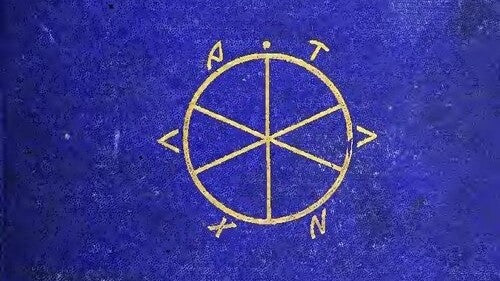
The script is an invented alphabet resembling runes, with 34 letters derived from the "Juul" or "Yule" wheel, a circular symbol representing Wr-alda. This script phonetically renders an archaic Frisian dialect, blending runic elements with 19th-century linguistic features.
Narrative Structure and Content
The book is structured as a collection of writings by successive authors, presented as inscriptions preserved in Frisian citadels. It begins with prefaces and letters urging transmission.
Mythological origins describe creation by Wr-alda, the eternal spirit, and the emergence of three mothers—Lyda, Finda, and Frya—from whom the three races descend. Lyda is described as black-skinned from hot lands, Finda as yellow-skinned from eastern lands, and Frya as white-skinned from temperate lands. Frisians descend from Frya, who establishes laws at Texland.
Historical accounts cover the submersion of Atland (also called Aldland) in 2193 BCE, followed by migrations and conflicts with Finns, Magyars, and Romans. The narrative includes the founding of cities and the spread of Frisian influence.
Prophecies warn of decline and eventual renewal, with references to future periods when priestly oppression ends.
Key Themes and Claims
The book asserts Frisian supremacy, portraying them as originators of writing, navigation, and laws promoting equality. It advocates isolation from other peoples to preserve purity and warns against greed and excess wealth.
Moral teachings emphasise simplicity, communal labour, and restraint in exploiting resources. Mining for metals is permitted only for the common good, not private gain.
Corruption by priests and encroaching evil feature prominently. The text criticises priests as self-serving lords who deceive the people. A story illustrates gradual corruption in Denmark, where traders sell jewellery to parents until families fall into debt and poverty.
Historical Context of Creation
The Oera Linda Book arose during the 19th-century Frisian revival. Frisia, incorporated into the Kingdom of the Netherlands in 1815, experienced linguistic and cultural assimilation, with Dutch dominating education and administration. The Frisian Society for History and Culture (1827) and figures like Joast Hiddes Halbertsma promoted Frisian language and heritage.

Location of Frisian lands in northern Netherlands and Germany (Illustration: Ætoms CC BY-SA 4.0).
The book's emphasis on ancient Frisian glory likely responded to this erosion, envisioning a pre-Dutch era of independence. Scholars suggest it as a hoax or satire critiquing contemporary pseudoscience, nationalism, or religious authority.
Debates on Authenticity
Early critics noted anachronisms, modern paper (machine-made, post-1800), and inconsistent language. Chemical tests in 1871 confirmed 19th-century ink. Modern consensus, per Goffe Jensma (2004), attributes it to François Haverschmidt (Piet Paaltjens), Eelco Verwijs, and Cornelis over de Linden, as a literary hoax or parody.
Some 19th-century defenders, like Ottema, argued for authenticity, but by 1877, the hoax view prevailed.
Cultural Impact and Legacy & Uncertainties
The book influenced occult and fringe groups in the 20th century, including those seeking Aryan origins. It inspired literature but faced criticism for misuse. In modern Frisian studies, it serves as an artefact of cultural resistance.
Provenance depends on over de Linden's account, with no verification. Linguistic features mix genuine Old Frisian with inventions. Authorship and intent—hoax, satire, or forgery—remain debated, though Jensma's theory is leading.
The Oera Linda Book claims to chronicle ancient Frisian history from Wr-alda's creation and the three mothers to prophecies of decline, warning against greed, isolation from outsiders, and priestly corruption. Published in 1872 amid Frisian assimilation under Dutch influence, it is regarded as a 19th-century forgery. Despite this, the text provides insight into nationalist sentiments and pseudohistorical trends, serving as a cultural document of Frisian identity struggles.
Frequently Asked Questions (FAQs)
What is the Oera Linda Book's main structure?
It consists of prefaces, letters, mythological origins, historical accounts, and prophecies, written by successive authors.
What script does the book use?
An invented alphabet resembling runes, based on the "Juul" wheel symbol for Wr-alda.
What themes does the book emphasise?
Frisian supremacy, isolation from other peoples, anti-greed teachings, and warnings against priestly corruption and encroaching evil.
Is the Oera Linda Book authentic?
No; it is a 19th-century forgery, as shown by linguistic, material, and historical inconsistencies.
Why was the book created?
It likely responded to 19th-century Frisian cultural assimilation under Dutch influence, as a hoax or nationalist fiction.
References
Over de Linden, Cornelis, and Jan Ottema. De Oera Linda Boek. Tresoar, 1872.
Sandbach, William R. (trans.). The Oera Linda Book. Trübner & Co., 1876. Project Gutenberg, 2013. https://www.gutenberg.org/files/40986/40986-h/40986-h.htm
Jensma, Goffe. De gemaskerde god: François HaverSchmidt en het Oera Linda-boek. Zutphen: Walburg Pers, 2004.
Jensma, Goffe. "The Oera Linda Book: A Neo-Pagan Hoax and its Academic Reception." In Handbook of Religion and the Authority of Science, edited by James R. Lewis and Olav Hammer. Brill, 2010.
Shipley, John T. "The Oera Linda Book." The Journal of English and Germanic Philology 15, no. 4 (1916): 550–572.
Ottema, Jan G. Historical Notes and Comments on the Oera Linda Book. Kemink en Zoon, 1873.







Leave a comment
This site is protected by hCaptcha and the hCaptcha Privacy Policy and Terms of Service apply.