
The Epic Saga of Harald Hardrada: From Exile to Legend
Harald Sigurdsson was born around 1015, the son of Sigurd Syr, a petty king in Ringerike, and Åsta Gudbrandsdatter. Through his mother he was the younger half-brother of Olav Haraldsson, who became king of Norway in 1015 and would later be canonised as Saint Olav. Harald therefore belonged to the Norwegian royal family at a time when the kingdom was still being consolidated and Scandinavian rulers were competing for control of the North Sea.
Olav's reign brought him into conflict with Knútr the Great, the Danish king who had conquered England in 1016 and subsequently established his authority over Norway. Knútr's influence in Norway was represented by his son Sveinn and his allies, while Olav attempted to reclaim the kingdom he had lost. The struggle culminated at the Battle of Stiklestad in 1030, when Olav returned to Norway with an army and was defeated by a coalition of Norwegian nobles and farmers opposed to his rule.
Harald, only about fifteen years old, fought alongside his half-brother. The battle ended with Olav's death and Harald's flight from Norway. Wounded during the fighting, he escaped eastwards with other survivors and eventually reached the court of Jaroslav the Wise, ruler of Kyiv and Novgorod. The defeat that ended Harald's first attempt to establish himself in Norway instead began the fifteen-year period abroad that would make him one of the most experienced Scandinavian warriors of his generation.

Harald's ancestry according the Old Norse sagas / Photo: Paganheim
Harald in the Rus' and Byzantium
Harald's journey east took him into a world with which Scandinavian warriors had maintained close connections for generations. The river routes of eastern Europe linked the Baltic with the Black Sea, and Norsemen travelled through the lands of the Rus' as merchants, mercenaries and political adventurers. Harald entered the service of Jaroslav the Wise, although the later saga claim that he immediately became commander of Jaroslav's entire army is considered an exaggeration by modern scholarship. He nevertheless acquired military experience in the service of the Rus' before continuing south towards Constantinople.
By approximately 1034, Harald had entered the service of the Byzantine emperor as a member of the Varangian Guard, the elite formation of foreign warriors attached to the imperial court. Constantinople, known in Old Norse as Miklagarðr, was one of the largest and wealthiest cities in the medieval world, and Byzantine military service offered Harald opportunities for wealth and advancement on a scale that could not easily be matched in Scandinavia. He spent roughly a decade in Byzantine service, participating in campaigns across the empire and becoming the most famous Scandinavian associated with the Varangian Guard.
The later Icelandic sagas give Harald an almost legendary career in the Byzantine world, attributing to him campaigns in Sicily, the Balkans and the eastern Mediterranean. Some of these stories are difficult to verify individually, and the saga writers clearly presented Harald as an exceptionally successful warrior. His presence in Byzantine service itself, however, is well established. By the time he left Constantinople, Harald had accumulated enormous wealth, extensive military experience and connections reaching far beyond Scandinavia.
His position was further strengthened through his marriage to Ellisiv, daughter of Jaroslav the Wise, around 1043–1044. Harald was no longer simply an exiled Norwegian prince seeking his fortune abroad. He was now a wealthy and experienced war leader with an international reputation and a strong dynastic connection in the Rus'.

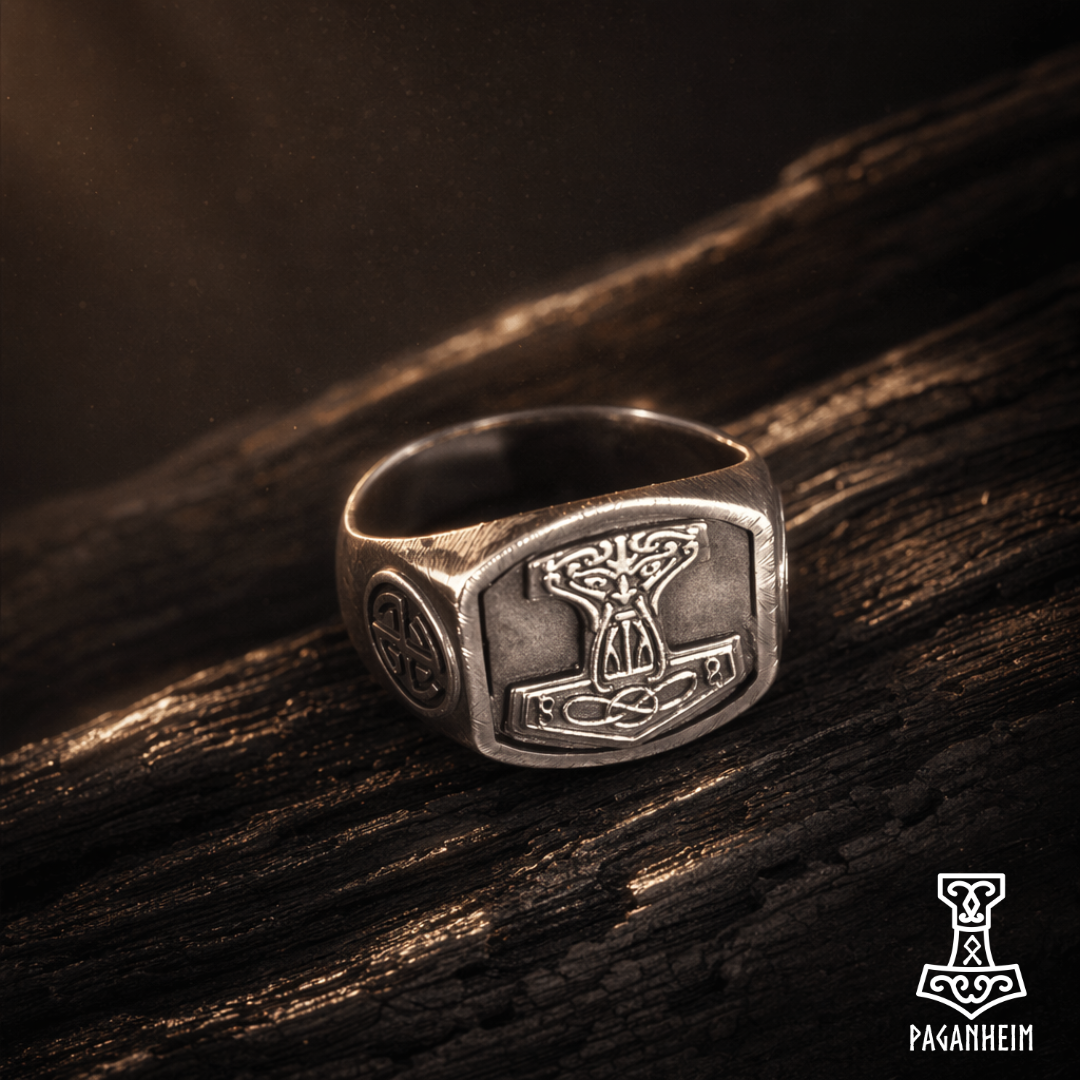
Valknut Valor: Norse Warrior's Ring
The Return to Norway
Harald returned to Scandinavia in 1045, after approximately fifteen years away from Norway. During his absence, the political situation had changed considerably. His nephew Magnus the Good, son of Olav Haraldsson, had become king of Norway in 1035 and had subsequently taken control of Denmark as well. Magnus had inherited the political legacy of his father and was already an established ruler when Harald arrived with his accumulated wealth and military following.
Harald's objective was straightforward: he wanted a share of the Norwegian kingship. Rather than immediately fight his nephew, he entered into an agreement with Magnus in 1046 under which the two ruled Norway together. The arrangement was short-lived, however, because Magnus died in 1047, leaving Harald as sole king of Norway. Harald's rise was therefore achieved through a combination of dynastic legitimacy, military power and political negotiation rather than a single act of conquest.
The king who emerged from this process was considerably different from the teenager who had fled Stiklestad. Harald had spent his formative adult years in foreign courts and armies, and his conception of kingship was correspondingly ambitious. He sought to strengthen royal authority over Norway and maintain the resources necessary to support a powerful royal household and military following.
Hardråde and the Norwegian Kingdom
The epithet Harðráði, usually rendered as “Hard Ruler” or “Hardrada”, reflects Harald's reputation for severity. His reign involved persistent efforts to strengthen royal authority over powerful regional interests, and the saga tradition portrays him as a demanding ruler who expected obedience from both nobles and farmers. This should not be understood simply as personal cruelty. Norway was still a relatively decentralised kingdom in which kings depended upon cooperation from local elites, and Harald was attempting to make royal authority more effective across the country.
His reign therefore formed part of the wider consolidation of the Norwegian kingdom. Harald maintained a large royal following, developed royal coinage and relied upon organised military resources, including the naval system associated with the leiðangr. His government also faced the financial pressures that came with maintaining a powerful monarchy. The silver content of some of his later coinage fell substantially, evidence of the economic demands placed upon the kingdom during his reign.

A triquetra symbol etched into a penny minted by Harald. Historically used by both Christians and Norse pagans, the symbol also appeared on Danish coins under Cnut the Great and his sons. Harald likely adopted the motif to reinforce his claim to the Danish throne (Photo: Zeichner: C. I. Schive).
Harald was also heavily involved in Scandinavian power politics. For much of his reign he fought Svend Estridsen, king of Denmark. The two had previously been associated as allies, but Harald now sought to recover the authority over Denmark that Magnus the Good had possessed. Their conflict lasted for years and involved repeated naval campaigns and attacks on Danish territory. Harald inflicted serious damage but never permanently conquered Denmark, and in 1064 the two kings finally reached a settlement and ended the war.
With Denmark no longer occupying his attention, Harald could turn towards a far more ambitious target.
Harald's Claim to England
The English throne became vacant in January 1066 when Edward the Confessor died without a direct heir. Harold Godwinson, the most powerful nobleman in England, was immediately crowned king, but his accession was challenged by both William, Duke of Normandy, and Harald Hardrada.
Harald's claim was rooted in the complicated succession arrangements surrounding the Scandinavian kings who had ruled England earlier in the century. He claimed that the kingdom had been promised or passed to Magnus the Good, whose rights Harald inherited. The precise legal basis of the claim was disputable, but medieval succession was not governed by a single fixed principle. Dynastic descent, previous agreements and the ability to enforce a claim by military power could all matter.

Anglo-Saxon Futhorc Carved Ring - Feoh, Nead, Sigel, Tiw
Harald also gained an important ally in Tostig Godwinson, Harold's exiled brother. Tostig had previously been Earl of Northumbria but had been driven from England after rebellion against him. He now offered Harald both a political connection and a potential source of support among opponents of the new English king.
In September 1066, Harald assembled a large Norwegian fleet and sailed towards England. The Anglo-Saxon Chronicle gives the traditional figure of approximately 300 ships, although the precise size of the army cannot be established. The expedition crossed through the northern islands before entering the Humber estuary, bringing Harald's forces directly into the region where Tostig had once held power.
Fulford and the Road to York
Harald and Tostig's first major engagement came at Fulford, near York, on 20 September 1066. The English forces were commanded by the northern earls Eadwine of Mercia and Morkere of Northumbria, who had assembled an army to stop the invasion before it could consolidate its position.
The battle ended in a decisive Norwegian victory. The defeat of the northern English earls left the road to York open, and Harald's army was able to establish control over the area. York itself surrendered, and the Norwegian king appeared to have achieved a strong position in northern England.
The victory was significant because the northern English kingdom was one of the most important centres of Scandinavian settlement and influence in England. The region had formed part of the Danelaw, and its population included communities whose connections to Scandinavia went back generations. Harald was therefore not invading an entirely foreign landscape. His campaign entered a part of England where Scandinavian political and cultural influence remained particularly strong.
Harald's position nevertheless depended upon the speed with which Harold Godwinson could respond. The English king had spent much of the summer preparing for William of Normandy's expected invasion in the south. When news arrived that Harald had landed in Yorkshire, Harold abandoned his preparations there and moved his army rapidly north.
The March to Stamford Bridge
Harold Godwinson's response was exceptionally fast. His army had already been mobilised in the south, and Harold now marched northwards with a substantial force, covering the distance to Yorkshire in remarkably little time. The speed of the march caught Harald's army off guard.

On 25 September 1066, the Norwegian forces were gathered at Stamford Bridge, just east of York. Harald had not expected Harold Godwinson to arrive so quickly, and much of the Norwegian army was dispersed or insufficiently equipped when the English appeared. The Norwegian forces nevertheless formed a defensive position and resisted the first English attacks.
The battle that followed was one of the bloodiest encounters of 1066. Harald's men initially fought effectively despite their disadvantage, and the fighting continued for hours. Later tradition places particular emphasis on the bridge itself, including the famous story of a lone Norwegian warrior who supposedly held the crossing until an Englishman killed him from beneath the bridge. This episode comes from later sources and cannot be treated as securely established, but the bridge clearly formed part of the battlefield's traditional memory.
The Norwegian position eventually collapsed under the sustained English assault. Harald Hardrada was killed during the fighting, as was Tostig Godwinson. The later saga tradition says that Harald was struck in the throat by an arrow, but the precise circumstances of his death are uncertain. What is beyond doubt is that the Norwegian king and a large portion of his army were killed on 25 September 1066, bringing the invasion to an abrupt end.
The Final Viking Invasion of England
The defeat at Stamford Bridge was catastrophic for the Norwegian invasion. Harald's surviving forces eventually returned to Norway under his son Olav Kyrre, and only a fraction of the original expeditionary fleet was required to carry the survivors home. Olav and his brother Magnus would later succeed their father as kings of Norway.

Harold Godwinson, from the Bayeux Tapestry.
For England, however, the consequences of Stamford Bridge extended far beyond the destruction of Harald's army. Harold Godwinson had won a decisive victory in the north, but his army was exhausted and had been forced to march across much of England. Within only a few days, news arrived that William of Normandy had landed in Sussex.
Harold therefore had to turn south once again. On 14 October 1066, he met William's Norman army at the Battle of Hastings, where the English king was killed and William ultimately secured the English crown. Stamford Bridge did not cause the Norman Conquest by itself, but Harald's invasion had forced Harold into a rapid northern campaign immediately before William's arrival. The two invasions therefore became inseparably connected in the events of 1066.
Harald Hardrada's Legacy
Harald Hardrada's importance lies in the extraordinary breadth of his career. Few Scandinavian rulers travelled so widely or accumulated experience in such different political worlds. He fought in Norway, served the rulers of the Rus', spent years in Byzantine military service and eventually returned to rule Norway before launching his final campaign against England.
As king, Harald played an important role in consolidating the Norwegian kingdom, and his descendants continued to occupy the throne for centuries. His death at Stamford Bridge is often regarded as one of the symbolic endpoints of the Viking Age, although Scandinavian warfare and overseas activity continued long afterwards. What ended with Harald was not Viking activity itself, but one of the last great attempts by a Scandinavian warrior king to win England through conquest.
Harald's career consequently stands at the boundary between two eras. He possessed the wealth, mobility and military ambitions associated with the Viking world, yet he was also a monarch ruling an increasingly organised Christian kingdom. His life connected the Scandinavian north with the Rus', Byzantium and England on an extraordinary scale, while his final defeat marked the failure of the last major Norwegian invasion of England.
Harald Hardrada died as he had lived: on a foreign battlefield, fighting for a crown. His career had carried him farther than almost any Scandinavian ruler of his generation, and his death at Stamford Bridge brought that remarkable age of overseas conquest to one of its most memorable endings.
Frequently Asked Questions (FAQs)
Who was Harald Hardrada?
Harald Hardrada was King of Norway from 1045 until his death in 1066. He was a former Varangian commander and one of the most prominent Scandinavian rulers of the eleventh century.
Why was Harald called Hardrada?
The Old Norse epithet Harðráði is generally understood as referring to his hard or harsh rule. It reflected his reputation as a forceful and uncompromising king.
Did Harald Hardrada serve in the Varangian Guard?
Yes. Harald spent part of his exile in Byzantine service as a Varangian and became one of the most famous Scandinavian commanders associated with the Byzantine imperial guard.
How did Harald Hardrada die?
Harald was killed at the Battle of Stamford Bridge in Yorkshire on 25 September 1066, while invading England. The exact circumstances of his death are uncertain, although later tradition says that he was struck by an arrow.
Was Harald Hardrada the last Viking king?
He is often described as the last great Viking king because his career represents one of the final major examples of the traditional Scandinavian warrior-king pursuing conquest overseas. The Viking Age itself did not end precisely with his death.
References
Snorri Sturluson. Heimskringla: Harald Hárdráði's Saga.
Anglo-Saxon Chronicle.
Ágrip af Nóregskonungasögum.
Benedikz, Benedict. The Varangians of Byzantium. Cambridge University Press, 1979.
Krag, Claus. “Harald Hardråde.” Store norske leksikon.
Dawkins, R. M. “The Later History of the Varangian Guard: Some Notes.” The Journal of Roman Studies, Vol. 37, 1947.
English Heritage. “The Events of 1066.”
English Heritage. “Stamford Bridge: The Other Battle of 1066."







Leave a comment
This site is protected by hCaptcha and the hCaptcha Privacy Policy and Terms of Service apply.