Article: The Galloway Hoard
The Galloway Hoard
On 1 September 2014, a metal detectorist searching farmland at Balmaghie in Kirkcudbrightshire, southwestern Scotland, uncovered one of the most remarkable early medieval hoards ever found in Britain or Ireland. What first appeared to be a collection of Viking-Age silver proved to be something considerably more unusual: a carefully assembled group of objects from Britain, Ireland, Scandinavia and the wider world, including exceptionally rare Anglo-Saxon metalwork and precious organic materials that had survived because of the way the hoard was buried.
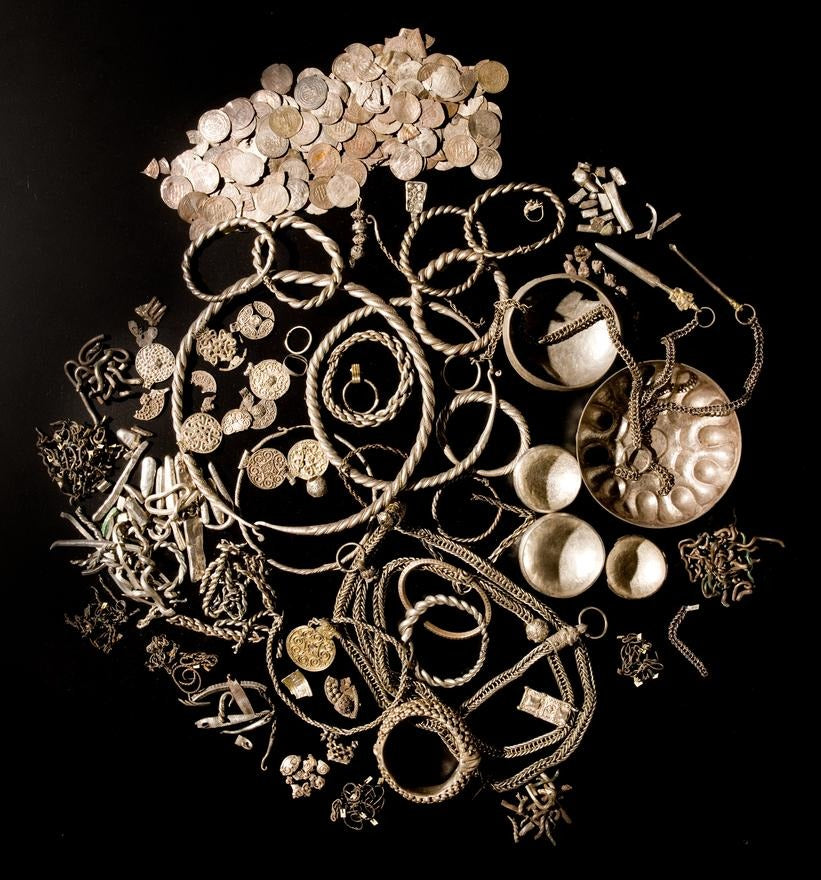
The hoard contained more than five kilograms of silver, together with gold, textiles, glass, rock crystal and other materials. It was buried around AD 900, during a period when the political map of Britain and Ireland was being transformed by Scandinavian settlement, warfare and the consolidation of emerging kingdoms. The hoard was acquired by National Museums Scotland in 2017 after a major fundraising campaign, and years of conservation have continued to reveal objects and inscriptions that were impossible to properly understand when they were first uncovered.
Its importance lies not simply in the quantity of treasure. The Galloway Hoard contains an unusually diverse collection in which bullion, jewellery, Christian objects, heirlooms and exotic imports were brought together in a single burial. It offers a rare glimpse into the movement of wealth and objects around the Irish Sea and beyond at the beginning of the tenth century.
Scotland at the Beginning of the 10th Century
The Galloway Hoard was buried during a period of profound political change. The kingdoms that would eventually become medieval Scotland and England were still developing, while the Irish Sea connected communities in Scotland, Ireland, northern England and the Isle of Man through trade, migration and warfare.
Galloway itself occupied an important position within this world. Its location on the southwestern coast of Scotland placed it directly within the maritime networks of the Irish Sea. Rather than being an isolated region at the edge of Europe, it was connected to a broad zone in which Scandinavian, Gaelic, Anglo-Saxon and Brittonic communities interacted.
The archaeological character of the hoard reflects this environment. Much of its silver belongs to traditions associated with the Irish Sea, including broad-band arm-rings and hacksilver, while other objects have distinctly Anglo-Saxon or continental characteristics. The combination makes the hoard difficult to assign to a single ethnic group.
This is one reason National Museums Scotland describes it specifically as a Viking-Age hoard, rather than simply a “Viking hoard”. The people who produced, traded, inherited and buried its contents cannot necessarily be reduced to one Scandinavian identity. The hoard belongs to a period in which identities and political loyalties were overlapping and changing.
A Hoard of Silver
The most substantial component of the Galloway Hoard is silver. Much of it consists of hacksilver, pieces of jewellery and other objects deliberately cut into fragments and valued according to their weight. Ingots and arm-rings were similarly suitable for use as bullion.
This practice was widespread during the Viking Age. Silver was not merely decorative; it functioned as a highly portable form of wealth. A silver arm-ring could be worn as jewellery, presented as a gift, used as a political symbol or cut apart and exchanged by weight. In the Irish Sea region, broad-band arm-rings became particularly characteristic forms of silver bullion during the late ninth and early tenth centuries.
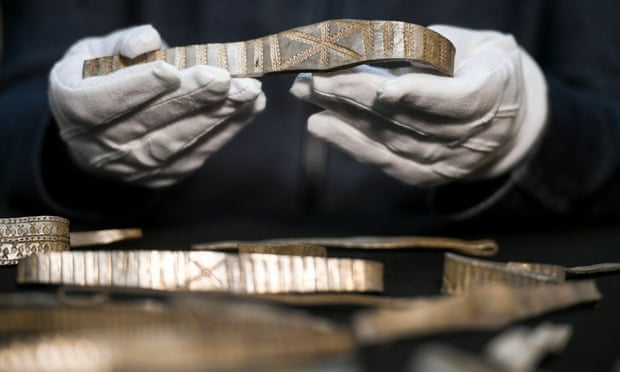
The Galloway Hoard contains examples of these arm-rings alongside bars and fragments, demonstrating that its owners possessed wealth intended, at least in part, to function as portable silver. Some of the arm-rings were deliberately flattened or cut, showing that their value was not necessarily dependent upon remaining intact.
Yet the hoard cannot be understood simply as a buried savings account. Some of its objects had clearly been treated very differently from the bullion. Fine textiles protected certain pieces, while unusual heirlooms had apparently been preserved for generations before being placed underground.
The contrast between hacked silver and carefully wrapped treasures is one of the most intriguing features of the discovery.
Anglo-Saxon Runes in a Viking-Age Hoard
One of the most revealing discoveries came from the runic inscriptions found on several silver arm-rings. Instead of using Scandinavian runes and Old Norse names, the inscriptions employ Anglo-Saxon runes and Old English.
One fragment bears the name EGGBRECT, recognisable as the Old English name Ecgbeorht, or Egbert. The arm-ring had already been hacked and folded when the inscription was made, with the final rune squeezed into the remaining space. This is particularly significant because such arm-rings are often automatically classified as “Viking” objects, yet the inscription demonstrates that at least some of the people using this form of silver were operating within an Anglo-Saxon linguistic and cultural tradition.
Other inscriptions appear to record abbreviated names or labels associated with different portions of the silver. Their precise interpretation remains difficult, but they provide a rare connection between the physical silver and the people who handled it.
In 2025, National Museums Scotland announced a further interpretation of one inscription as “this is the community's wealth/property.” The reading remains a scholarly interpretation rather than an indisputable statement of ownership, but if correct it raises the possibility that at least part of the hoard belonged to a community rather than a single individual. The religious objects found alongside the inscription make an ecclesiastical community one possibility, although the precise identity of that community remains unknown.
The inscriptions therefore complicate the simple image of Scandinavian raiders carrying stolen Anglo-Saxon silver. The people connected with the hoard could have included Anglo-Saxons, Scandinavians, Britons, Gaels or people whose identities crossed those boundaries.
The Great Anglo-Saxon Cross
Among the most extraordinary objects is a large silver pectoral cross, approximately 104 millimetres wide, decorated in the late Anglo-Saxon style known as Trewhiddle style. Its surface combines silver, gold and black niello, producing intricate images of animals and foliage.
The four arms of the cross carry symbols representing the four Evangelists. A fine silver chain remains attached to it, coiled around the cross as it was found. The survival of the chain is particularly valuable because it suggests that the cross had been worn shortly before its burial rather than simply being an old piece of scrap metal.
Its presence is striking because complete Christian objects are unusual within Viking-Age silver hoards, where much of the metal was deliberately broken down into bullion. The cross had also been modified: a central boss or gem setting had been removed before burial. Whether this represented desecration, the removal of a valuable stone or the conversion of a sacred object into bullion remains uncertain.
The cross demonstrates how closely Christian and Scandinavian material cultures could exist beside one another. It does not by itself prove that the hoard was taken during a raid on a church. Other possibilities include trade, inheritance, deliberate collection or the safeguarding of ecclesiastical wealth during a period of political instability.
The Rock Crystal Jar of Bishop Hyguald
Perhaps the most extraordinary object in the hoard is a tiny rock crystal jar, only around five centimetres high, decorated with gold. It was found wrapped in textiles and placed within a larger lidded vessel alongside other carefully protected objects.
Conservation revealed a Latin inscription formed from gold wire and granulation around its base:
“Bishop Hyguald had me made.”
The identity of Bishop Hyguald remains uncertain. No bishop of that name is securely recorded in the surviving ninth-century episcopal lists, although the historical record for Northumbria during this period is incomplete. National Museums Scotland considers it likely that Hyguald was an otherwise undocumented Northumbrian bishop. The kingdom of Northumbria at this time extended into the region of modern Galloway, making a Northumbrian ecclesiastical origin plausible.
The jar itself has an even more remarkable history. Scientific analysis has demonstrated that the material originated in what is now central Iran, within the territory of the former Sasanian world. Its silver and copper composition and lead isotopes correspond to materials from Iran, while its decoration includes imagery associated with the artistic traditions of the Sasanian Empire.
The object had therefore already travelled an extraordinary distance before it ever reached Britain. An object made in or from the Iranian world was transformed into a new vessel centuries later, apparently for an ecclesiastical purpose in the British Isles, before eventually becoming part of the Galloway Hoard.
Its journey demonstrates how misleading the modern image of the Viking Age can be when reduced to raids and warfare. The same period that produced Scandinavian expansion across the North Atlantic and British Isles was also an age of extensive trade and movement connecting Europe with the Islamic world and Asia.
Heirlooms and Objects from the Wider World
The rock crystal jar was not the only object in the hoard with a long history. A coin of Coenwulf, king of Mercia from 796 to 821, had been incorporated into a pendant with an older bead. By the time the hoard was buried around 900, the coin was already several generations old.
This suggests that some objects were valued precisely because they had survived from an earlier period. They were not simply interchangeable silver. They had histories of their own, and those histories may have contributed to their value.
The hoard also contained glass, rock crystal, gold, decorated metalwork and remarkably preserved textiles. Some objects had been wrapped in silk or linen, while others were placed inside pouches and containers. Such treatment indicates deliberate curation rather than indiscriminate accumulation.
The distinction matters because it suggests that the hoard had multiple layers of meaning. Silver bullion could represent wealth measured by weight, while older objects could carry associations of ancestry, prestige, religion or personal ownership.
The Lidded Vessel
Many of the rarest objects were contained within a large lidded vessel. The vessel itself was wrapped in textiles, and the treasures inside had been arranged and protected with considerable care.
Among them were the rock crystal jar, gold objects, decorated Anglo-Saxon metalwork and various curios whose original functions are not always clear. The survival of textiles around and between these objects is particularly important because organic materials almost never survive in ordinary Viking-Age hoards.
The vessel effectively created a collection within the larger hoard. Rather than throwing valuable objects directly into a hole in the ground, whoever assembled this portion had taken considerable care in arranging and protecting its contents.
This is why the Galloway discovery has changed the way archaeologists think about early medieval hoards. It does not fit comfortably into a single category such as merchant's wealth, raider's loot or emergency savings. Different objects appear to have had different biographies before being brought together.
Who Buried the Galloway Hoard?
The identity of the person or community responsible for burying the hoard remains unknown. This is one of the central questions surrounding the discovery, but the evidence allows several important observations.
The presence of Scandinavian-style silver demonstrates participation in the economic networks of the Viking Age. The Anglo-Saxon runes demonstrate connections with the English-speaking world. The Christian cross and the object made for Bishop Hyguald point towards ecclesiastical connections, while the eastern vessel demonstrates links extending far beyond Britain and Ireland.
The location is equally important. The hoard was buried in Galloway, a region whose political affiliations were changing during the late ninth and early tenth centuries. Historical sources for Galloway itself are comparatively sparse, making archaeological discoveries especially valuable for reconstructing the period.
The idea that the hoard was simply buried by a Viking raider returning from England is therefore attractive but unproven. The evidence is more complicated. The hoard could represent wealth acquired through trade, inheritance, raiding, political exchange or several of these processes at different times.
The proposed reading of one runic inscription as “this is the community's wealth” adds another possibility: that at least part of the collection belonged collectively to a religious or other community. National Museums Scotland has specifically noted that the Christian objects support the possibility of an ecclesiastical connection, although the identity of the community remains unknown.
A Crossroads of the Viking Age
The Galloway Hoard is ultimately important because it brings together objects that are normally studied separately. Anglo-Saxon England, Gaelic Ireland, Scandinavian settlement, Northumbrian Christianity, the Irish Sea economy and long-distance trade with Asia all appear within a single archaeological discovery.
Its silver reflects the expanding bullion economy of the Viking Age, but its inscriptions reveal people using Old English. Its Christian objects show that sacred material could circulate within the same world as Scandinavian-style arm-rings and hacksilver. Its ancient heirlooms demonstrate that objects could retain value across generations, while the Iranian vessel reveals connections extending thousands of kilometres beyond Scotland.
The hoard therefore belongs to a world of movement rather than isolated cultures. Galloway sat at a maritime crossroads where goods, people, ideas and identities could move between Britain, Ireland and the wider North Sea world. The discovery gives unusually tangible evidence of that interconnected society.
The Legacy of the Galloway Hoard
The Galloway Hoard has transformed understanding of Scotland during the Viking Age because it refuses to fit the familiar categories through which the period is often described. It contains Scandinavian-associated silver, but also Old English runes, Anglo-Saxon Christian art, Northumbrian connections and an object originating in Iran. Some treasures were probably newly acquired, while others had already survived for generations.
Most importantly, the hoard places individual people back into a world that can otherwise seem distant and anonymous. Names such as Egbert and Hyguald survive on the objects themselves, while the proposed inscription concerning a community's wealth hints at relationships and institutions that written sources barely preserve.
Buried around AD 900 and concealed for more than a millennium, the Galloway Hoard now provides one of the clearest archaeological glimpses into the interconnected world of the Irish Sea during the early Viking Age. It was not simply a collection of silver hidden underground. It was an accumulation of wealth, heirlooms, religious objects and distant imports, each carrying traces of the people and places through which it had passed.
The treasure's greatest significance may therefore lie in its complexity. The Galloway Hoard shows that the Viking Age was not a world divided neatly between Vikings and their victims, or between Christians and pagans. It was a period in which peoples, objects and traditions crossed those boundaries constantly, producing the interconnected societies from which medieval Scotland, England and Ireland would emerge.
Frequently Asked Questions (FAQs)
When was the Galloway Hoard buried?
The hoard was buried around AD 900, during the early Viking Age.
When was the Galloway Hoard discovered?
It was discovered by a metal detectorist on 1 September 2014 at Balmaghie in Kirkcudbrightshire, southwestern Scotland.
What is the Galloway Hoard made of?
It contains more than five kilograms of silver alongside gold, textiles, glass, rock crystal and other materials. Its silver includes jewellery, arm-rings, ingots and hacksilver.
Was the Galloway Hoard Viking treasure?
It is best described as a Viking-Age hoard rather than simply a “Viking hoard.” Its contents come from several cultural traditions, including Scandinavian, Anglo-Saxon, Christian and wider international contexts.
What is the most unusual object in the Galloway Hoard?
Among its most extraordinary objects is a small rock crystal jar made from material originating in Iran. It bears a Latin inscription stating that Bishop Hyguald had it made.
References
Bede. Historia Ecclesiastica Gentis Anglorum.
Anglo-Saxon Chronicle.
National Museums Scotland. The Galloway Hoard.
National Museums Scotland. Understanding Hoards in the Viking Age.
National Museums Scotland. A Rare Pectoral Cross in the Galloway Hoard.
National Museums Scotland. A Runic Revelation: Who Owned the Galloway Hoard?
National Museums Scotland. Investigating the Galloway Hoard Rock Crystal Jar.
National Museums Scotland. New Runic Translation Reveals Community Ownership of the Galloway Hoard.
National Museums Scotland. Distant Origin of Star Object from the Galloway Hoard Revealed Ahead of Its First Public Display.




Leave a comment
This site is protected by hCaptcha and the hCaptcha Privacy Policy and Terms of Service apply.